

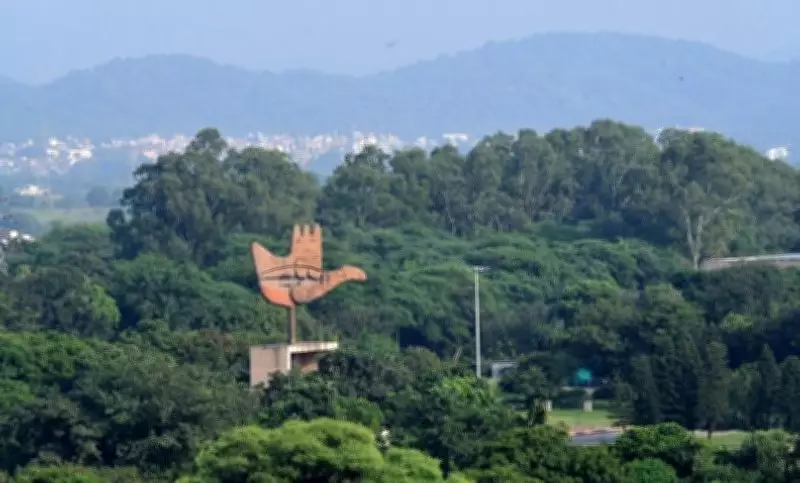
Former Chief Architect of the Chandigarh Administration and principal technical mind behind the Chandigarh Master Plan-2031 (CMP-2031), Sumit Kaur, has filed a comprehensive formal objection demanding the immediate withdrawal of draft amendments notified on May 22 and supplemented on May 29. Kaur, also a member of the plan’s Board of Inquiry and Hearing and the Chandigarh Heritage Conservation Committee, describes the proposals as a 'reckless, blunt-force' intervention that would dismantle seven decades of protected urban heritage in one administrative stroke.
FAR Hikes Without Infrastructure Audit
The amendments would simultaneously double and triple Floor Area Ratios (FAR) across residential, institutional, industrial, and peripheral zones, affecting all three phases of the city at once, without a single infrastructure audit placed in the public domain. Kaur’s most damning procedural objection is that a consultant has been engaged to study the city’s holding capacity only after the notifications were issued. The CMP-2031 mathematically fixed Chandigarh’s terminal population ceiling at 16 lakh persons, calibrated against finite water, sewerage, drainage and power infrastructure. Uniformly tripling FAR without first testing that ceiling against upgraded systems is, she argues, not optimisation but a controlled demolition of the city's metabolic equilibrium.
Heritage Committee Mandates Violated
The Government of India-approved Expert Heritage Committee (EHC), whose report is embedded within the CMP-2031, explicitly mandated no further FAR increases, strict restoration of architectural controls, and city-wide maintenance of existing height limits. The draft amendments contradict all three directives simultaneously. Kaur calls this the central planning fallacy: the amendments treat Phase I as a protected 'Corbusian' heritage zone while fundamentally recasting Phases II and III. The city shares one water grid, one electricity network, and one arterial road system across all phases. Overloading the later phases with stilt-plus-four and 30-metre high-rise blocks will collapse infrastructure that Phase I itself depends upon. Chandigarh, she writes, is a single living organism — damage cannot be quarantined.

Judicial Precedents Ignored
Three binding judicial precedents stand against the notifications. The Punjab and Haryana High Court ruled in May 2026 that the Master Plan is a statutory instrument binding all authorities, with heritage protections applying uniformly across every sector. The Supreme Court’s 2023 RWA judgment mandated that all changes to development norms be routed through the Chandigarh Heritage Conservation Committee before execution — a step the current notifications skip entirely. The 2019 Tata Camelot ruling quashed peripheral high-rises near the Sukhna Wildlife Sanctuary under the Public Trust Doctrine — the exact typology these amendments now seek to codify at Maloya and Mani Majra.
Alternative: Regional Planning Board
Kaur’s counter is not a freeze but a redirect. The CMP-2031 itself mandates establishing a Chandigarh Regional Planning Board — an inter-state framework modelled on the NCR Planning Board — to channel growth outward to satellite settlements beyond the Union Territory's borders. Brasília, Paris, and Washington DC have all protected their founding urban forms by exporting density to designated peripheral hubs. Chandigarh, she argues, must do the same: export the planning model to the region, not import regional chaos into the city.

Five Salient Facts
- FAR nearly tripled: Group Housing FAR in Phase III rises from 1.2 to 3.0 — a 150% increase — with building heights jumping to 98 feet.
- Seismic red zone: Chandigarh lies in Seismic Zone IV. The mandated stilt-plus-four typology creates soft-storey ground floors, the primary collapse point in earthquakes on alluvial soil.
- Wildlife corridor at risk: A 2022 MoEFCC ruling blocked multi-storey construction near Mani Majra for disrupting a protected migratory bird path. The amendments propose stilt-plus-five there regardless.
- Reserve land consumed: The Mixed Land Use footprint expands from 252 acres to 428 acres, eating into finite reserve land the city set aside against unforeseen civic and ecological needs over the next 50 years.
- No studies, no basis: Eight mandatory impact studies — covering infrastructure capacity, traffic, seismic risk, ecology, heritage, microclimate, population load, and social infrastructure — have not been commissioned, let alone published, before the notifications were issued.
The Screening Committee is yet to rule. The notifications remain in force.





