

NGT Mandates Environmental Cells for Waste Management Training in Madhya Pradesh
The central bench of the National Green Tribunal (NGT) in Bhopal has issued a sweeping order directing the formation of Environmental Cells across Madhya Pradesh. This move aims to address the persistent flouting of the Solid Waste Management Rules, 2016, despite repeated directives from the NGT and courts.
Accountability and Compliance Measures
In a comprehensive ruling, the NGT has called for strict accountability from state authorities. The tribunal has instructed the principal secretary of urban development, district collectors, municipal commissioners of all corporations and municipalities, and chief executive officers of municipal councils to rigorously enforce the 2016 waste management regulations.
The Madhya Pradesh Pollution Control Board (MPPCB) has been tasked with ensuring compliance. In cases of violations, the board must take punitive actions, including the realization of environmental compensation or damages, and implement immediate measures to restore any environmental harm.

Establishment of Environmental Cells
A key directive from the NGT is the constitution of Environmental Cells within local bodies. Each cell is to be headed by an officer qualified in environmental fields. The primary responsibility of these cells will be to train government employees and personnel involved in the collection, transportation, and handling of solid waste. This training will also cover the operation of Material Recovery Facilities (MRF) and Sanitary Landfills (SLF) in accordance with the 2016 rules.
Statewide Reporting and Monitoring
The bench, comprising judicial member Sheo Kumar Singh and expert member Sudhir Kumar Chaturvedi, has mandated detailed reporting from district headquarters. The member secretary of the State PCB must collect information on:
- Number of plants with disposal facilities in each district
- Capacity for waste-to-energy conversion
- Approximate daily waste availability
- Gap analysis and functionality of waste-to-energy facilities
Specific municipal commissioners in Indore, Rewa, and Jabalpur, or managers of waste-to-energy plants, must submit separate reports. These reports should detail treatment capacities, daily material supply from within and outside districts, and identified gaps.
Focus on Legacy Waste and Industrial Responsibility
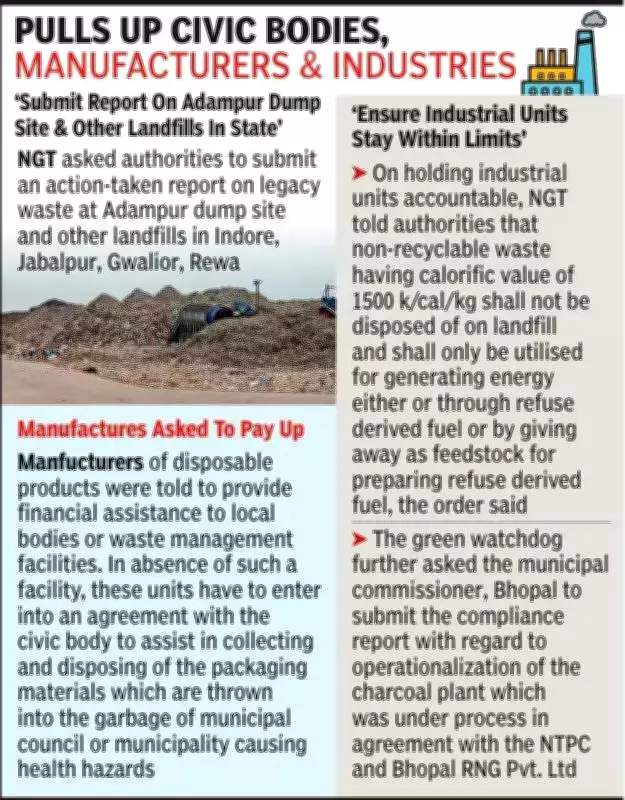
The NGT has directed the collector and municipal commissioner of Bhopal to submit an action taken report regarding the disposal of legacy waste at the Adampur dump site and other locations in Bhopal. Similarly, district municipal corporations in Jabalpur, Indore, Gwalior, and Rewa must file compliance reports on legacy waste disposal in their areas.
In a significant move, the tribunal has also held manufacturers accountable. Producers of disposable items such as tin, glass, plastic packaging, televisions, refrigerators, and food packaging materials must provide financial assistance to local bodies for establishing waste management systems. They are required to either buy back packaging materials from consumers or set up disposal facilities. Failure to do so necessitates agreements with municipal corporations for proper collection and disposal.
Fuel Requirements and Energy Generation
The order stipulates that industrial units using fuel and located within 100 kilometers of a solid waste-based Refuse Derived Fuel (RDF) plant must replace at least 5% of their fuel needs with RDF produced at disposal centers. Additionally, non-recyclable waste with a calorific value of 1500 k/cal/kg must not be landfilled. Instead, it should be utilized for energy generation, either as RDF or as feedstock for RDF preparation.
The municipal commissioner of Bhopal has been asked to submit a compliance report on the operationalization of a charcoal plant, which is under process in agreement with NTPC and Bhopal RNG Pvt. Ltd.
The case is scheduled for further hearing on February 13, 2026.






