

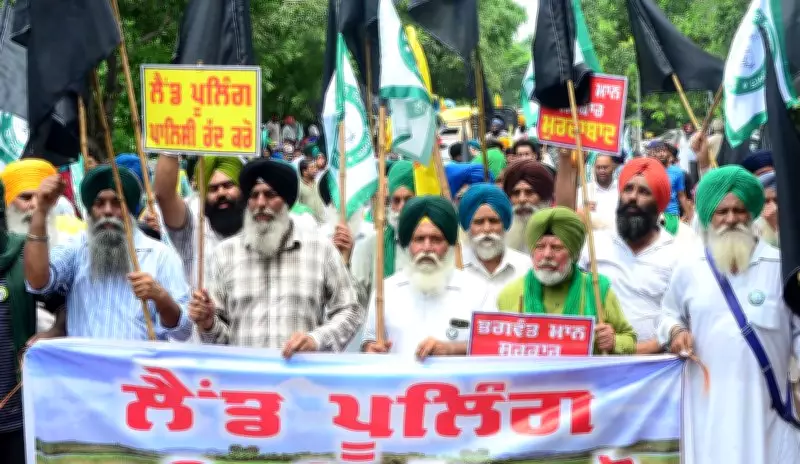
Punjab's Land Pooling Policy has been rewritten three times in a year, each version driven by farmer resistance and political pressure. The latest, most generous iteration offers enhanced plots and village development, but structural gaps remain that could trigger further revisions.
In less than 12 months, the Punjab Government has written, scrapped, rewritten and now significantly amended its Land Pooling Policy — the centrepiece of the most ambitious urban expansion drive in the state’s history. Each revision has been driven by farmer resistance, political pressure, judicial intervention, or ground-level implementation failures. Each has inched the policy closer to something farmers can live with. The question now is whether the latest version, the most generous yet, is finally the one that holds.
What is land pooling policy, why does it matter
At its core, the Land Pooling Policy offers farmers an alternative to straight cash compensation when their land is acquired for urban development. Instead of selling farmland to the government for money, a farmer pools his land with the development authority and receives fully developed urban plots, residential, commercial or industrial, in return. The logic is straightforward: agricultural land in the GMADA belt was worth approximately ₹5 crore per acre before acquisition notifications. After notifications, values rose to around ₹8 crore per acre. But the developed plots a farmer receives under the policy carry a combined estimated market value of approximately ₹16 crore per acre, double the post-notification price and more than triple the pre-notification value.
For lakhs of farmers across Greater Mohali and New Chandigarh, this is not an abstract policy distinction. It is the difference between a one-time cash payout and a permanent stake in the urban economy being built on their former fields. For Tricity residents in Chandigarh, Mohali and Panchkula, it matters because the 11,103-acre acquisition drive underpinning the policy is the only meaningful near-term answer to the region’s acute housing and commercial space crunch. Chandigarh’s own supply is frozen by Union Territory status and heritage restrictions. Mohali and New Chandigarh must absorb the pressure. Seven new townships, seven new sectors including a commercial Sector 87 modelled on Chandigarh’s iconic Sector 17, a tripled Aerotropolis near the international airport, and 1,240 acres of master plan roads all depend on this policy working.

Version 1: Compulsory model that failed
The first Land Pooling Policy-2025, notified on June 4, 2025, proposed pooling 65,533 acres statewide — compulsorily. Farmers were told their land would be taken and developed plots returned in lieu, whether they agreed or not. The Tribune first exclusively broke the story of the June 2025 acquisition plan on June 10. Protests erupted within days, backed by the Congress, Shiromani Akali Dal and BJP. The Punjab and Haryana High Court issued an interim stay. By August 2025, facing the combined weight of judicial intervention, political opposition and mass farmer agitation, the government withdrew the policy entirely. The problem was not the incentive structure. It was the compulsion. Farmers who had watched GMADA acquire land and deliver nothing for years — the Aerotropolis itself, conceived in 2016, remains unbuilt in its earliest pockets — had no reason to trust that developed plots promised today would materialise tomorrow.

Version 2: Optional but insufficient
In November 2025, the government returned with a revised policy — structurally identical in its plot entitlements but transformed in one critical respect: it was now optional. Every farmer in the acquisition belt could freely choose between developed plots under the policy or statutory cash compensation under the Land Acquisition Act, 2013. The shift worked, partially. A majority of village panchayats endorsed the acquisition. Three compensation awards totalling ₹6,069 crore across 1,231 acres were declared — ₹3,690.32 crore for 716 acres of Eco City-3 in New Chandigarh, ₹446.22 crore for 206.39 acres of Aerotropolis Blocks A-D, and ₹1,932.38 crore for 309.30 acres of the low/high density township in New Chandigarh. Letters of Intent began flowing to allottees. But a section of farmers, arguing that plot entitlements were inadequate, the Sahuliyat Certificate window too short, oustee quota absent, and their villages condemned to infrastructure neglect, launched the Pucca Morcha, a permanent dharna and chain hunger strike outside GMADA headquarters at Sector 62 in Mohali.
Version 3: Enhanced package
At a high-level meeting held recently, the government produced its most comprehensive response yet. The commercial plot entitlement in the mixed use category was raised from 200 to 210 square yards per acre; the residential category entitlement from 1,600 to 1,630 square yards. Oustee quota certificates with plots at scheme price — 200 sq yd for up to half an acre, 300 sq yd for half to 2.5 acres, 500 sq yd for above 2.5 acres — were extended to all farmers including those opting for cash. The Sahuliyat Certificate validity was doubled from two to four years, giving farmers more time to identify and purchase alternative land. Priority tubewell connections were extended to the same four-year window, with mandatory installation within two months of application. Conveyance deeds for original landowners were made free of cost. All plots, including preferential location plots previously retained by GMADA, were included in the draw of lots. Most significantly, the government committed for the first time to a fixed, formal development deadline, three years from award and possession, and pledged to develop affected villages simultaneously with the townships around them. Schools, parks and dispensaries on panchayat land were exempted from acquisition. GMADA committed to integrating village sewerage, water supply and storm water drainage with its own systems. Village phirni houses were fully protected. Critical gap funding was committed for village road construction. The Pucca Morcha ended.
Who benefits, who is still waiting
The enhanced package materially benefits three categories of stakeholders. Farmers opting for land pooling now receive more land, better plot access, longer financial flexibility, and a community development commitment. Farmers opting for cash receive oustee quota plots on top of their compensation, a benefit previously unavailable to them. And villages across the acquisition belt receive a formal, notified commitment to infrastructure integration and simultaneous development. The ones still waiting are genuine landowners in Aerotropolis Pockets A, B, C and D, whose compensation and development have been frozen by proceedings under FIR No. 16 registered by the Vigilance Bureau, the guava orchard scam in which fictitious orchards were fabricated to claim Rs 147 crore in fraudulent compensation. The April 11 meeting addressed this too: pending payments will be deposited in the Reference Court, compensation for structures not covered under the FIR released directly, and a new transparent assessment policy framed. But the underlying judicial proceedings continue, and genuine farmers in those villages remain in limbo.
What needs to be done to make it fool proof
The enhanced policy is the most farmer-friendly iteration yet. But several structural gaps remain that, if unaddressed, risk the same cycle of protest, revision and erosion of trust repeating itself. The three-year development deadline is the most critical commitment and the most vulnerable. Every previous timeline in the Mohali-New Chandigarh belt has slipped. The deadline needs independent oversight and financial penalties for non-compliance, not just a government circular. The orchard and structure assessment process that enabled the guava scam must be replaced entirely. Mandatory drone and satellite imagery as a pre-payment baseline, cross-verification by two independent departments, and real-time upload of all assessment reports to a public portal must be institutionalised before the next wave of acquisition awards is declared. The ring-fencing of disputed and undisputed compensation claims within the same acquisition, so that innocent farmers are not held hostage to proceedings against fraudulent ones, needs a statutory mechanism, not an administrative workaround through the Reference Court. The insider trading problem, in which information about upcoming acquisition notifications was used to purchase land cheaply and then claim inflated compensation, needs a specific legal deterrent, including criminal liability for officials who leak acquisition intelligence. And the Sahuliyat Certificate, now extended to four years and formally notified for state-wide acceptance, must be backed by a grievance redressal mechanism for farmers who face departmental resistance when presenting it.
What it means
Punjab’s urban renaissance, Chief Minister Bhagwant Mann’s phrase for what is being built in Mohali and New Chandigarh, will ultimately be judged not by how many acres were acquired but by how many farmers became genuine partners in the development, how many villages rose alongside the townships, and whether the Aerotropolis, Eco Cities and new sectors that were promised actually get built within the timelines now formally committed to. The policy has been rewritten three times in a year. Each rewrite has made it better. The question is whether the fourth rewrite will ever need to happen or whether the state has finally found a model that is generous enough to win consent, transparent enough to prevent fraud, and enforceable enough to deliver results. The farmers of Greater Mohali and New Chandigarh have been patient. The Tricity’s homebuyers and residents have been patient. That patience has a limit and it is now measured in years, not decades.





