

Massive Illegal Transfer of Tribal Land in Telangana
HYDERABAD: Despite constitutional safeguards and stringent laws prohibiting the transfer of tribal land in notified agency areas, nearly 20,000 acres across Telangana have gradually passed into the hands of non-tribals over the decades, exposing persistent gaps in enforcement and monitoring.
Pending Cases and Regional Breakdown
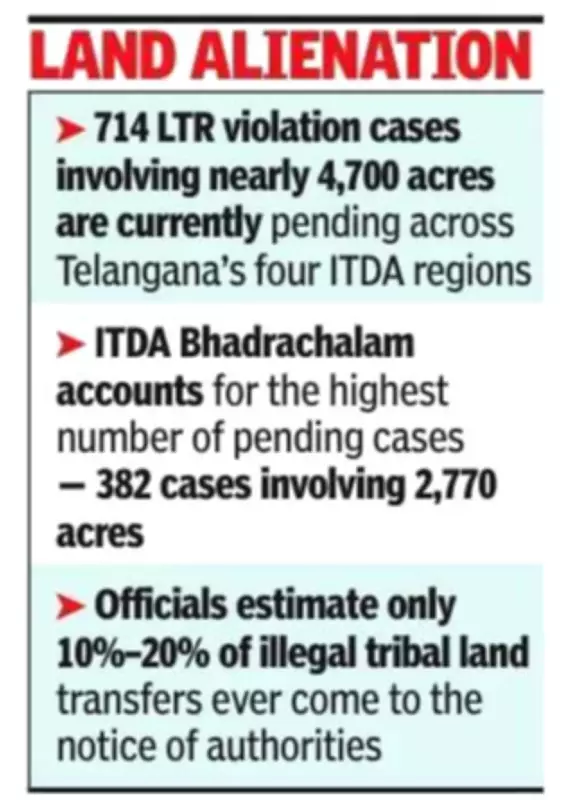
Official records from the tribal welfare department reveal that 714 Land Transfer Regulation (LTR) violation cases involving nearly 4,700 acres are currently pending at various levels, including before Integrated Tribal Development Agency (ITDA) project officers, the Telangana high court and the Supreme Court. Officials and legal experts, however, maintain that these figures represent only a fraction of the actual extent of transactions across the state’s four ITDA regions.
Among the 714 pending cases, ITDA Bhadrachalam accounts for the largest share, with 382 cases involving 2,770 acres. ITDA Eturnagaram has 186 cases covering 847 acres, while ITDA Utnoor has 56 cases (543 acres). ITDA Nagarkurnool accounts for 90 cases spread across 537 acres.

Understanding the Land Transfer Regulation Act
The LTR, popularly known as the 1/70 Act and introduced in 1970, prohibits the transfer of land in agency areas from tribals to non-tribals and even between non-tribals themselves. The legislation was enacted to shield tribal communities from exploitation and prevent the alienation of their land.
Challenges in Enforcement
Tribal welfare department director BM Santosh said ITDA authorities were conducting inquiries into complaints while also initiating suo motu action in certain instances by filing encroachment cases and restoring land rights to tribal communities. He added that government pleaders were actively pursuing matters pending before higher courts.
Officials and legal experts estimate that barely 10% to 20% of LTR violations ever come to the attention of authorities. Most land transactions, they say, are carried out informally on plain or stamp papers without official records, making violations difficult to establish legally. Such practices often leave tribal families struggling to prove ownership or illegal transfers. Officials noted that financial distress, medical emergencies and urgent personal needs frequently compel tribals to sell land despite legal restrictions. Non-tribal buyers, meanwhile, often offer higher prices, creating a strong economic incentive for these transactions.
Categories of Land Transactions
Land transactions in agency areas fall into four categories: tribal-to-tribal, tribal-to-non-tribal, non-tribal-to-tribal and non-tribal-to-non-tribal. Existing rules permit tribal-to-tribal transfers and certain non-tribal-to-tribal transactions after verification. In cases of suspected illegal transfer, complaints may be filed before the special grade deputy collector of tribal welfare or the revenue divisional officer. Appeals can move to ITDA project officers, the high court and eventually the Supreme Court, according to senior officials.
Historical Context and Expert Views
Land laws expert M Suneel Kumar said nearly 76,000 acres linked to LTR violations were involved in cases pending across agency areas of united Andhra Pradesh between 1959 and 2004. According to him, nearly 90% of these cases were disposed of because violations could not be legally established. Referring to the Koneru Ranga Rao Commission report of 2006, Kumar noted that nearly 51% of land in tribal agency areas was already under the control of non-tribals. He cited a pilot study conducted under the UPA-II government’s ‘Giri Nyam’ project across eight mandals in Utnoor, Eturnagaram and Bhadrachalam. Physical verification and scrutiny of records reportedly uncovered widespread violations and revealed that many tribals lacked passbooks and updated land records.
Allegations of Continuing Violations
Meanwhile, Adivasi Lawyers Association Telangana state committee leader Sunnam Ramesh alleged that illegal transactions were continuing in Venkatapuram and Vajedu mandals of Mulugu district with the support of officials and political leaders. He demanded a comprehensive probe into all land transactions.






