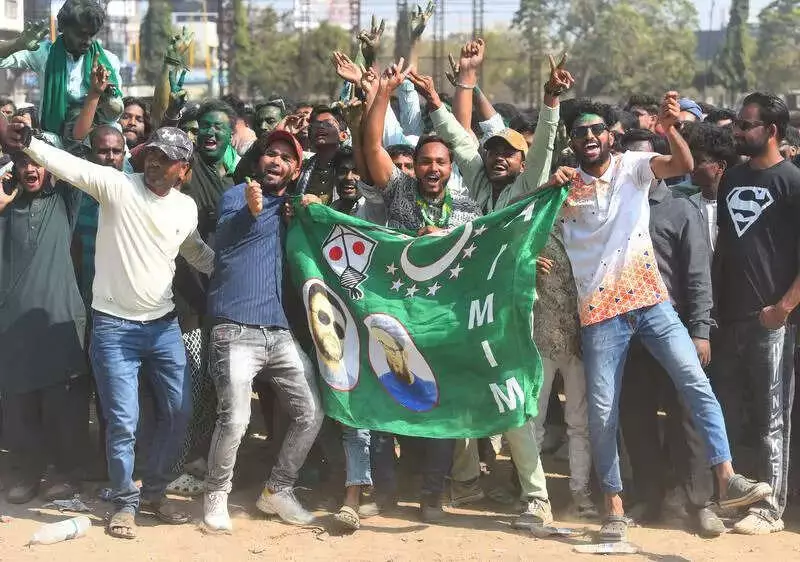
The All India Majlis-e-Ittehadul Muslimeen (AIMIM) has secured a landmark political victory in Chhatrapati Sambhajinagar. The party registered twin wins in Gulmandi ward, the very area that once served as the cradle of Shiv Sena's organizational journey in the city.
A Historic Shift in Political Power
For the first time since Shiv Sena established its maiden local branch here over four decades ago, two AIMIM corporators have been elected from the same ward. This result signals a profound transformation in the political narrative of a region long considered the bedrock of Sena's influence.
The Significance of Gulmandi Ward
Gulmandi represents a historic flower market and the densely populated commercial heart of the old city. It was precisely here that Shiv Sena opened its first local office on June 8, 1985. From this single branch, the party expanded its footprint across eight districts of the Marathwada region, producing leaders who eventually reached the state legislature and Parliament.

Election Results and Voter Response
In the latest municipal elections, AIMIM candidates Taranum Aqil Ahmed and Noorjahan Iqbal clinched victory with 6,808 and 6,983 votes respectively. Their success has generated considerable unease among veteran Shiv Sainiks, who view the outcome as emblematic of their party's erosion in what was once an unquestioned bastion.
Remarkably, these seats were secured without the presence of AIMIM's star campaigners. Neither party president Asaduddin Owaisi nor state chief Imtiaz Jaleel participated directly in the local campaign. Instead, victory was built on a hyper-local, door-to-door strategy that connected with voters at the grassroots level.
The Campaign Strategy That Worked
"We personally met over 95 percent of the electors and requested they give us a chance. People trusted us, and the results are here," explained Feroz Ahmed Khan, son of winner Noorjahan Iqbal, in an interview.
Taranum Aqil Ahmed's husband added further insight. "Coming from a business family, we have contacts across all communities. That helped us secure support beyond just one demographic," he noted, highlighting their deep local roots.
Shiv Sena's Historical Connection
The loss carries particular significance for Shiv Sena, whose formative years in the city were defined by aggressive street-level mobilization in these very lanes. Senior functionaries recalled the first major Sena rally on January 17, 1986, led by then-district chief Subhash Patil.
"Meetings, planning sessions, and discussions on civic issues like healthcare and corruption were a daily feature at the Gulmandi branch," remembered Avinash Kumawat, an early associate of the movement.
Changing Political Dynamics
Despite the city's history of communal volatility, Shiv Sena's network thrived for decades under leaders like former four-time MP Chandrakant Khaire. Even in this election, the Sena presence remained visible—Khaire's nephew, Sachin Khaire, and Rishikesh Jaiswal (son of Sena MLA Pradeep Jaiswal) were both elected alongside the two AIMIM corporators.
However, party old-timers argued that Shiv Sena's character changed significantly after it tasted power in the 1990s. "Grassroots activism gradually gave way to a culture driven by authority and electoral arithmetic," observed one founder member. "Internal splits and shifting alliances further weakened the organization at the block level."
AIMIM's Path to Victory
AIMIM leaders attributed their success to voter consolidation and disciplined campaigning. They noted that more than 6,500 Muslim votes were polled in the ward, while emphasizing that the election remained focused on local issues rather than religious tension.
While Gulmandi previously elected a Muslim corporator, Alaf Khan, in 1980—five years before Shiv Sena arrived—the simultaneous election of two AIMIM representatives represents an unprecedented development.
A New Political Landscape
With the AIMIM symbol now flying in the ward where Shiv Sena first planted its flag, the result marks a historic realignment in the city's political geography. This shift demonstrates how local engagement and community connections can overcome established political traditions that have dominated for generations.

The election outcome reflects changing voter priorities and the effectiveness of personalized campaigning in urban political contests. As political dynamics continue to evolve in Maharashtra's urban centers, the Gulmandi results may signal broader trends in how parties connect with constituents at the neighborhood level.