

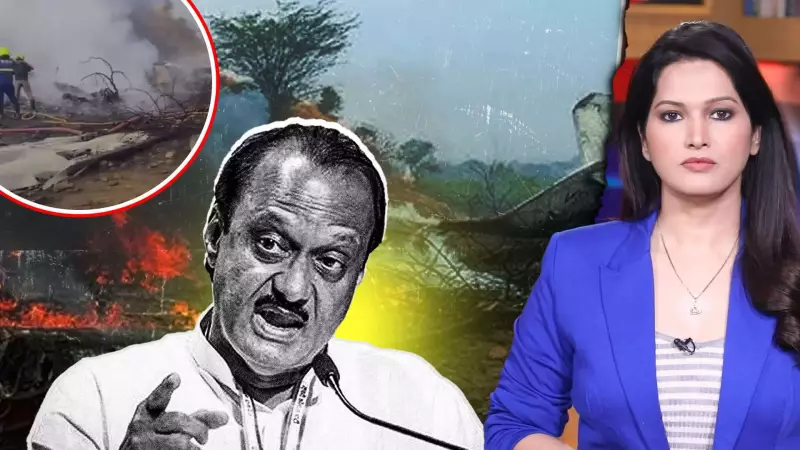
The End of an Era: Ajit Pawar's Sudden Demise Reshapes Maharashtra's Political Landscape
The political landscape of Maharashtra has been irrevocably altered with the sudden and unexpected passing of veteran leader Ajit Pawar. His death marks the conclusion of a remarkable political journey that spanned over three decades, during which he emerged as one of the most influential power brokers in the state's complex political ecosystem.
From Baramati Stronghold to Statewide Dominance
Ajit Pawar's political career was built upon an impressive electoral record, having secured victory in his Baramati constituency an astonishing seven consecutive times. This consistent electoral success provided him with an unshakable foundation from which he expanded his influence across Maharashtra. Beyond mere electoral politics, Pawar established himself as a dominant force in the cooperative sector, creating a network of economic and social influence that complemented his political authority.
The Master Strategist Who Transcended Party Lines
What truly distinguished Ajit Pawar was his remarkable ability to navigate Maharashtra's turbulent political waters while maintaining his relevance across changing alliances and governments. Serving under multiple chief ministers from different political parties, he became an indispensable component of both governance mechanisms and electoral calculations. His strategic brilliance was evident in his capacity to engineer party splits when necessary while simultaneously maintaining his political standing.

Ajit Pawar successfully carved out a distinct political identity that extended beyond his family legacy and traditional party affiliations. Known for his brash demeanor, tireless work ethic, and fierce ambition, he cultivated what became known as "Brand Dada" – a persona that combined administrative acumen with deep ground-level connections. This unique combination allowed him to make bold administrative decisions while retaining the support of grassroots workers and constituents.
A Leadership Vacuum of Unprecedented Scale
The sudden nature of Pawar's passing has created a political vacuum of extraordinary proportions. This void extends far beyond his own Nationalist Congress Party (NCP) to encompass the entirety of Maharashtra's political framework. As political alliances begin the delicate process of recalibration and succession questions loom large, the absence of Pawar's strategic guidance and negotiating skills leaves a gap that will be challenging to fill.
Legacy of Individual Power in State PoliticsAjit Pawar's political legacy serves as a powerful reminder of how individual personalities once shaped Maharashtra's political destiny. In an era increasingly dominated by party machinery and centralized leadership, Pawar demonstrated how a single determined politician could influence policy, determine electoral outcomes, and navigate the complex web of Maharashtra's power politics. His approach combined traditional political methods with modern strategic thinking, creating a model that few have successfully replicated.
The Road Ahead for Maharashtra Politics
As Maharashtra's political stakeholders assess the new landscape created by Pawar's absence, several critical questions emerge:
- Who will fill the leadership vacuum within the NCP and broader political alliances?
- How will the cooperative sector, long dominated by Pawar's influence, adapt to new leadership?
- What impact will this have on Maharashtra's governance and policy direction?
- How will electoral calculations change in the absence of Pawar's strategic guidance?
The coming months will reveal how Maharashtra's political ecosystem adapts to this significant loss. What remains certain is that Ajit Pawar's three-decade-long influence has left an indelible mark on the state's political history, and his absence will be felt across multiple dimensions of public life in Maharashtra.






