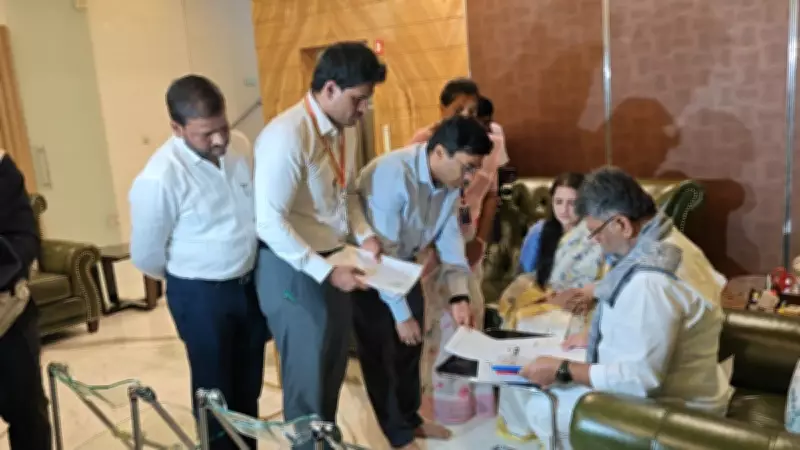
Karnataka Chief Minister DK Shivakumar has announced that the state government will link welfare benefits to the findings of the Socio-Economic and Caste Survey (SECC), a move aimed at ensuring targeted delivery of schemes to the most deserving sections. The decision, revealed during a press conference in Bengaluru on July 1, 2026, has ignited a political firestorm, with opposition parties accusing the Congress government of using the survey for electoral gains.
What the survey entails
The SECC, initiated by the Karnataka government earlier this year, is a comprehensive exercise to collect data on the socio-economic status and caste composition of households across the state. The survey covers parameters such as income, education, occupation, housing conditions, and access to basic amenities. According to official sources, over 1.5 crore households have been enumerated so far, with the process expected to conclude by August 2026.
CM Shivakumar stated, "The SECC data will serve as the backbone for all welfare programs. We cannot afford to waste resources on those who do not need them. This survey will help us identify the poorest of the poor, the most backward castes, and the marginalized communities." He emphasized that the linkage would apply to schemes like the Anna Bhagya (food security), Gruha Lakshmi (financial assistance for women), and fee reimbursement for students from backward classes.

Political reactions
The announcement has drawn sharp criticism from the Bharatiya Janata Party (BJP) and Janata Dal (Secular). BJP state president B.Y. Vijayendra said, "This is a blatant attempt to divide society on caste lines and create a vote bank. The Congress is playing with fire by linking welfare to caste identity." He demanded that the survey be made voluntary and that the data not be used for any form of discrimination.
In response, CM Shivakumar defended the move, stating, "Caste is a reality in India. By ignoring it, we only perpetuate inequality. The SECC will provide empirical evidence to design policies that uplift the oppressed. This is not about vote bank politics but about social justice."
Implementation challenges
Administrative experts have flagged potential hurdles. Former Chief Secretary of Karnataka, Dr. K. Ratna Prabha, noted, "The success of this initiative depends on the accuracy of the data and the transparency of the process. There are concerns about underreporting or overreporting of caste and income. The government must establish a robust grievance redressal mechanism."
To address these issues, the state has set up a high-level committee chaired by the Additional Chief Secretary of the Revenue Department. The committee will oversee data verification using Aadhaar-linked biometric authentication and field audits. A pilot project in three districts—Kalaburagi, Mysuru, and Belagavi—has already been completed, with a reported error rate of less than 2%.
Financial implications
The survey is estimated to cost the state exchequer ₹450 crore, a significant investment for a state facing a fiscal deficit. However, CM Shivakumar argued that the long-term savings from eliminating leakages and misallocation would outweigh the initial expenditure. "Currently, many welfare schemes suffer from inclusion and exclusion errors. By targeting benefits accurately, we can save up to 20% of the budget allocated for social welfare," he said.
The state government has allocated ₹1.2 lakh crore for social welfare in the 2026-27 budget, making it the largest expenditure head. Officials believe that linking benefits to SECC data could reduce the burden by ₹24,000 crore annually, which could be redirected to infrastructure and health.
Legal and constitutional aspects
Legal experts have pointed out that the use of caste data for welfare is permissible under Article 15(4) of the Constitution, which allows the state to make special provisions for socially and educationally backward classes. However, they caution that the survey must comply with the Right to Privacy judgment of 2017, which mandates that personal data be collected with consent and used only for lawful purposes.

The Karnataka government has assured that the data will be stored securely and will not be shared with any third party. A dedicated data protection officer has been appointed, and the survey forms include a clause requiring explicit consent from respondents.
Next steps
The state cabinet is expected to approve the linkage of welfare benefits to SECC data in its next meeting scheduled for July 15. Meanwhile, the opposition has announced plans to hold protests across the state. CM Shivakumar remains undeterred, stating, "We are committed to this path. The SECC is not just a survey; it is a tool for empowerment. We will ensure that every eligible person gets their due."