Political Parties Overhaul Candidature Strategy for Gujarat Local Body Elections
In a significant strategic shift, political parties have drastically revamped their candidature approach for the upcoming elections to local bodies in Gujarat, opting to drop a majority of incumbent members in favor of new, younger candidates. This move signals a bold attempt to refresh their ranks and appeal to a broader voter base ahead of the crucial polls.
Voter Turnout and Election Details
As many as 4.2 crore voters out of the total 4.4 crore in the state are expected to exercise their franchise to elect representatives for 10,000 seats. These seats span 15 municipal corporations, 84 municipalities, 34 district panchayats, and 260 taluka panchayats. Voting is scheduled to be held on April 26, marking a pivotal moment in Gujarat's political landscape.
BJP's Aggressive Candidate Replacement
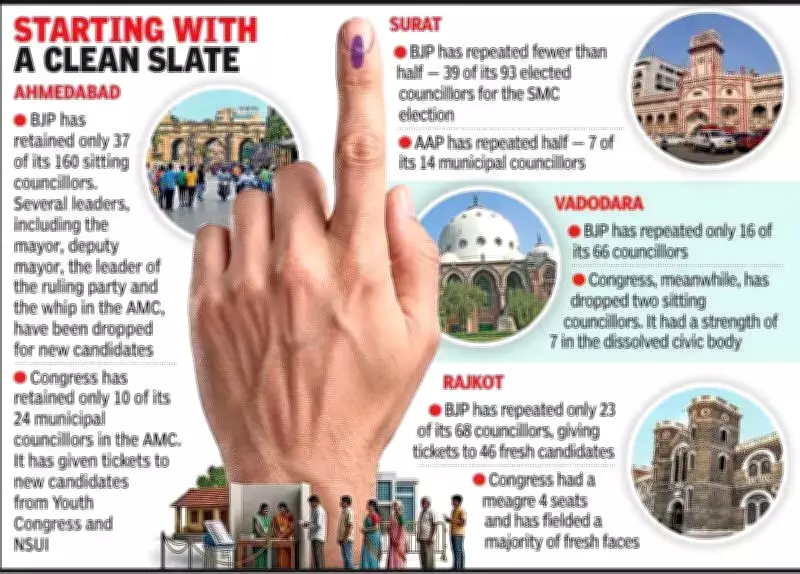
The Bharatiya Janata Party (BJP), which previously enjoyed an overwhelming majority in all six municipal corporations up for election (with the remaining nine corporations going to polls for the first time), has implemented a sweeping change by replacing approximately 70% of its sitting councillors. The party has fielded new, younger faces across all civic bodies, aiming to infuse fresh energy and perspectives into its leadership.

Congress's Youth-Focused Ticket Distribution
Similarly, the Congress party has allocated tickets to about 50% of candidates who are relatively younger. Despite having a meagre presence in the six municipal corporations where elections are being held, Congress has chosen not to re-field most of its previous candidates. Instead, it has prioritized workers from the Youth Congress and the National Students' Union of India (NSUI), emphasizing a commitment to youth empowerment and party rejuvenation.
Drastic Changes in Key Municipal Corporations
The extent of this candidature overhaul is particularly evident in the Ahmedabad Municipal Corporation (AMC) election. The BJP has dropped high-profile figures including the mayor, deputy mayor, a former mayor, the chief whip of the party in the AMC, and the leader of the ruling party in the civic body. Additionally, chairpersons of almost all civic committees have been excluded, with the party repeating only 37 of its 162 councillors in the AMC.
In Surat, the BJP has dropped more than 50% of its sitting councillors, although it has retained its mayor, standing committee chairman, and deputy mayor. Sources indicate that the average age of BJP and Congress candidates for the Surat Municipal Corporation (SMC) election is 45 years, while it is around 40 years for Aam Aadmi Party (AAP) candidates, highlighting a trend towards younger leadership.
Patterns in Other Major Cities
In Vadodara, the BJP has fielded only 16 of its 66 sitting councillors, dropping former mayors, former deputy mayors, and a former standing committee chairman. A local party member involved in candidate selection explained, "The party's criteria of not giving tickets to persons older than 60 and changes in reservations in constituencies led to many losing tickets."
A similar pattern is observed in Rajkot, where the BJP held a commanding majority of 68 in the 72-member civic body. Only 23 of the sitting councillors have been given tickets again, with party sources revealing that 45 fresh faces have been chosen to contest the election for the Rajkot Municipal Corporation.
Implications and Broader Context
This widespread replacement of incumbents underscores a strategic pivot by major political parties to address voter fatigue and demand for new leadership. By prioritizing younger candidates, parties aim to connect with the state's dynamic demographic and tackle local issues with renewed vigor. The upcoming elections on April 26 will be a critical test of this revamped strategy, potentially reshaping governance at the grassroots level in Gujarat.