

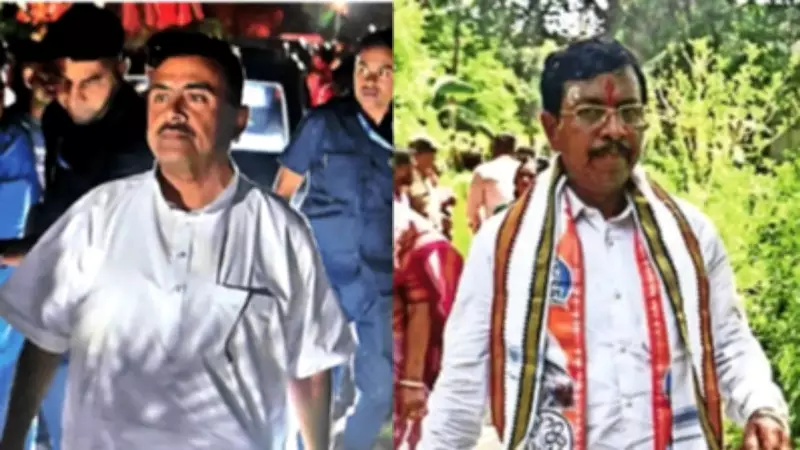
Identity Politics Takes Center Stage in Nandigram's Electoral Arena
At Tekhali Bridge, a location forever etched in memory due to the 2007 land acquisition movement that resulted in 14 tragic deaths, and serving as a key entry point to Nandigram, the visual landscape is now dominated by a sea of saffron. Prominently displayed on numerous flags is the slogan "Jai Shri Ram," while others feature imagery of the Ram Temple. Interspersed among these saffron banners are bright yellow flags bearing the phrase "Joy Bangla." Notably absent are any flags representing the Bharatiya Janata Party (BJP) or the Trinamool Congress (TMC). This pattern extends to surrounding areas like Reyapara, Sonachura, and Mohammadpur, unmistakably signaling the arrival of identity politics in Nandigram.
Suvendu Adhikari: The Local Icon Confident in His Roots
"You could blindfold me, and I would still know Nandigram like the back of my hand," declares Suvendu Adhikari, the BJP candidate from this constituency. "Newcomers might need to submit their resumes here, but not me. I am the same Suvendu standing here in 2026 as the one who stood with the people of Nandigram back in 2004," asserts Adhikari, who famously defeated Chief Minister Mamata Banerjee here in the 2021 elections.
When contacted, Adhikari had just concluded an election meeting at Binandapur in Nandigram-I, held at the Manasa Mandir grounds, approximately 5 kilometers from the Nandigram bus stand. The politics of religious identity is palpable. "Sanatanis will decisively defeat Adharma," states Bapi Das, a local resident. "Adhikari is an icon here," he adds. "He shaped Nandigram into what it is today. He presented Nandigram to CM Banerjee in 2007, and he possesses the knowledge to reclaim it as well."

During the gathering, Adhikari highlighted voting patterns, noting that while he secures merely two votes from the Mohammadpur Madrasah booth, where Muslims form a majority, he garners around 400 votes from the Hindu-majority local high school booth, with the opposition securing an additional 250-odd votes. "When will you learn to unite? Think, practice thinking," Adhikari urged the crowd.
Adhikari's Claim of Inclusivity and Grassroots Strategy
Adhikari attributes his confidence to what he calls his "inclusivity." "It is not only Hindus who have been targeted by the Trinamool," he states with conviction. "Several Muslims have also suffered. I am the first person to arrive at the scene whenever anyone is attacked by Trinamool goons. I can name individuals from the minority community whom I have assisted. That is why they may vote for the CM but turn to me for help. There is a palpable enthusiasm among workers here. They know that even if they are imprisoned, their families are secure because Suvendu is there for them. They have instructed me to focus on Bhowanipore and defeat Mamata Banerjee there once more. They have assured me that they will manage Nandigram on my behalf," Adhikari emphasizes.
Nevertheless, he is taking no chances. Despite extensive travel across the state, Adhikari has visited each of the 17 anchals in his constituency almost every evening, cultivating an image as "the boy next door."
Pabitra Kar: The TMC Challenger with Deep Hindu Ties
Adhikari's opponent from the Trinamool Congress is 46-year-old Pabitra Kar, who is pursuing a similar campaign strategy. Kar is a formidable contender. A political turncoat himself, he maintains strong connections with various Hindu organizations, including Hindu Samhati and Sanatani Sena. The TMC nominee, a former confidant of Adhikari, possesses intimate knowledge of Adhikari's organizational framework. In 2021, when CM Banerjee contested here, many credited Kar with securing a lead of over 3,500 votes for Adhikari in Boyal I and II, which proved crucial for his narrow victory.
Kar pledges to bring development, which he argues has been absent in Nandigram, while directly criticizing Adhikari. "All Nandigram has received in the past are empty promises," he claims. "It is time I delivered genuine development. If Adhikari is truly the heartbeat of Nandigram, why does he rely on intimidation and threats in every election? My sole objective is to connect with every individual. This cycle of intimidation must cease."

Demographic Shifts and Voter Concerns
Political analysts observe that in the closely contested electoral battle of Nandigram, the fine line between victory and defeat hinges on various demographic segments. This dynamic has gained significance following the SIR process, which saw approximately 12,500 Muslim voters removed from the electoral rolls. Alleged overt threats to migrant workers—attributed to Adhikari himself—have further heightened unease within the Muslim community.
Kar has been conducting a relatively low-profile yet consistent grassroots campaign. The Trinamool Congress appears concentrated on bolstering his local networks and organizational backing.
According to an analysis by the research organization Sabar Institute, although Muslims constitute only 25% of Nandigram's total population, nearly 95.5% of the voters deleted from the supplementary list belong to the minority community. "My neighbor's name is missing, and I remain uncertain whether I will be permitted to vote," expresses Rubina Bibi, a resident of Mohammadpur.
Voters Yearn for Development Beyond Political Rhetoric
Many voters express a desire to move beyond political slogans. "We possess a railway station, yet there is no rail line," alleges Tarun Das, a resident of Reyapara. "Direct connectivity to Haldia remains elusive because we lack a bridge over the Haldi river. Meaningful employment opportunities are scarce even in Haldia."
Gokulnagar resident Nur Ali emphasizes that Nandigram should no longer be headline news solely for its political dramas. "It is challenging for me to keep pace with today's youth. They align with the BJP one day and switch to TMC the next," remarks Swadesh Jana, a trader from Tangua Bazar. "There exists a relentless cycle of threats, influence, and monetary power."





