

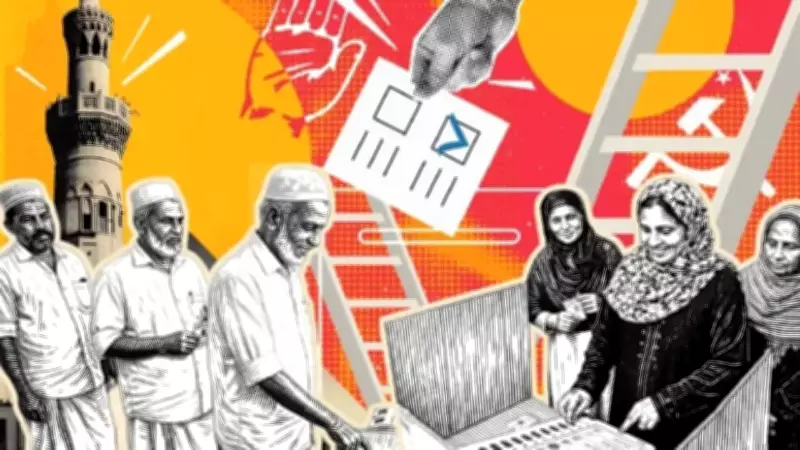
Kerala's Muslim Electorate: A Decisive Force at a Crossroads
The political behavior of Kerala's Muslim community remains a subject of intense speculation and concern during every election cycle. This focus is natural, given that Muslims constitute a sizable portion of the state's population and their collective choices are the most decisive factor in numerous constituencies, particularly in the northern regions.
The Legacy of Consolidated Power
Since the 1960s, Muslims in Kerala have exercised their collective bargaining power with remarkable effectiveness, often achieving a better strike rate compared to other communities. Despite internal differences in faith interpretation, economic status, and regional disparities, they have largely remained united under the banner of a single political entity: the Indian Union Muslim League (IUML). This party has represented Muslim electoral interests in every election since Kerala's formation in 1956.
The League's journey began with a learning curve. In 1960, after joining an electoral coalition with the Congress and PSP, it had to settle for the speaker's post despite earlier promises of cabinet positions. However, by 1967, the League strategically switched sides, aligning with Communist parties and securing two cabinet berths. From that point forward, the IUML never looked back, cementing its role as a decisive force in Kerala politics. The cornerstone of this success has been the Muslim community's consistent resolve to consolidate its votes into a single political basket.

The Rise and Fade of the Red Crescent
This longstanding arrangement has not been without significant strain. In the aftermath of the Babri Masjid demolition, widespread soul-searching led many Muslims to shift their loyalties to Left parties. Throughout the 1990s and early 2000s, the CPI(M) and its allies made substantial inroads into the Muslim heartlands of central and south Malabar, including districts like Wayanad, Kozhikode, and Malappuram.
The high-water mark of this shift came in 2004, when CPI(M) candidate T.K. Hamza won the Manjeri Lok Sabha seat. Over the following two decades, the Left contested and won a string of Muslim-majority or Muslim-significant seats: Koduvally, Kunnamangalam, Thiruvambady, Nilambur, Mankada, Kuttippuram, Ponnani, Tanur, and others. On a map, these constituencies trace a rough semicircle across Malabar's geography—a formation aptly described as a Red Crescent in Kerala's political landscape.
That Red Crescent is now visibly fading. The social engineering meticulously built by the CPI(M) over two decades is showing serious cracks. Key figures who once anchored the Left's relationship with the Muslim community—including Manjalamkuzhi Ali, Karat Razak, and P.V. Anwar—have crossed over to other political sides. Others, such as P.T.A. Raheem, K.T. Jaleel, and V. Abdurahman, have grown noticeably less enthusiastic about their CPI(M) affiliations. The signals are unmistakable: political winds are shifting, and the community is becoming increasingly disillusioned with the Left parties.
Forces Driving the Political Shift
Several powerful forces are driving this significant change. The first is the national political picture. With the BJP firmly in power at the Centre, the Left has been reduced to a mere spectator in national politics, its influence negligible and its recovery unlikely. Beyond rhetoric, few seriously expect the Left to reclaim the ground it has lost. In this vacuum, the Congress under Rahul Gandhi has emerged as the default alternative for many.
The second factor involves tactical blunders by the CPI(M). The party miscalculated that a campaign centered around a Muslim bogey might help recover its declining Hindu base and attract the Christian community. However, the type of malicious communal propaganda unleashed by figures like Vellappally Natesan proved counterproductive. Unlike southern Kerala, Malabar remains relatively aloof from the divisive politics of communalism practiced by some mainstream parties. While such tendencies exist, they remain peripheral.

The widespread perception that this vituperative campaign had the tacit blessing of Chief Minister Pinarayi Vijayan has inflicted damage on the ruling front. Additionally, some CPI(M) leaders and their television spokesmen have indulged in right-wing Hindutva dog-whistles, with their rhetoric often echoing that of the RSS-Sangh Parivar. It is a stark reality that many Left spokesmen struggle to distinguish themselves from right-wing voices on popular TV channels.
The Nuanced Role of Christian Voters
In northern Kerala, where Muslims hold significant electoral weight, Christian voters are concentrated mostly in hill pockets. Christians in the north understand that their political fortunes are intrinsically tied to maintaining friendly relations with other communities, including Muslims, who form a solid bloc in areas where Christians have a meaningful presence. Consequently, northern Church voices tend to remain quiet on contentious issues like love jihad and other narratives of Muslim threat—issues that their counterparts in southern Kerala pursue relentlessly. This contrast offers a clear lesson and highlights the geographical boundaries and limitations of communal politics in the state.
The Muslim electorate in Kerala continues to shape electoral outcomes decisively, but the changing signals suggest a more complex and fragmented future. As alliances shift and new political realities emerge, the community's voting patterns are evolving, potentially redrawing the state's political map in the coming elections.





