

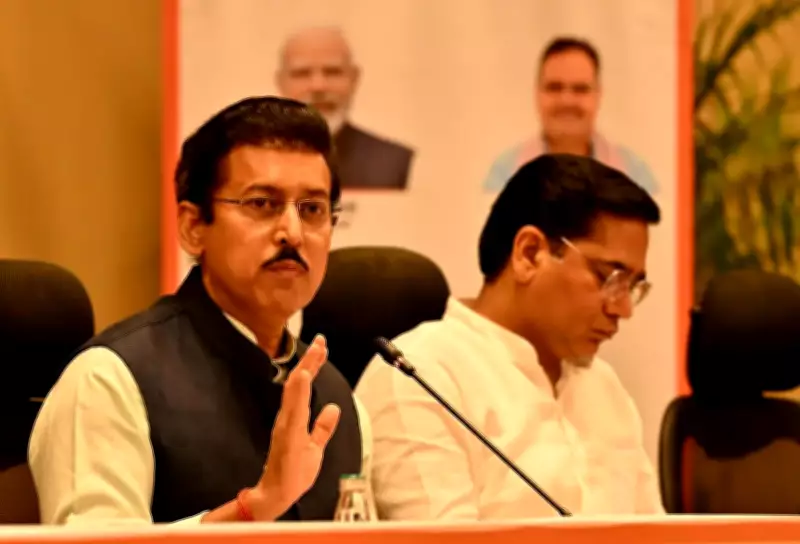
The Rajasthan Cabinet, chaired by Chief Minister Bhajan Lal Sharma, on Friday approved the Rajasthan Industrial Development Policy, aiming to transform the state into a global industrial hub under the 'Developed Rajasthan@2047' vision. The Cabinet also took key decisions related to pensions, water conservation, renewable energy, and rural development.
Industrial Policy Highlights
Addressing a press conference after the meeting, Industries Minister Rajyavardhan Singh Rathore said the policy is based on four pillars: Green, Governance, Growth, and Globalisation. It aims to expand Rajasthan's economy to $350 billion by 2028-29. The policy focuses on building a globally competitive industrial ecosystem, with special emphasis on future-oriented sectors such as semiconductors, data centres, global capability centres, and defence manufacturing.
The state will also promote sectors including gems and jewellery, textiles, tourism, handicrafts, agro-processing, dairy, and logistics, while encouraging renewable energy, circular economy projects, and indigenous manufacturing.

Pension Reforms
The Cabinet approved amendments to the Rajasthan Civil Services (Pension) Rules, 1996, allowing pensioners to submit annual life certificates through a mobile application using face authentication technology. Rules were also relaxed for specially abled dependents, who will now need to submit permanent disability certificates only once instead of every three years.
Water Conservation Campaign
Water Resources Minister Suresh Singh Rawat announced that the statewide 'Vande Ganga Jal Sanrakshan-Jan Abhiyan' will run from May 25 to June 5. The campaign focuses on cleaning water bodies, desilting canals and ponds, plantation drives, and public awareness. It aims to strengthen public participation in water conservation through Jal Chaupals, cleanliness drives, and plantation activities across Rajasthan.
Energy Management
State Energy Minister Heeralal Nagar said Rajasthan has successfully managed peak summer electricity demand. On May 20, the state recorded peak demand of 16,487 MW while supply remained higher at 16,580 MW.
Land Allotments
The Cabinet also approved land allotments for industrial and renewable energy projects in Jaisalmer, Barmer, and Bikaner districts, including a Rs 3,047 crore Dalmia Cement plant expected to generate around 820 jobs.






