

The Telangana government is staring at a potential annual financial burden of ₹1,000 crore to ₹1,500 crore due to proposed changes in the flagship rural employment scheme. The Mahatma Gandhi National Rural Employment Guarantee Scheme (MGNREGS), rechristened as the Viksit Bharat Guarantee for Rozgar and Ajeevika Mission (Gramin), is set for a major overhaul in funding patterns, placing significant strain on the state's coffers.
New Funding Formula Shifts Burden to States
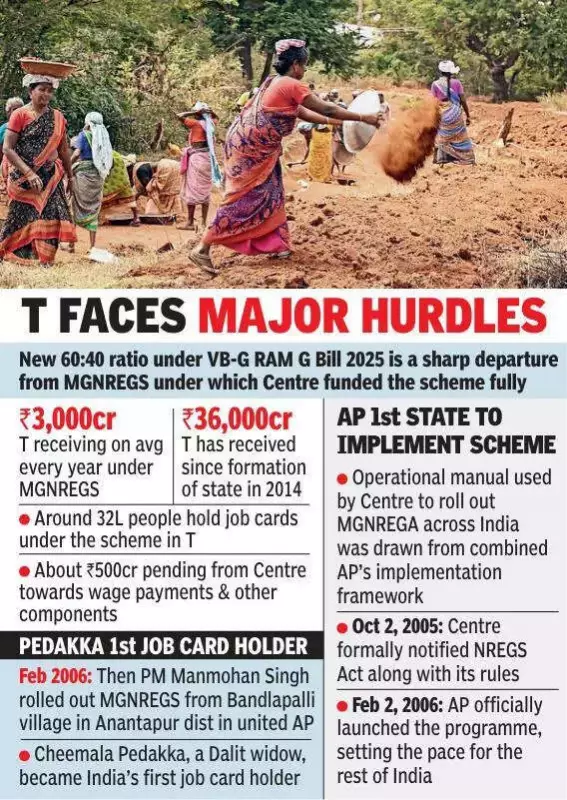
Under the new framework detailed in a recent Bill, state governments will be required to bear 40% of the scheme's cost. This marks a sharp departure from the previous model where the Central government funded the programme entirely. For Telangana, which has received an average of about ₹3,000 crore annually under MGNREGS in recent years, this shift could lead to substantially reduced disbursements and create operational hurdles.
State officials confirm they are currently studying the Bill to assess its full implications. Data reveals that up to December 3 of the current financial year, Telangana has received ₹2,314 crore. This follows allocations of ₹3,825 crore in 2024-25, ₹3,520 crore in 2023-24, ₹2,992 crore in 2022-23, ₹4,116 crore in 2021-22, ₹4,112 crore in 2020-21 and ₹2,733 crore in 2019-20. Since the state's formation in 2014, it has received a cumulative total of approximately ₹36,000 crore under the scheme.

Structural Challenges and Pending Dues
The scheme supports around 32 lakh job card holders in Telangana. Compounding the financial worry, the state has about ₹500 crore pending from the Centre for wage payments and other components. Government sources expressed concern, stating, "Over the years, funding has been decreasing, and with this new 60:40 ratio, there will be a greater burden on the state."
Officials also highlight structural differences in implementation that could exacerbate the problem. Unlike some states where panchayat secretaries handle administrative costs, Telangana earmarks 6% of total funds for administration. This model supports nearly 15,000 contract employees working at the ground level, whose positions could be impacted by the new rules.
Stricter Norms and Operational Hurdles
Further tightening of compliance norms has added to the state's concerns. While group photographs of completed works were previously accepted, the new mandate requires individual worker photographs with geo-coordinates. These are verified during central inspections, a process officials describe as difficult to execute consistently in rural areas.
Telangana's Panchayat Raj Minister, Seethakka, has accused the Centre of gradually diluting the scheme. She pointed to existing wage delays exceeding 42 days and urged the Central government to provide funds without mandating the 40% state contribution.
The potential impact on development works is significant. In 2025 alone, over one lakh projects were undertaken, including toilets, anganwadi buildings, and horticulture works covering 20,000 acres. Officials warn that with the new rules, all future works could be severely impacted, affecting rural infrastructure and livelihood support across the state.






