

Urban Expansion Clashes with Tribal Rights in Assam's Palasbari Constituency
As election campaigning reaches its peak in Assam, the Palasbari constituency on the outskirts of Guwahati has transformed into a critical electoral battleground. The contest is increasingly defined by a profound clash between rapid urban expansion and the determined resistance of tribal and indigenous communities fighting to protect their ancestral lands.
Satellite Township Proposal Sparks Widespread Concern
At the heart of this political confrontation lies a proposed satellite township in Barduar Bagan, which has triggered deep anxiety among local tribal residents. Hundreds of families, predominantly from the Rabha community, fear potential displacement if the project moves forward. Both BJP candidate Himanshu Shekhar Baishya and AJP candidate Pankaj Lochan Goswami have publicly pledged to safeguard indigenous interests in this constituency where tribal voters are expected to wield decisive influence in the election outcome.
Political Alliances Form Against Development Plan
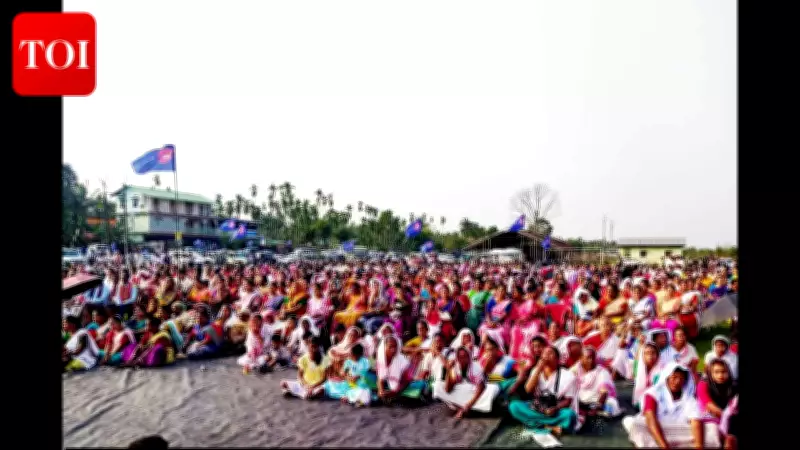
On Wednesday, AJP leaders joined forces with Congress representatives, the Barduar Bagan Bhumipattan Dabi Samiti, and the Joint Forum for Land Struggles (JFLS), Assam, during an election rally that openly endorsed the AJP. These groups collectively opposed the BJP-led government's alleged plans to advance the township project, possibly under a different designation. Tribal villagers now express heightened fears that if the township replaces the existing tea garden, their homes could face demolition.

Aditya Rabha, a leader of the Barduar Bagan Bhumipattan Dabi Samiti, made serious allegations about ongoing preparations for the project. "An aerial survey was recently conducted and roads are reportedly planned to be widened, raising fears of encroachment on tribal land," he claimed. Rabha emphasized that approximately 8,500 bighas of government land currently house residents from the area, warning that "if tribal belts and blocks are breached in the name of urbanisation, tribal families will not be able to claim their rights over their land."
Government Assurance Fails to Alleviate Community Fears
Despite Chief Minister Himanta Biswa Sarma's statement in June last year that the Barduar township project would be abandoned if it faced public opposition, local leaders report that this assurance has done little to ease community concerns. Subrat Talukdar, convener of JFLS, Assam, insisted that "the satellite township plan must be dropped officially and people living on tea garden land for generations must be given land pattas." The rally concluded with a resolution to oppose the BJP, reflecting growing political mobilization around this issue.
Candidate Positions and Historical Context
During the rally, AJP candidate Pankaj Lochan Goswami seized the opportunity to bolster the protesters' cause and intensify his criticism of the ruling party. "We encouraged and supported the movement of the tribal families of Barduar Bagan. Our president Lurinjyoti Gogoi and Congress president Gaurav Gogoi extended support to the protesters, and we stand with your demand. Be assured, your demand will be fulfilled once our government comes to power," Goswami declared.
Local organizations provided crucial historical context, explaining that hundreds of families reside on land belonging to a tea garden established during British colonial rule. Remarkably, residents had been living in the area even before the plantation was established. Today, hundreds—and possibly thousands—of Rabha tribal families in Palasbari, located near the Assam-Meghalaya border, continue to live without formal land pattas despite generations of residence in the region.
The electoral dynamics in Palasbari now reflect broader tensions between development agendas and indigenous rights, with the proposed satellite township serving as a powerful symbol of this conflict. As voting approaches, the constituency's tribal communities are mobilizing to ensure their voices are heard and their land rights protected against what they perceive as threatening urban expansion.






