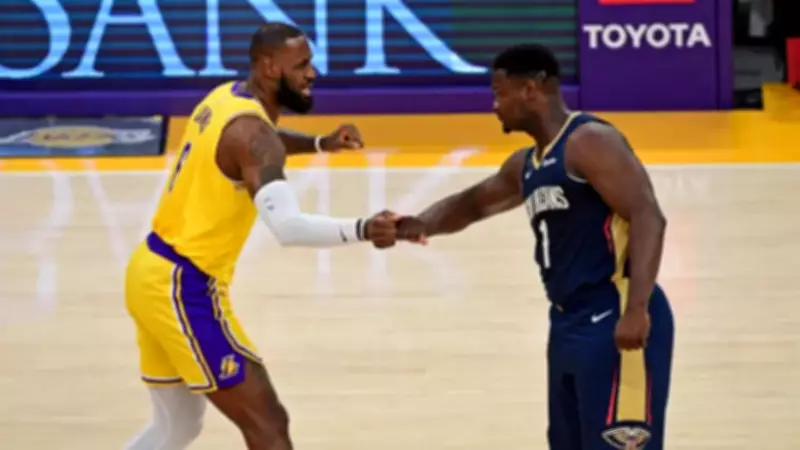
LeBron James and Stephen A. Smith Feud Intensifies Over Zion Williamson Controversy
The long-standing public disagreement between basketball icon LeBron James and prominent ESPN analyst Stephen A. Smith shows no signs of abating. Nearly one year after their highly publicized courtside confrontation in Los Angeles, Smith has explicitly stated he harbors no desire for reconciliation with the Lakers' superstar. This enduring conflict has now drawn in New Orleans Pelicans star Zion Williamson, creating a fresh flashpoint in the NBA media landscape.
LeBron James' Five-Word Defense of Zion Williamson
Recently, LeBron James issued a concise yet powerful five-word message directed at Zion Williamson, which has been interpreted as a direct response to critical comments made by Stephen A. Smith. The Los Angeles Lakers legend's statement, "Don't mind all the bullsh*t," was shared by the sports media outlet Bricks Center on social media platform X. This message reflects James' characteristic approach to handling external criticism and media noise, demonstrating his willingness to publicly support fellow players against perceived unfair attacks.
The context for James' intervention stems from Stephen A. Smith's recent commentary about Zion Williamson's physical condition and professional habits. During an ESPN segment, Smith launched a pointed critique of the Pelicans forward, questioning his dedication and even labeling him a "food addict." Smith elaborated with controversial comparisons, stating, "You got people that are alcoholics, you got people that are drug addicts, and stuff like that. What was Zion's problem? Food! Food addict! Somebody told me how he got busted hiding food under his bed."

New Orleans Pelicans Organization Responds Forcefully
The New Orleans Pelicans franchise did not remain silent in the face of Stephen A. Smith's criticisms. The team's official social media channel on X issued a strong rebuttal, defending their star player and pushing back against what they perceived as unfair characterization. This organizational response adds another layer to the controversy, indicating that Smith's comments have resonated beyond individual players to affect team dynamics and public relations.
LeBron James' decision to publicly advise Zion Williamson represents more than just veteran guidance—it serves as a pointed commentary on media responsibility and player treatment. James, who has navigated intense media scrutiny throughout his two-decade career, appears to be drawing a line against what he views as excessive personal criticism directed at younger players. His message emphasizes mental fortitude and selective attention in an era of constant sports commentary and social media amplification.
The Unresolved History Between James and Smith
This latest episode continues a pattern of tension between LeBron James and Stephen A. Smith that dates back to their 2023 confrontation in Los Angeles. Despite the passage of time, neither party has moved toward resolution, with Smith recently confirming his unwillingness to reconcile. The Zion Williamson situation has effectively reignited their public disagreement, transforming what began as personal friction into a broader discussion about media ethics, player advocacy, and the boundaries of sports commentary.
The controversy highlights several ongoing debates within professional basketball:
- The appropriate scope of media criticism regarding athletes' personal habits and physical conditions
- The role of veteran players in mentoring and protecting younger colleagues from media scrutiny
- The evolving relationship between high-profile athletes and influential media personalities
- Organizational responses to external criticism of franchise players
As the NBA season progresses, observers will be watching whether this three-way tension between LeBron James, Stephen A. Smith, and Zion Williamson develops further or gradually subsides. What remains clear is that the intersection of media commentary, player solidarity, and organizational protection continues to generate compelling narratives beyond the basketball court itself.