As electric vehicle adoption rises in India, high upfront costs continue to remain a major concern for buyers. To make EVs more accessible, several automakers and EV startups have introduced Battery-as-a-Service (BaaS) schemes that separate battery costs from vehicle prices. Since the battery is the most expensive part of an EV, this model helps reduce the initial purchase cost, while customers pay separately through subscription, lease, or usage-based plans.
Benefits of BaaS Model
The BaaS model also helps lower EMIs and reduces concerns related to battery replacement and long-term ownership costs. Over the last few years, more manufacturers have started offering such schemes across multiple segments, including affordable city EVs and premium electric SUVs. Here is a look at the electric vehicles in India currently available with Battery-as-a-Service plans, along with the benefits offered by each brand.
MG Comet EV
First EV on the list is the MG Comet EV, priced from Rs 4.99 lakh (BaaS scheme) plus Rs 3.2 per kilometre. The MG Comet EV is offered in five variants: Executive, Excite, Excite Fast Charge, Exclusive, and Exclusive Fast Charge. It gets a 17.3 kWh battery pack paired to a single electric motor which puts out 42 hp of power and 110 Nm of torque, sending power to the rear wheels. The battery is IP67-rated for water and dust resistance and offers an ARAI-certified range of 230 km.

Tata Punch EV
Second EV on the list is the Tata Punch EV, priced from Rs 6.49 lakh (BaaS scheme) plus Rs 2.6 per kilometre. The Punch EV is offered with two battery pack options: 30 kWh and 40 kWh, and is available in five variants: Smart, Smart+, Adventure, Empowered, and Empowered+ S. Prices for the non-BaaS versions range from Rs 9.69 lakh to Rs 12.59 lakh, ex-showroom. The larger battery pack has an ARAI-certified range of 468 km on a single charge and a C75 real-world range of 355 km.
MG Windsor EV
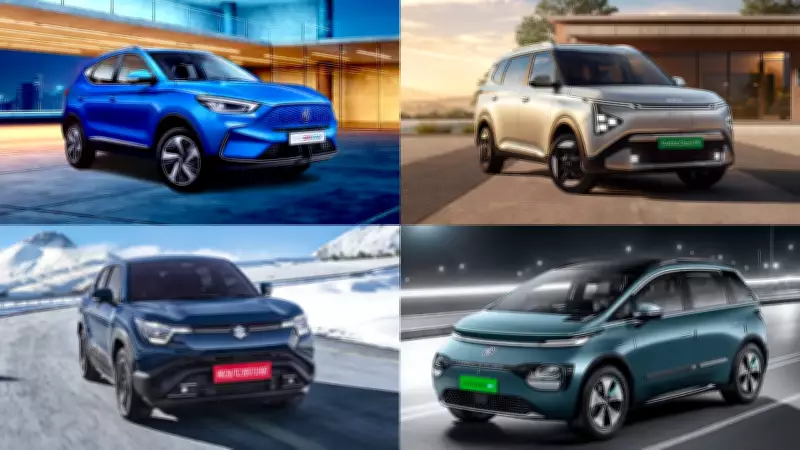
The MG Windsor EV was the first electric vehicle to be introduced with a Battery-as-a-Service (BaaS) scheme in the Indian market. The Windsor EV is priced from Rs 9.99 lakh (BaaS scheme) plus Rs 3.9 per kilometre. It is offered in two battery pack options: a 38 kWh battery pack with a claimed range of 332 km, and a larger 52.9 kWh battery pack delivering a claimed range of 449 km. Power output remains consistent across the range, with a 136 hp motor pushing out 200 Nm of torque.
Maruti Suzuki e-Vitara
Next EV on the list is the Maruti Suzuki e-Vitara, priced from Rs 10.99 lakh (BaaS scheme) plus Rs 3.99 per kilometre for the smaller battery and Rs 4.39 for the bigger battery. The e-Vitara is offered in two battery pack options: 49 kWh and 61 kWh. The batteries use LFP (Lithium Iron-phosphate) blade cells sourced by BYD. The 49 kWh battery comes paired with a single motor on the front axle, putting out 144 hp. The bigger 61 kWh battery also gets a single motor, but here it puts out 174 hp. Both motors produce identical 189 Nm of torque.
Kia Carens Clavis EV
Next comes the recently introduced Kia Carens Clavis EV, priced from Rs 12.84 lakh (BaaS scheme) plus Rs 3.3 per kilometre. The MPV EV is offered with two battery pack options: a 42 kWh unit offering an ARAI-certified range of 404 km, and a larger 51.4 kWh battery delivering up to 490 km on a single charge. The electric motor produces up to 126 kW of power and 255 Nm of torque.
MG ZS EV
Next is the MG ZS EV, priced from Rs 13 lakh (BaaS scheme) plus Rs 4.5 per kilometre. The ZS EV is powered by a 50.3 kWh battery paired with a single electric motor that pumps out 174 bhp and 280 Nm of torque. It boasts an ARAI-certified range of 461 km on a full charge.