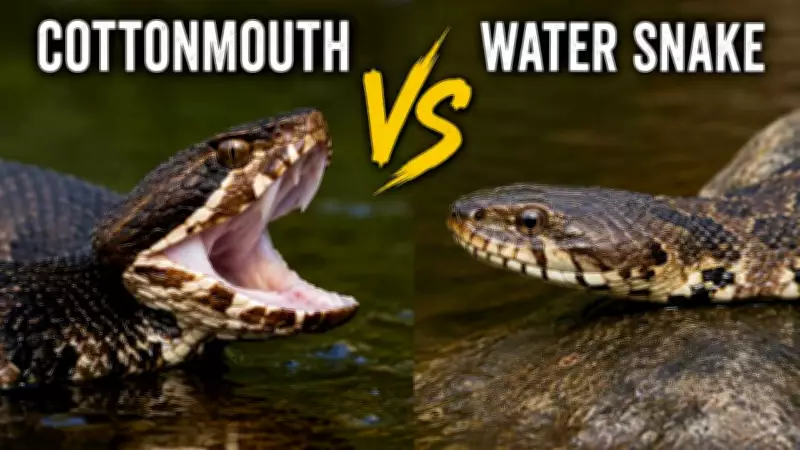
Few snakes in North America are mistaken for one another as frequently as cottonmouths and watersnakes. The confusion is understandable. Both are commonly found around ponds, rivers, marshes and wetlands, and both can appear surprisingly similar at a glance. A dark-coloured snake swimming across a lake or resting on a riverbank often leaves observers wondering which one they have just seen. Yet despite the resemblance, these reptiles belong to different groups and possess very different characteristics. One is a venomous pit viper with specialised hunting adaptations, while the other is a non-venomous snake that relies on entirely different survival strategies. Looking closely reveals distinctions in appearance, behaviour and biology that are often overlooked.
Cottonmouth vs Watersnake: Key differences in appearance, behaviour and venom
| Parameter | Cottonmouth snake | Watersnake |
|---|---|---|
| Scientific name | Agkistrodon piscivorus | Nerodia species |
| Family | Viperidae | Colubridae |
| Geographic range | Southeastern United States | Much of eastern and central North America |
| Average length | 75–110 cm | 60–150 cm depending on species |
| Body build | Thick, heavy-bodied | Thick but generally more streamlined |
| Venom | Venomous | Non-venomous |
| Head shape | Broad triangular head | Rounded or less distinct head |
| Heat-sensing pits | Present | Absent |
| Pupils | Vertical | Round |
| Habitat | Swamps, marshes, wetlands and slow-moving water | Rivers, lakes, ponds, streams and wetlands |
| Main prey | Fish, frogs, birds, rodents and other reptiles | Fish, amphibians and aquatic animals |
| Defensive behaviour | Mouth-gaping display showing white interior | Biting and releasing foul-smelling musk |
| Swimming posture | Often floats high on the water | Usually swims with much of the body submerged |
| Conservation status | Least Concern | Varies by species |
Cottonmouths and Water Snakes: How to distinguish these similar-looking reptiles
Size and physical build
Cottonmouths are often described as heavy-bodied snakes, and the description fits. Their thick midsections, broad heads and muscular appearance give them a stocky look that can seem intimidating when encountered at close range.
Watersnakes can also appear robust, which is one reason people confuse them with cottonmouths. Most species, however, have a slightly more streamlined appearance. Their bodies tend to blend more gradually into the neck and head, creating a less bulky profile overall.

Habitat and distribution
Cottonmouths are largely confined to the southeastern United States. They favour swamps, marshes, drainage channels and other wet habitats where fish, amphibians and small animals are abundant.
Watersnakes occupy a much broader range. Different species can be found across large parts of eastern and central North America. They thrive in freshwater environments and are equally comfortable in lakes, rivers, ponds and slow-moving streams.
Appearance and identification
This is where much of the confusion begins.
A cottonmouth typically has a broad triangular head, vertical pupils and visible facial pits located between the eyes and nostrils. Adults are often dark brown, olive or nearly black, with markings that may become difficult to see as they age.
Watersnakes display considerable variation in colour and pattern. Many have banded or blotched markings that resemble those of venomous snakes. Their heads are generally rounder, their pupils are circular, and they lack the heat-sensing pits found in cottonmouths.
Venom and hunting strategy
One of the most significant differences between the two snakes lies in their venom.
Cottonmouths are venomous pit vipers. Their venom helps immobilise prey and allows them to tackle a surprisingly varied diet that includes fish, frogs, rodents, birds and even other snakes.

Watersnakes do not possess venom that poses a threat to humans. They instead rely on speed, strong jaws, and persistence when capturing prey. Fish and amphibians form the bulk of their diet, though some species consume a wider variety of aquatic animals.
Sensory abilities
Cottonmouths possess specialised heat-sensing pits on either side of the face. These organs help detect warm-bodied animals, particularly in low-light conditions, giving the snake valuable information about its surroundings.
Watersnakes lack these structures. Like many non-venomous snakes, they depend primarily on sight, scent and vibration to locate prey and navigate their environment.
Defensive behaviour
Despite their reputation, cottonmouths generally prefer to avoid conflict. When threatened, they often adopt a defensive posture and open their mouths wide. The bright white interior creates a striking visual warning and is responsible for the common name "cottonmouth".
Watersnakes respond differently. They may flatten their bodies, strike repeatedly or release a strong-smelling musk. While these displays can seem aggressive, they are usually attempts to discourage predators rather than initiate a confrontation.
Behaviour in water
Many people attempt to identify snakes based on how they swim, though this method is far from perfect.
Cottonmouths often float with much of their body visible above the water's surface. This buoyant posture can make them appear more conspicuous while swimming.
Watersnakes frequently move with much of their body submerged, leaving only the head and part of the back visible. There are exceptions, however, which is why swimming posture alone is not considered a reliable identification tool.
Relationship with humans
Encounters with cottonmouths tend to attract attention because of their venomous status. Yet bites usually occur when the snake is handled, cornered or deliberately approached.
Watersnakes face a different problem. Their resemblance to cottonmouths often leads to misidentification, causing people to kill harmless snakes unnecessarily. In reality, watersnakes play an important role in controlling populations of fish, amphibians and other aquatic animals.
How habitat, appearance and behaviour contribute to a long-standing case of mistaken identity
The resemblance between cottonmouths and watersnakes is one of the most persistent cases of mistaken identity in North American wildlife. Both spend much of their lives near water, both can have dark bodies with banded patterns, and both may be encountered swimming or basking along shorelines.
A closer look usually reveals the differences. Cottonmouths possess venom, heat-sensing pits and the distinctive mouth display that gave them their name. Watersnakes lack these features and belong to an entirely different family of snakes. The comparison highlights how similar environments can sometimes produce animals that look alike while following very different evolutionary paths.