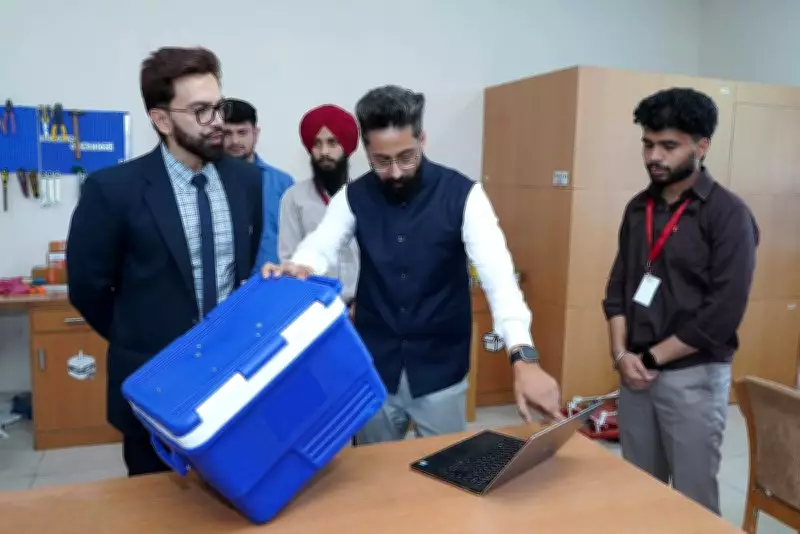
CT University's Robotics Lab has developed an innovative Smart Organ Transportation Box aimed at strengthening healthcare technology and organ transplant logistics. The device ensures safe and secure transportation of organs through real-time environmental monitoring, IoT connectivity, and blockchain technology.
Addressing Critical Challenges in Organ Transplantation
The Smart Organ Transportation Box continuously monitors essential environmental conditions, including temperature and humidity, ensuring that organs remain in optimal conditions throughout the journey. The system also detects any unauthorized opening of the box, providing an additional layer of security during transportation.
Cost-Effective Solution
The Smart Organ Transportation Box has been developed at a highly economical cost of under ₹8,000, making it a cost-effective solution that can significantly benefit hospitals, healthcare institutions, and organ transplant organizations across the country.

Real-Time Monitoring via IoT Dashboard
The developers explained that the receiver can monitor all critical parameters in real time through an IoT-enabled dashboard, allowing healthcare professionals to track the condition of the organ throughout its transportation journey and respond immediately if any abnormality is detected.
Blockchain Integration for Data Security
Adding another technological advancement, Dr. Geet Bawa, a PhD graduate from CT University, stated that the system integrates blockchain technology by deploying smart contracts to securely store the data generated by the sensors. This creates a decentralized, tamper-proof, and immutable record of transportation conditions, ensuring complete transparency and authenticity of the data.
Technical Specifications
The Smart Organ Transportation Box incorporates temperature, light, and accelerometer sensors, all integrated with a NodeMCU ESP32 Wi-Fi-enabled microcontroller. The device also features an inbuilt rechargeable battery capable of operating for more than 24 hours on a single charge, making it suitable for long-distance transportation.
Rapid Development and Team
The innovation was developed within just three days by the dedicated Robotics Lab team comprising Dharampreet Singh, Pulkit Sangar, and Gurkirat Singh, under the guidance of Dr. Harmeet Singh.
University's Commitment to Social Impact
“At CT University, we strongly believe that technology should serve humanity. The Smart Organ Transportation Box reflects our commitment to developing affordable, practical and socially impactful innovations. Organ transplantation is a race against time, and this innovation has the potential to improve the safety, transparency and reliability of organ transportation. We are proud of our researchers and students for creating a solution that can contribute meaningfully to the healthcare sector while demonstrating the University’s focus on research, innovation and nation-building,” the university said.