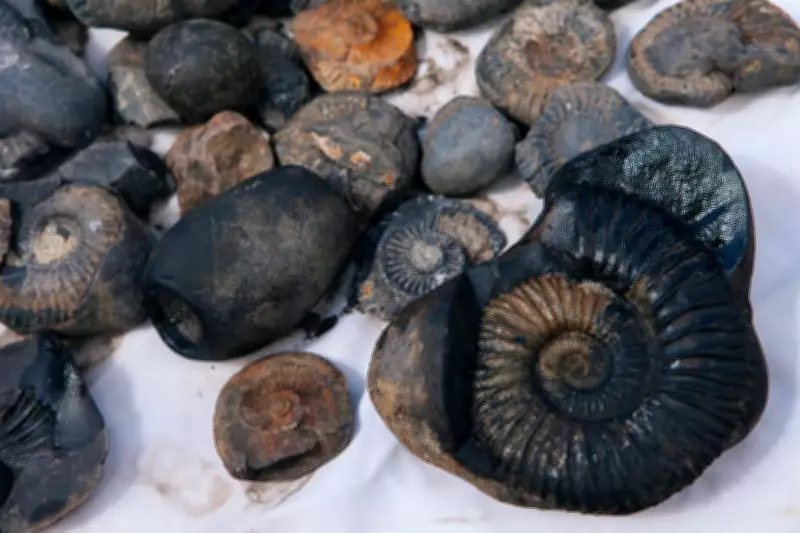
Fossilised shark teeth, molluscan shells, and other marine remains discovered in Odisha's Mayurbhanj district provide compelling evidence that present-day Baripada was once submerged under a shallow sea during the Miocene epoch, a researcher announced on Thursday.
Age and Significance of the Fossils
The fossils, estimated to be between 12.6 million and 8.3 million years old, were identified and documented by Dr Debabrata Nandi, assistant professor in the Department of Remote Sensing and GIS at Maharaja Sriram Chandra Bhanja Deo (MSCB) University in Baripada. The findings offer valuable insights into the region's prehistoric marine biodiversity and palaeoenvironmental conditions.
The Baripada Fossil Bed
The fossil-bearing site, locally known as 'Asurahada' and scientifically referred to as the Baripada Fossil Bed, is located in the foothill region near the district headquarters town. Researchers have found an assemblage of fossilised shark teeth, molluscan shells, and other marine biogenic remains preserved within sedimentary rock formations.

Nandi explained that the findings indicate the area was part of a shallow marine environment during the Miocene period, which marked significant continental shifts and global cooling. Detailed stratigraphic studies and fossil analyses suggest that these sediments were deposited in a coastal marine basin that supported a wide variety of aquatic organisms.
Key Discoveries and Implications
Among the most significant discoveries are fossilised shark teeth belonging to extinct marine species and a rich diversity of well-preserved molluscan remains. These fossils are helping scientists reconstruct ancient ocean ecosystems and understand climatic changes and sea-level fluctuations that occurred millions of years ago.
Nandi emphasised that the discovery raises important questions about the geological evolution of the region, particularly how the coastline retreated nearly 60 kilometres from present-day Baripada. He noted, "There is a need to study why the sea receded so far, whether due to climate change or other natural geological events. Further research could reveal many more insights into the region's past."
Geological Archive and Future Research
The researcher highlighted that the Baripada Fossil Bed has emerged as an important geological archive for scientists studying India's palaeogeographic evolution. The fossil horizon may provide additional evidence of marine transgression in eastern India and help establish links with similar fossil-bearing formations elsewhere in the country.
Advanced geospatial tools, remote sensing technology, and GIS-based mapping played a crucial role in locating and documenting the fossil site. The integration of field investigations with spatial analysis enabled researchers to map fossil distribution and geological features with greater accuracy.
Preservation and Scientific Interest
The discovery has attracted considerable interest from geologists, palaeontologists, and academic institutions because of its scientific significance. Researchers have urged authorities to preserve the area as a geo-heritage site to protect it from natural erosion and human-induced disturbances.