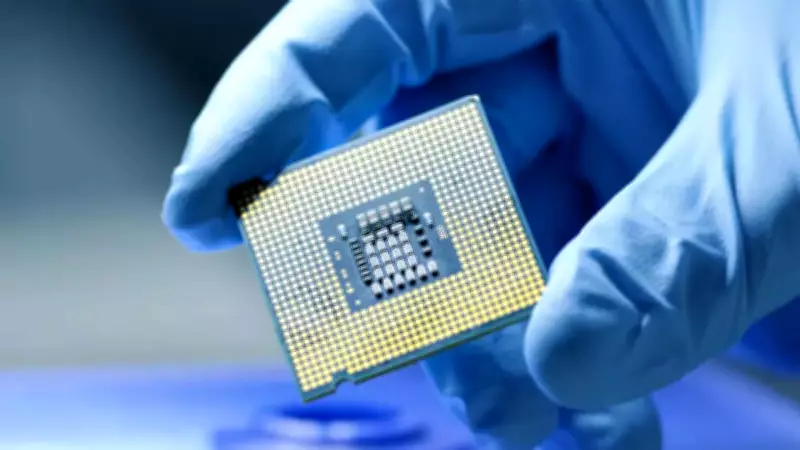
US Commerce Secretary Howard Lutnick has informed ASML, the Dutch manufacturer of the world's most critical chipmaking machines, that Washington suspects one of its most advanced tools may have been illicitly transferred to China. If confirmed, this would represent a significant violation of the export controls the United States has meticulously constructed over years to prevent cutting-edge semiconductor technology from reaching Beijing.
The warning was conveyed during a series of recent meetings, as reported by Bloomberg, which first broke the story. Lutnick directly raised concerns with ASML's senior leadership regarding the company's extreme ultraviolet lithography (EUV) machines. These systems are the only tools globally capable of printing the most advanced semiconductor patterns. ASML has been prohibited from selling EUV equipment to China since the first Trump administration.
Why an Obscure European Company Matters So Much
ASML may not be a household name, but it occupies a central role in the entire artificial intelligence infrastructure. Its machines produce the chips that TSMC manufactures for Nvidia and Apple. There is no alternative supplier, a monopoly that has propelled ASML's market value to approximately $700 billion, making it Europe's most valuable publicly traded company. The systems themselves are roughly the size of a school bus and weigh 180 tons, according to Reuters. This sheer scale underscores why a single missing machine would be consequential. An EUV system in Chinese hands would represent one of the most significant breaches yet in the barrier the US has erected around advanced AI capabilities.

The Company's Flat Denial and the Evidence Washington Won't Show
ASML is not backing down. The company told Reuters that it has never shipped an EUV machine to China, nor any component or module specifically designed for one. It states that it tracks every machine it has ever produced, all either in use with monitored customers or dismantled and returned.
The catch is that US officials have so far declined to provide proof. Senior administration figures told Bloomberg they possess evidence that ASML shipped EUV-related components and transport gear to China, but they have not shown it to Bloomberg or, apparently, to ASML. The Commerce Department has not indicated whether it has evidence of an actual machine on Chinese soil.
CEO Christophe Fouquet addressed the China question in a TechCrunch interview weeks before this story broke. His argument was straightforward: you cannot reverse-engineer a machine you have never possessed. ASML built an internal firewall years ago that isolates its China-based staff from EUV technology and training. Solving the genuinely novel problem of generating EUV light took the company two decades on its own.
What Is at Stake and the Bill Waiting in the Wings
There is also commercial logic in ASML's denial. The company expects roughly 20% of its 2026 revenue from already-permitted sales to China, mostly older deep ultraviolet (DUV) tools. Risking the EUV ban over one illegal sale would jeopardize that revenue and its position as Europe's most valuable monopoly.
The pressure may not stop at EUV. A bipartisan bill moving through Congress would ban all DUV shipments to China. It cleared a key committee in April, and the Trump administration has not taken a formal position.
Get the latest technology news and updates. Download the TOI App.
About the Author: TOI Tech Desk is a dedicated team of journalists committed to delivering the latest and most relevant news from the world of technology to readers of The Times of India. TOI Tech Desk's news coverage spans a wide spectrum across gadget launches, gadget reviews, trends, in-depth analysis, exclusive reports, and breaking stories that impact technology and the digital universe. Be it how-tos or the latest happenings in AI, cybersecurity, personal gadgets, platforms like WhatsApp, Instagram, Facebook, and more; TOI Tech Desk brings the news with accuracy and authenticity.