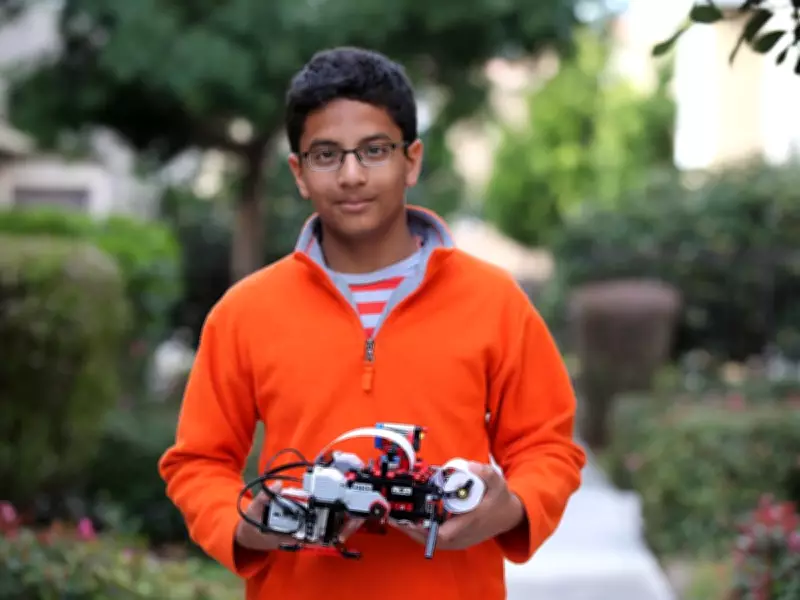
An American teenager, just 13 years old, used Lego blocks to build a Braille printer that is cheap enough to manufacture for blind and partially sighted people who find existing embossers costly. This invention, named Braigo, quickly gained prominence for offering a solution to a real-life problem using a simple and easily comprehensible design.
The Inspiration Behind Braigo
According to reporting by the Wharton Global Youth Program, Shubham Banerjee began researching Braille after coming across information about visual impairment and wondering how blind people read printed text. During his research, he discovered that standard Braille printers, also known as embossers, often cost thousands of dollars. That price became the core problem he wanted to solve.
A School Project Addressing a Real-World Need
Braigo stood out because it was not framed as a toy experiment. Banerjee focused on making the product affordable from the start. According to reports, the initial prototype was built from a Lego Mindstorms EV3 robot kit, which was then estimated to retail for about $350. This was significantly cheaper than most commercially available Braille embossers. According to the University of Colorado Boulder's Braille resource page, Braille embossers are essential assistive tools that convert text into tactile dots for reading. These devices are widely used by blind and low-vision readers, but their cost can make access difficult for schools, families, and smaller organizations.

This context helps explain why Banerjee's idea gained popularity. The concept was easy to grasp, yet the problem it addressed was serious: inexpensive printing could mean increased accessibility and many other benefits.
Why the Lego Design Mattered
One reason Braigo was popular is that it was clearly constructed from familiar materials. The use of Lego blocks suggested something novel but not overly complicated, rather than an industrial engineering masterpiece. Reportedly, Banerjee chose Lego blocks to enable quick, inexpensive prototyping of movement and mechanics.
The visual simplicity of the machine also made it easier for people to relate to the broader problem of accessibility. Rather than seeming like another high-tech product that was hard to understand, the machine appeared approachable. Moreover, according to reports, the initial prototype of Braigo was lightweight, weighing just a few pounds, significantly lighter than some of its contemporaries.
The Project Quickly Evolved Beyond a Science Fair
The Braigo project started as a school science fair project but quickly garnered interest from the industrial sector. Braigo Labs, which was spun off from the project, received financial support from Intel Capital for creating prototypes. Banerjee subsequently developed Braigo 2.0 using the Intel Edison processor and a modified desktop printer to convert text electronically into Braille before printing.
There is extensive coverage of the Braigo project, much of it revolving around Banerjee's age. However, what makes the coverage interesting is that it actually addresses a gap in assistive technology solutions. Many industrialists have pointed out that the device is an attempt to reinvent an expensive system, and that is truly intriguing.
Affordability Became the Central Idea
The strongest part of the Braigo story was the focus on access rather than invention alone. Technology can be sophisticated, but it will not have much impact unless users can actually use it without financial barriers. In other words, Braigo made affordability an engineering objective.
One of the key things Banerjee emphasized was his desire to produce an affordable Braille printer for those who really need one. At the same time, reports indicated that he learned Braille during his research, showing that he approached his task in a very user-oriented manner despite his young age. In short, empathy, curiosity, and a practical approach made the Braigo story so fascinating.

About the Author
The TOI Science Desk stands as an inquisitive team of journalists, ceaselessly delving into the realms of discovery to curate a captivating collection of news, features, and articles from the vast and ever-evolving world of science for the readers of The Times of India. Consider us your scientific companion, delivering a daily dose of wonder and enlightenment. Whether it is the intricacies of genetic engineering, the marvels of space exploration, or the latest in artificial intelligence, the TOI Science Desk ensures you stay connected to the pulse of the scientific world. At the TOI Science Desk, we are not just reporters; we are storytellers of scientific narratives. We are committed to demystifying the intricacies of science, making it accessible and engaging for readers of all backgrounds. Join us as we craft knowledge with precision and passion, bringing you on a journey where the mysteries of the universe unfold with every word.