The world of technology is witnessing a seismic shift, where the power of artificial intelligence is enabling individual creators to achieve feats once reserved for large teams. This transformation is redefining productivity and raising important questions about the future of work in India's tech sector and beyond.
An Engineer's Solo Feat Stuns Zoho Founder
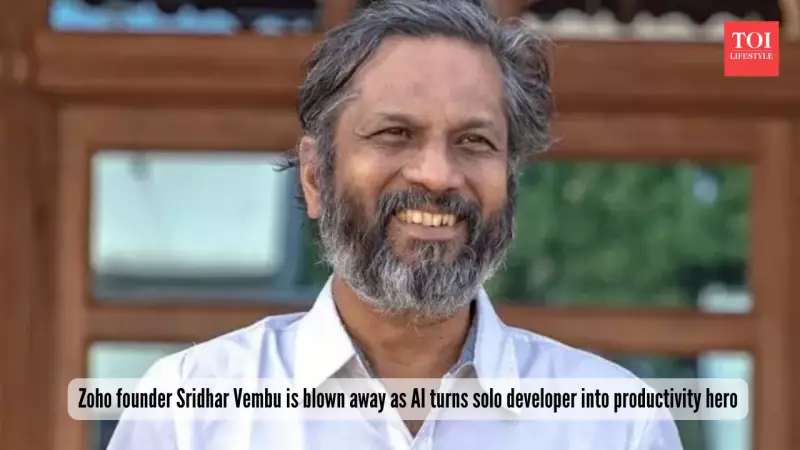
Recently, Sridhar Vembu, the founder and former CEO of the Indian software giant Zoho Corporation, shared a remarkable story on social media platform X. He recounted how an experienced engineer from his own research and development team presented him with a sophisticated assembly and machine code security tool. Vembu was completely unaware the engineer was building it, and was astounded by the tool's depth and complexity, especially given its origins.
The most staggering detail was the timeline. This was not a minor side project but a substantial piece of software. The engineer developed the entire tool entirely on his own, during his spare time, over just one month. Vembu emphasized that traditionally, a task of this scale and specialization would require a coordinated team of three to four people working for at least a full year.

The AI Game Changer: From Skeptic to Believer
The catalyst for this extraordinary productivity leap was a specific advanced AI model. Vembu identified the Opus 4.5 AI model as the "game changer" that fundamentally altered the engineer's workflow and perspective. According to Vembu, the engineer was previously not very enthusiastic about AI-generated code. However, the capabilities of this particular model caused him to completely revise his opinion.
This instance highlights a critical evolution in AI's role. It is not merely about automating simple tasks or generating generic code. Instead, it demonstrates how intelligent assistance, when applied to specialized and complex problems, can compress the entire development cycle. The AI acted as a force multiplier, allowing deep expertise to be applied with unprecedented efficiency.
Zoho's Culture of Freedom and the Bigger Picture
Vembu directly linked this innovation to Zoho's internal culture and management philosophy. He explained that the company's approach to learning and innovation is to "let smart people experiment and find new pathways." This environment of autonomy and trust, free from top-down micromanagement, allows professionals the space to explore and for breakthroughs to emerge organically.
The social media response to Vembu's post was swift and significant, racking up over 200,000 views. Users noted the profound shift this represents, with one commenting, "When one engineer can build in a month what once took a team a year, the leverage curve has shifted." Others highlighted the importance of work-life balance, thanking Zoho for allowing the engineer to have the "spare time" to pursue such innovative work.
While this story is a powerful testament to AI's potential to boost individual productivity to staggering levels, it also casts a shadow. The very efficiency that allows one person to replace a year of team effort inevitably fuels ongoing concerns about job displacement and the future of human employment in an AI-augmented world. The landscape of work is changing irrevocably, and India's tech industry is at the forefront of navigating this new reality.