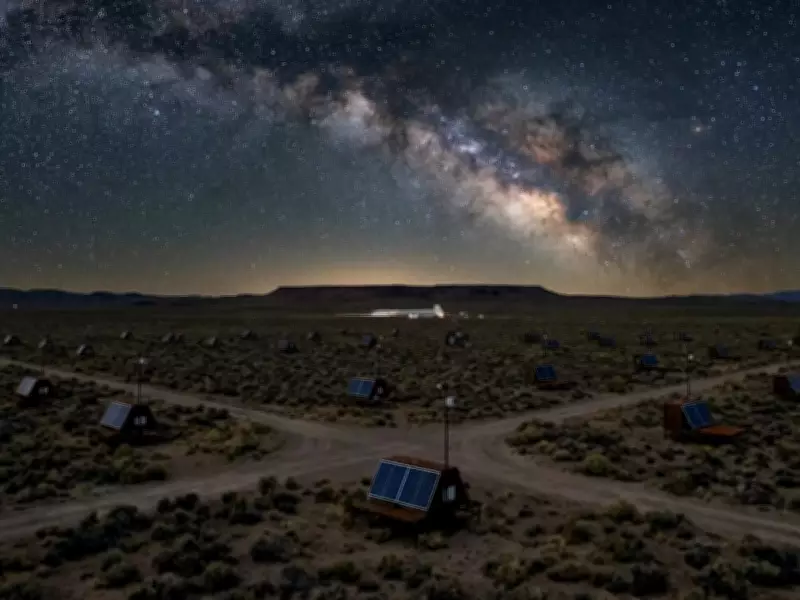
In May 2021, one of the most powerful cosmic rays ever recorded struck Earth's atmosphere over Utah, triggering a massive shower of secondary particles. Named Amaterasu, after the Japanese sun goddess, this event was later confirmed in 2023 as the second strongest cosmic ray ever observed, surpassed only by the famous Oh-My-God particle detected in 1991.
How Was Amaterasu Detected?
The Amaterasu particle was detected by the Telescope Array, a vast cosmic-ray observatory located in the Utah desert. According to the University of Utah, it is the largest cosmic-ray detector in the Northern Hemisphere, designed to study ultra-high-energy particles. Scientists did not directly observe the particle itself but rather the air shower it produced. When a high-energy cosmic particle enters Earth's atmosphere, it collides with air molecules, creating a cascade of secondary particles that spread out and are detected by ground-based instruments. This process allows researchers to determine the energy and trajectory of the primary particle, though the actual source remains elusive.
Why Is Finding the Source So Difficult?
A key puzzle in the Amaterasu study was its origin. A paper published in Nature noted that the particle appeared to come from a region of space described as a void, with no known high-energy sources. Cosmic rays typically originate from energetic environments such as active galactic nuclei, supernova remnants, or black hole jets. However, none of these were apparent in the Amaterasu event, leaving scientists baffled. How could such a powerful particle emerge from an area seemingly devoid of matter?

Compounding the challenge, cosmic rays are charged particles that interact with magnetic fields during their journey through space. These magnetic fields can bend their trajectories, meaning the direction from which a cosmic ray arrives does not necessarily point back to its source. This makes pinpointing origins extremely tricky, even with precise detection.
Progress Toward an Explanation
In 2025, a glimmer of clarity emerged. A Nature Research Highlight suggested that the blazar PKS 1717+177 could be a possible source. Blazars are active galaxies with jets of high-energy particles aimed toward Earth, powered by supermassive black holes. According to the study, protons from the blazar's jet may collide with ambient photons, producing ultra-high-energy particles that could travel across space and reach Earth as cosmic rays. While this is not a definitive solution, it offers a plausible connection between the Amaterasu event and a known class of cosmic accelerators.
Role of Neutrinos in Tracing Cosmic Rays
Scientists also use neutrinos to investigate cosmic ray origins. Neutrinos are subatomic particles with negligible mass that travel in straight lines, unaffected by magnetic fields. High-energy neutrinos often accompany cosmic rays, and in multi-messenger astronomy, researchers analyze multiple particle types simultaneously to trace sources more effectively.
Significance of the Amaterasu Discovery
The detection of Amaterasu represents a remarkable achievement for humanity, showcasing our ability to observe and measure some of the most extreme phenomena in the universe. Yet it also highlights our limitations: even with advanced detectors, tracing the origin of such particles remains a formidable challenge. Each new discovery, however, brings science closer to unraveling these cosmic mysteries.
From an unexplained event to a potential link with a blazar, the Amaterasu cosmic ray has already advanced our understanding. Whether the blazar theory holds or not, this particle has demonstrated that there are still profound secrets in the cosmos waiting to be uncovered. One particle can indeed pave the way to discovery.