

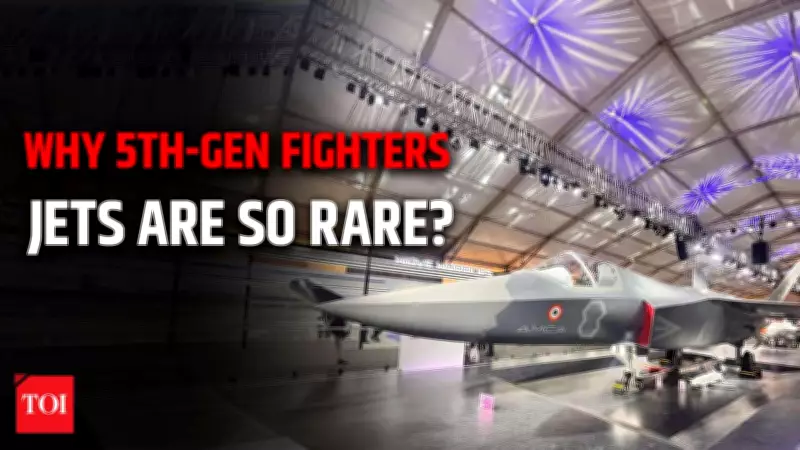
India's Advanced Medium Combat Aircraft (AMCA) has entered a critical phase, marking a significant step toward the nation's first indigenous fifth-generation stealth fighter. But what does it truly take to build such an advanced aircraft?
The Complexity of Fifth-Generation Fighters
Developing a fifth-generation fighter jet involves far more than designing an airframe. It requires mastery of stealth technology, radar-absorbing materials, sensor fusion, software integration, prototype testing, and large-scale production. The journey is a decades-long process of science and engineering.
Key Technologies Behind Stealth Fighters
Stealth fighters like the F-22 Raptor, F-35 Lightning II, J-20, Su-57, and India's AMCA rely on several core technologies:

- Stealth Technology: Reducing radar cross-section through shape design and special coatings.
- Radar-Absorbing Materials: Materials that absorb radar waves rather than reflecting them.
- Sensor Fusion: Integrating data from multiple sensors to provide a unified picture to the pilot.
- Advanced Avionics: Sophisticated computers and software for navigation, targeting, and communication.
The Development Process
The process from blueprint to battlefield spans many years:
- Concept and Design: Engineers create detailed blueprints and computer models.
- Prototype Construction: Building test aircraft to validate designs.
- Flight Testing: Rigorous testing to ensure performance and safety.
- Production: Scaling up manufacturing for operational use.
India's AMCA Programme
India aims to join the elite club of nations capable of building fifth-generation combat aircraft. The AMCA programme is ambitious, requiring advanced research and development in aerodynamics, materials, and electronics. If successful, it will bolster India's defense capabilities and technological independence.
Global Context
Other nations have already fielded fifth-generation fighters:
- F-22 Raptor (USA): The world's first operational stealth fighter.
- F-35 Lightning II (USA): A multirole fighter with advanced sensor fusion.
- J-20 (China): China's stealth fighter, now in service.
- Su-57 (Russia): A twin-engine stealth fighter with supermaneuverability.
Each programme faced immense technical hurdles, from engine development to software integration. India must overcome similar challenges to realize its AMCA vision.
In summary, building a fifth-generation fighter is a monumental task that combines cutting-edge science, engineering, and industrial capability. India's progress on the AMCA represents a bold step toward self-reliance in advanced aerospace technology.






