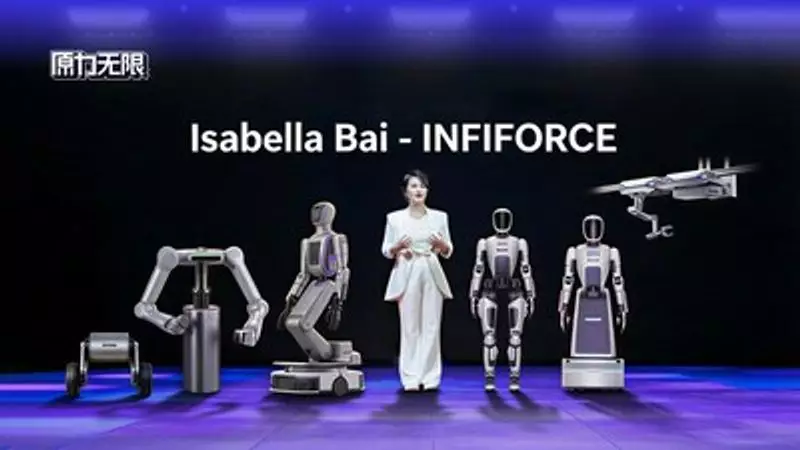
At the Consumer Electronics Show (CES) 2026 in Las Vegas, a significant declaration from a Chinese tech leader has reshaped the global conversation on artificial intelligence. Isabella Bai, the co-founder and CEO of Infiforce, articulated a profound strategic pivot for China, moving beyond its established role as the world's factory to becoming the architect of the next technological frontier: embodied artificial intelligence.
From Assembly Lines to AI Pioneers: China's Strategic Ambition
Isabella Bai's keynote address served as a clarion call, marking a deliberate transition in China's technological identity. For decades, the nation's economic strength has been synonymous with high-volume manufacturing and hardware assembly. However, Bai emphasized that China is now channeling its immense resources, talent, and data capabilities towards defining and leading the development of embodied AI systems.
This new form of intelligence goes beyond software algorithms confined to servers or smartphones. Embodied AI refers to intelligent systems that interact with the physical world through robots, autonomous vehicles, and advanced humanoid machines. It represents the convergence of AI software, sophisticated sensors, and mechanical hardware—a domain where China's manufacturing prowess provides a unique foundational advantage.

The Infiforce Vision and the Global AI Race
Bai positioned her company, Infiforce, at the vanguard of this national shift. She detailed how the firm is integrating cutting-edge AI models with physical actuators and sensory apparatus to create intelligent entities capable of complex, real-world tasks. The announcement underscores the intensifying global race for supremacy in advanced robotics and autonomous systems, with China making its ambitions unequivocally clear.
The implications of this shift are monumental for global tech dynamics. By aiming to set the standards and core technologies for embodied intelligence, China seeks to move up the value chain from being a component supplier to becoming the essential innovator whose platforms and architectures others will build upon. This challenges the current narrative of AI leadership, often centered on US-based software firms.
What This Means for India and the World
For India, a major player in software services and an emerging hub for AI research, China's focused push into embodied AI presents both a challenge and an opportunity. It highlights the critical need for strategic investments in interdisciplinary research that blends AI, robotics, and material science. The global supply chain for advanced robotics, from rare-earth minerals to semiconductor chips, is also likely to see increased strategic competition.
Bai's CES 2026 presentation was not just a product launch; it was a geopolitical statement in the realm of technology. It signals that the next phase of the AI revolution will be physical, tangible, and built upon a fusion of digital and industrial might. As nations and corporations plot their course, the declaration from Las Vegas makes it clear that China intends to be the one drawing the map for the future of intelligent machines.