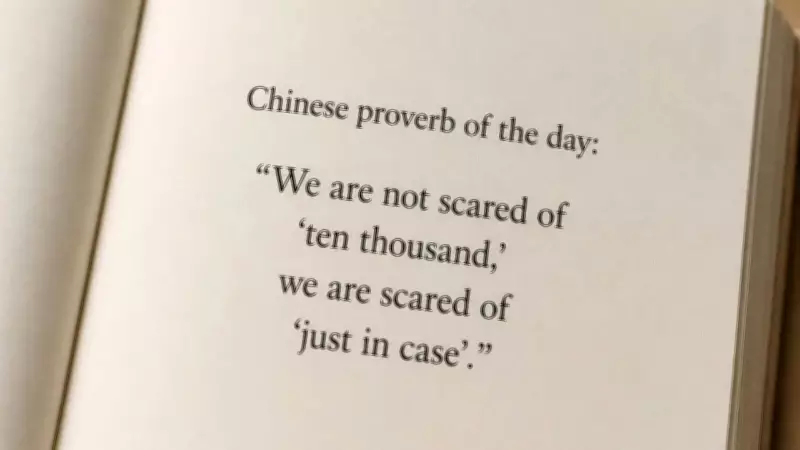
People deal with different kinds of fears every day. Some fears are based on real events, while others stem from uncertainty or imagination. Many individuals are not afraid of obvious dangers but rather of possibilities that may never occur. This mindset often leads to procrastination, hesitation, and unnecessary stress.
In a world of constant information and uncertain outcomes, people tend to consider every possible result. While preparation is important, excessive analysis can cause confusion and hinder action. Ancient wisdom, such as Chinese proverbs, remains relevant by simplifying complex human behaviors. The saying, 'Ten thousand dangers don't scare us, but one 'what if' does,' highlights that fear often arises from the unknown rather than the magnitude of the problem.
What This Chinese Proverb Really Means
The proverb contrasts two types of fear. 'Ten thousand' represents a large, clear problem—a known risk or tangible challenge that people can prepare for. In contrast, 'what if' embodies uncertainty, imagining potential negative outcomes without evidence. This type of thinking fuels anxiety because it is based on possibilities, not facts.

The essence of the proverb is that uncertainty can be more frightening than facing real problems. The mind tends to envision worst-case scenarios when situations are unclear, amplifying stress and doubt.
Why Uncertainty Causes More Fear Than Real Problems
When people understand a problem, they can plan and act. A clear challenge is easier to tackle because expectations are defined. However, uncertainty offers no clear answers, leading to self-doubt and indecision. For example, someone may not fear a difficult task but dread the thought of 'what if something goes wrong,' preventing them from even starting.
The proverb teaches that fear often grows in ambiguity, not in difficulty. Recognizing this can help individuals shift focus from hypothetical worries to actionable steps.
Everyday Lessons From This Chinese Proverb
- Fear usually stems from uncertainty, not actual threats.
- Overthinking options increases stress and confusion.
- Known problems are easier to address than imagined ones.
- Taking action alleviates anxiety caused by 'what if' thoughts.
- Not every potential issue needs advance consideration.
- Focusing on the present leads to better decisions.
- Action builds confidence, while overthinking erodes it.
- Preparation is important, but excessive worry is unhelpful.
- Clarity reduces fear and maintains focus.
- Small steps can overcome hesitation.
How This Proverb Applies to Modern Life
In today's world, people constantly receive new information, opinions, and options, often leading to ambiguity. Before making decisions about careers, finances, or relationships, individuals typically weigh multiple outcomes. While careful thought is valuable, excessive focus on 'just in case' scenarios can cause delays. Many postpone decisions due to fear of the unknown.
This proverb remains relevant because it addresses this common behavior. It encourages people to concentrate on what they know rather than worry about what might happen.
The Role of Decision-Making and Confidence
When people overthink possibilities, decision-making becomes difficult. Fear of mistakes or unforeseen problems can lead to inaction. The proverb suggests that confidence comes from tackling real challenges, not imagined ones. Taking action provides learning and clarity. Even if issues arise, they can be resolved step by step, reducing fear and building confidence over time.
Why Overthinking Can Be Harmful
Overthinking often results in stress and inaction. Considering too many options can feel overwhelming, affecting both personal and professional life. People may delay career moves, miss opportunities, or hesitate in relationships due to 'what if' fears. The proverb highlights that not every option needs deep analysis; focusing on the present and taking action is often more beneficial.

Finding a Balance Between Caution and Action
The proverb does not advocate ignoring risks. Caution and preparation are important, but there must be a balance between readiness and action. It is impossible to consider every possible outcome. Instead, focusing on probable scenarios and implementing sensible measures yields better results. This balanced approach enables smart decisions while reducing stress.
Why This Chinese Proverb Still Matters Today
Despite technological and lifestyle changes, human behavior remains consistent. People still experience fear, uncertainty, and doubt. This proverb endures because it describes a universal thought pattern: fear is more often linked to the unknown than to reality. Understanding this idea helps individuals make better decisions and lower stress levels.
A Simple Takeaway From This Chinese Proverb
The message is clear: people are often more afraid of possibilities than of actual challenges. By focusing on known facts and taking action, one can diminish fear and move forward with confidence.
About the Author: TOI Lifestyle Desk — A dynamic team of dedicated journalists curating lifestyle news for The Times of India readers, covering fashion, travel, food, wellness, and more.