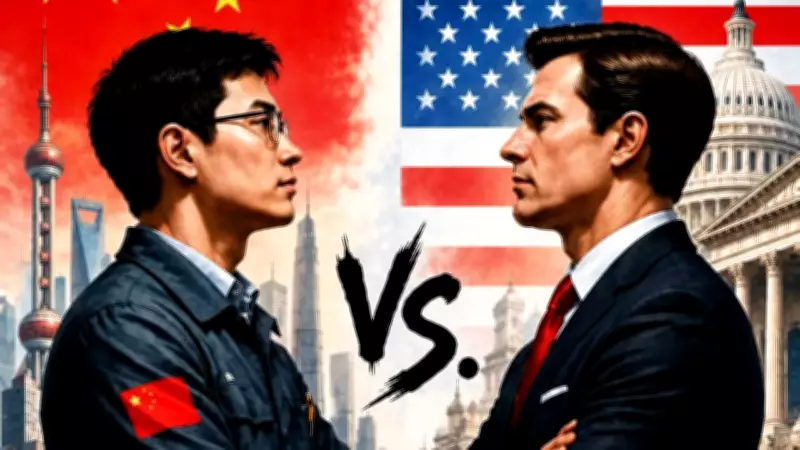
The recent meeting between Donald Trump and Xi Jinping generated a flurry of headlines about US-China rivalry. The central question often posed is whether the world's two largest powers can manage their competition responsibly or are destined to fall into the so-called 'Thucydides Trap'—where a rising power inevitably collides with an established one. However, the relationship between Washington and Beijing is far more nuanced. Beneath the diplomatic theatrics lies a deeper civilisational contrast in how the two nations think, govern, and build.
The Engineer vs Lawyer Divide
In his book Breakneck: China's Quest to Engineer the Future, Dan Wang offers a compelling argument to understand this divide: China is run by engineers, while America is run by lawyers. One side is obsessed with building, the other with regulating. China sees every challenge as a construction problem to be solved with more factories, railways, housing, and infrastructure. The US, meanwhile, instinctively approaches problems through rules, litigation, oversight, and compliance.
Leadership Backgrounds
This contrast is evident even in political leadership. China's top brass is packed with technocrats and engineers. Xi Jinping himself studied chemical engineering. The Chinese state tends to think in linear, technical terms: identify a target, mobilise resources, and execute at speed. America's leadership class, by contrast, is overwhelmingly shaped by the legal profession. From Abraham Lincoln to Joe Biden, 28 of 45 US presidents have had legal backgrounds. Naturally, the American instinct is less about bulldozers and blueprints and more about lawsuits, environmental clearances, public hearings, and procedural safeguards.

Infrastructure: A Tale of Two Projects
The consequences are starkly visible in infrastructure. In 2008, both countries embarked on ambitious high-speed rail projects. China launched the Beijing-Shanghai line, while the US approved a rail corridor linking San Francisco and Los Angeles. China opened the line in 2011 at a cost of roughly $36 billion. America, meanwhile, remains trapped in paperwork and delays. Seventeen years after approval, only a modest stretch has been built, costs have exploded to nearly $128 billion, and operations are now expected no earlier than 2033.
The Dark Side of China's Model
Yet Wang cautions against romanticising China's model. Beneath the gleaming skyscrapers and futuristic train stations lies a brittle reality. Much of China's infrastructure is overbuilt and underused. Ghost cities, debt-ridden provinces, and rampant local corruption expose the darker side of compulsive construction. Social welfare remains weak, healthcare uneven, and education outside major cities inadequate. During the COVID-19 pandemic, the contrast became stark. The US pumped thousands of dollars directly into households through stimulus payments, while China offered only limited unemployment support that reached a tiny fraction of workers.
Conservatives in Revolutionary Clothing
Ironically, Wang argues, China's leadership often behaves less like revolutionaries and more like conservatives disguised in Leftist clothing. The disastrous One Child policy, for example, was designed not by sociologists or philosophers but by missile scientist Song Jian, whose rigid engineering logic produced one of the greatest demographic crises of modern times. Even today, Beijing's response remains mechanical, with Xi urging women to return home and have more children, as though population decline can simply be recalibrated like a machine.
Lessons for Both Nations
Still, China's relentless construction drive gives its people a sense of momentum and national purpose. America, despite its innovation and freedoms, increasingly struggles to build with confidence or speed. Perhaps the lesson for both nations is clear. The US needs to rediscover its lost appetite for grand projects and physical ambition. China, meanwhile, must learn that societies cannot thrive on concrete and steel alone.