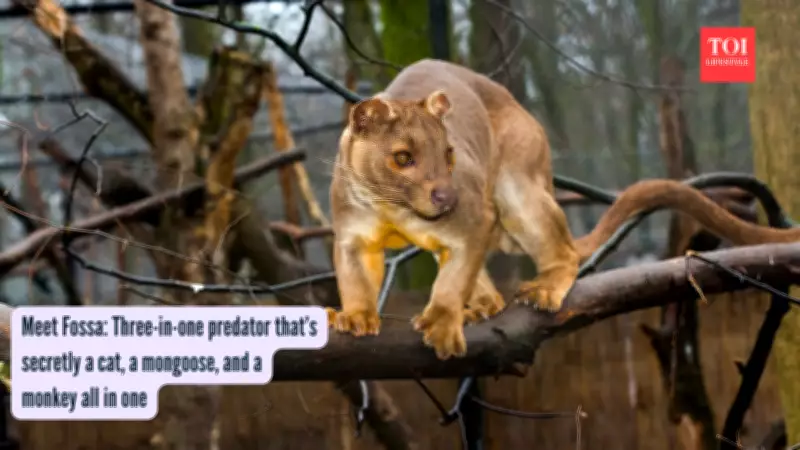
Madagascar's isolated forests possess unique biodiversity due to millions of years of geographical separation. This separation allowed evolution to brew in unimaginable ways, producing creatures that seem to defy conventional biological understanding. Among these unique animals, one creature stands out as a true master of its environment: a predator that has confused scientists because it looks like a mix of several different animals. This mysterious animal is called the fossa.
Meet the Fossa: A Mosaic of Biology
The fossa is, in many ways, an evolutionary contradiction. Its anatomy is a mosaic of traits borrowed from disparate carnivore branches. Its face and teeth, along with sharp carnassials, resemble those of a cat, while its lithe, muscular body resembles that of a mongoose. The most abstract physical trait is its tail, nearly as long as its body, which acts as a crucial counterbalance for navigating the dense forest canopy.
Unique Movement Abilities
The way the fossa moves is also very special. It is one of the few meat-eating animals that can climb down a tree head-first, using its incredibly flexible ankles. When traveling through the trees, it jumps and leaps with a smoothness expected from a monkey, rather than the way most ground-dwelling predators move. This combination of traits raises the question: how can a carnivore share features from three different types of animals?

Scientific Classification Resolved
For much of the 19th and 20th centuries, scientists were amazed by the outstanding features of the fossa. Early classification relied heavily on physical appearance, and because the animal displayed mixed signals, it was frequently moved between different taxonomic categories. The confusion was finally resolved in 2003 through molecular genetics. A landmark study led by Anne Yoder, published in Nature, confirmed that all of Madagascar's native carnivores, including the fossa, descended from a single ancestor and belong to their own unique family, Eupleridae.
Convergent Evolution at Work
The resemblance to other carnivores is a classic example of convergent evolution. As researchers noted, the fossa did not inherit its features from a shared ancestor with cats or mongooses; rather, it independently evolved these traits because it occupied a similar ecological role as a flexible, mid-sized carnivore. Essentially, evolution reached a similar successful design strategy across different parts of the world.
Top Predator of Madagascar
The fossa is Madagascar's ultimate apex predator, perfectly adapted to a landscape that lacks the large cats or dogs found on other continents. By filling this top ecological role, it has become a master of its unique environment, focusing its hunting strategy primarily on tree-dwelling lemurs. To hunt such quick prey, the fossa uses a special toolkit, including semi-retractable claws that provide a firm grip and a highly flexible spine that aids in lightning-fast turns. These physical traits define it as a dual-domain hunter, giving it the rare ability to dominate both the forest floor and the high canopy.