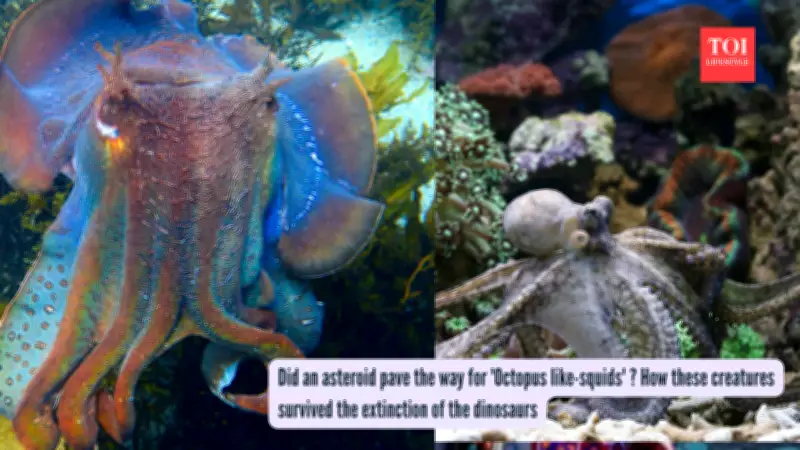
Most of us have encountered squids at a seafood restaurant or during an aquarium visit, but understanding their actual nature is an interesting and deep dive into marine biology. While they are often compared to octopuses, squids are fundamentally different, especially in their anatomy. Beyond the obvious physical traits that set these creatures apart, scientists have always been puzzled over the complex evolutionary history that led to the distinct groups we see today. By using advanced genomic data, researchers are finally beginning to understand how these remarkable marine predators branched off millions of years ago, adapting to global catastrophes to become the diverse, intelligent animals that now dominate our oceans.
These predators have not 8 but 10 tentacles instead!
While octopuses are known for their eight arms, squid and cuttlefish are classified as Decapodiforms, a Greek term for "ten-limbed." These creatures possess eight arms and two special tentacles used for grabbing prey. Despite their shared ten-limb anatomy, they belong to different scientific orders: Teuthida for squid and Sepiida for cuttlefish.
How are squids and cuttlefish different?
A major anatomical difference lies in their internal structures: squid have a feather-like, flexible "pen" that anchors their muscles for high-speed swimming, while cuttlefish feature a porous, internal cuttlebone used to regulate buoyancy. Their visual differences are equally interesting, with squid having round pupils compared to the W-shaped pupils of cuttlefish.

For many years they were considered nearly the same
For years, the evolutionary timing of these two groups remained a mystery. A recent study published in Nature Ecology & Evolution used genomic information to resolve these origins. According to lead author and molecular geneticist Gustavo Sanchez of the Okinawa Institute of Science and Technology, "Squid and cuttlefish are remarkable creatures, yet their evolution has been notoriously difficult to study… With our new genomic information, we have been able to resolve some of the mysteries surrounding their origins." The study suggests that squid and cuttlefish diverged approximately 100 million years ago during the Mid-Cretaceous period.
But how did these separate from each other and survive?
The survival of these lineages is linked to one of Earth's most significant extinction events. Sixty-six million years ago, when an asteroid caused the End-Cretaceous extinction that wiped out the dinosaurs, these cephalopods managed to survive by retreating into deep, oxygen-rich waters. As Sanchez explained, "The sea surface would have been a very harsh environment for cephalopods. Intense ocean acidification in shallower waters would also likely have degraded their shells." Following this mass extinction, the recovery of ocean ecosystems paved the way for an explosion in diversity. As coral reefs rebuilt and fish competitors disappeared, soft-bodied cephalopods moved into shallower waters, evolving unique adaptations like special camouflage and complex eyes. This rapid diversification allowed them to inhabit new niches, resulting in the variety of species observed today.