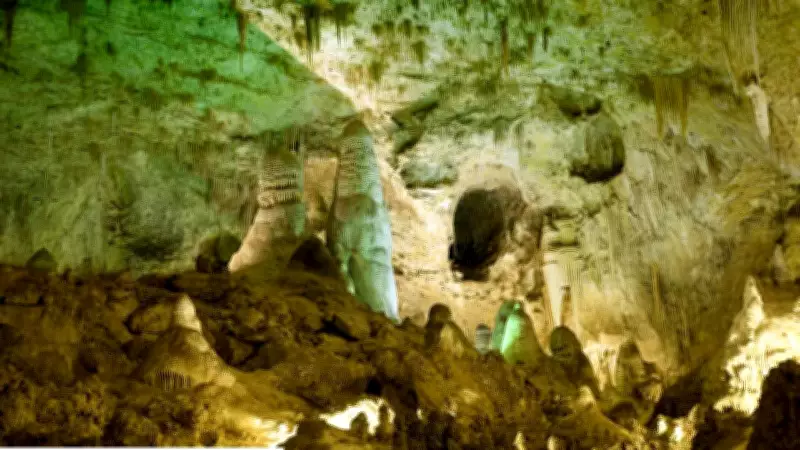
Glowing Green Microbes in New Mexico Caves Astonish Scientists
Deep within the caves of New Mexico, microbial communities have captivated researchers focused on extreme environments and the search for extraterrestrial life. In 2018, a scientific team exploring Carlsbad Caverns stumbled upon strange green colonies clinging to limestone walls, situated far from any natural light sources. Subsequent analysis confirmed these organisms as cyanobacteria, capable of conducting photosynthesis using near-infrared light, a groundbreaking discovery that challenges previous assumptions about life's survival in darkness.
Discovery of Photosynthetic Life in Pitch-Black Conditions
The finding occurred in an alcove that appeared completely black to the naked eye. When researchers illuminated the wall with a torch, a vibrant green layer became visible, starkly contrasting with the stone. Laboratory tests identified the growth as cyanobacteria, single-celled organisms typically associated with sunlit surface environments. What set this colony apart was its location: it resides well beyond the cave entrance, receiving no direct sunlight, yet remains active and stable, defying conventional biological limits.
Adaptation to Near-Infrared Light for Survival
Further investigation revealed that these microbes contain chlorophyll d and chlorophyll f, pigments enabling them to absorb near-infrared light, which lies beyond the visible spectrum for humans. This faint, scattered light reflects and diffuses minimally from limestone surfaces within the cave. The cyanobacteria utilize this limited energy to photosynthesize at record-low light levels, a process that, while not dramatic, is steady and sustainable, showcasing remarkable evolutionary adaptation.

Implications for Astrobiology and Extraterrestrial Search
The study, titled "Life in the dark: far-red absorbing cyanobacteria extend photic zones deep into terrestrial caves," has garnered significant interest from astrobiologists. By understanding the minimum light conditions required for photosynthesis, scientists can better define potential habitats for life elsewhere in the universe. If organisms can adapt to such restricted wavelengths, planets orbiting dimmer stars may become viable targets for exploration, reshaping telescope surveys and exoplanet atmosphere modeling.
Long-Term Evolution in Extreme Environments
Carlsbad Caverns provide a controlled setting with stable temperatures and minimal disturbance, allowing these cyanobacteria to adjust over millions of years—estimated at 4 to 9 million—to exploit scarce energy resources. This simple, quiet ecosystem offers insights into early adaptations, reminding us that life can persist in conditions once deemed too harsh. While not suggesting alien microbes lurk in darkness, it subtly expands the margins of where life might thrive, offering hope in the search for extraterrestrial existence.
Led by Hazel Barton of the University of Alabama and Lars Behrendt of Uppsala University, this research highlights how organisms modify themselves to survive with very low energy supplies in enclosed, low-light environments, with potential impacts on biology and astrobiology fields.