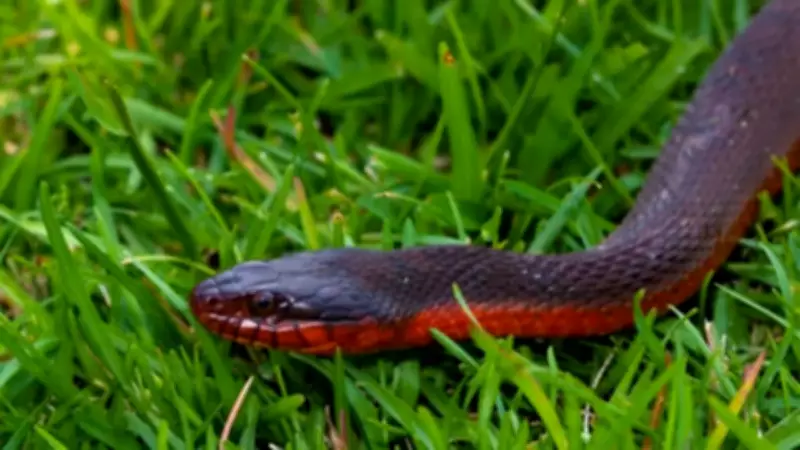
It is disturbing to see a snake in your backyard. In Australia, however, identifying the species is more important than reacting to it. The red-bellied black snake is among the most commonly encountered snakes on the east coast, especially in suburbs near bushlands or water bodies. The Australian Museum reports that it is not usually aggressive, but it is venomous and must never be approached. Knowing how to identify it early can influence your reaction.
Color and Appearance
At first glance, the snake appears entirely black. However, in good light, a sharp difference becomes visible. The belly and sides of the upper body are red or pinkish, contrasting with the glossy black back. This red is not clearly visible in certain lighting, leading to confusion with other black snakes. This color contrast is one of the most reliable identification features.
Body Structure
The red-bellied black snake is not thin and sharp but has a smooth, slightly bulky body. Its average body thickness is comparable to most other species. Its structure is heavier and more firm, unlike slim, fast-moving snakes. Its scales are smooth, giving it a shiny appearance, especially in sunlight.

Size and Habitat
The Queensland Government Department of Environment reports that adults can reach up to approximately 2 meters in length, though most are shorter. This species is not typically found in dry open areas but near water. It favors humid places such as creeks, wetlands, and water-feature gardens. It preys on frogs, so it is often spotted after rain or near garden ponds. If a black snake is observed in a dry, open yard far from water, it is less likely to be this species.
Behavior
A key behavioral characteristic is its response to humans. The red-bellied black snake is timid. Studies and field observations by Australian wildlife authorities indicate that it generally retreats when disturbed rather than charging. However, this should not be confused with safety. If handled or cornered, it will bite, and its venom requires medical attention.
Juvenile Identification
Young red-bellied black snakes are not as deeply colored. They can be light or brown, with less pronounced red on the sides. This often leads to misidentification with other species. Researchers recommend not attempting to distinguish juvenile snakes too closely because they are very similar.
Recognizing a red-bellied black snake does not require scrutinizing every detail but rather identifying key patterns, color contrast, body structure, and location. When in doubt, always assume the snake is potentially dangerous. Keep your distance and treat it with caution.