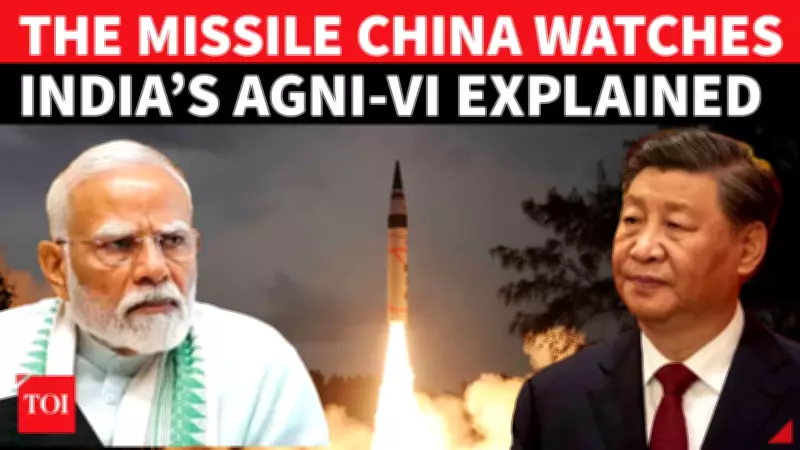
From Agni-I to the growing discussion around Agni-VI, India's missile programme reflects the country's transformation into a major strategic power. This explainer breaks down how ballistic missiles function, how India gradually expanded its strategic reach through the Agni series, and why reports of a possible 10,000-km-plus missile have triggered global attention.
Understanding Ballistic Missiles
Ballistic missiles follow a ballistic trajectory, launching into space and descending onto their target. They are categorized by range: short-range (less than 1,000 km), medium-range (1,000–3,000 km), intermediate-range (3,000–5,500 km), and intercontinental ballistic missiles (ICBMs, over 5,500 km). India's Agni series covers these categories, with Agni-V reaching ICBM status.
The Agni Series Evolution
India began the Integrated Guided Missile Development Programme (IGMDP) in 1983. Agni-I, first tested in 1989, had a range of 700 km. Agni-II (1999) extended to 2,000 km, followed by Agni-III (2006) at 3,000 km. Agni-IV (2011) reached 4,000 km, and Agni-V (2012) achieved 5,000 km, placing it in the ICBM category. Agni-VI, still under development, is expected to have a range of 8,000–10,000 km, making it a true ICBM.

Key Features of Agni-VI
- Range: Estimated 8,000–10,000 km, covering most of Europe, Asia, and parts of North America.
- Canisterisation: Allows storage in canisters for rapid launch from mobile platforms, enhancing survivability.
- MIRV Capability: May carry multiple independently targetable reentry vehicles (MIRVs) to defeat missile defenses.
- Advanced Propulsion: Likely uses solid-fuel motors for reliability and reduced launch preparation time.
The China Factor
China's nuclear arsenal and missile capabilities are a primary driver for India's missile development. China has deployed ICBMs like the DF-41 with ranges over 12,000 km. India's Agni-VI aims to counterbalance China's strategic reach, ensuring credible deterrence against any potential threat.
Survivable Deterrence
Survivability is crucial for a credible nuclear deterrent. Canisterised missiles on mobile launchers are harder to target, ensuring second-strike capability. India's development of rail-mobile and road-mobile systems for Agni-VI enhances survivability.
International Technology Restrictions
Despite decades of technology restrictions under the Missile Technology Control Regime (MTCR) and other export controls, India developed its missile programme indigenously. India's entry into the MTCR in 2016 eased access to some technologies, but the core development remains indigenous.
Global Attention
A 10,000-km ICBM would place India among a select group of nations—the US, Russia, China, France, and the UK—with such capabilities. This has triggered global attention, particularly from neighboring countries and major powers, who view it as a shift in regional and global strategic balance.
Conclusion
India's Agni missile journey from Agni-I to Agni-VI showcases its technological prowess and strategic ambition. While Agni-VI is not yet officially confirmed, its potential to become a 10,000-km ICBM underscores India's commitment to maintaining a credible, survivable nuclear deterrent in an evolving geopolitical landscape.