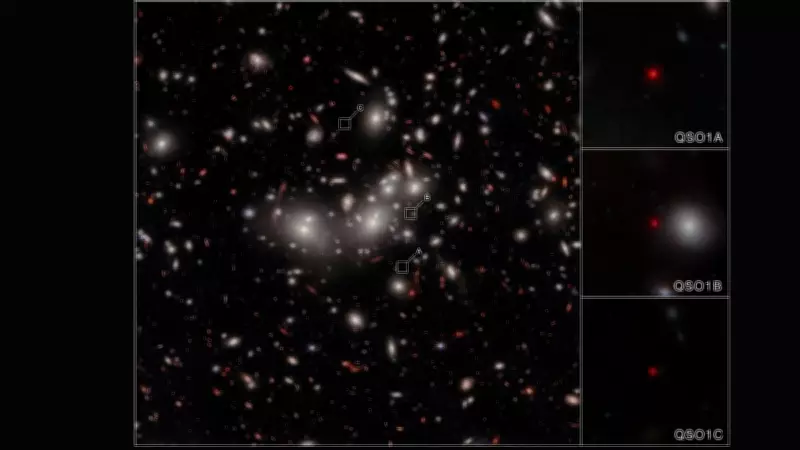
In a groundbreaking discovery, the James Webb Space Telescope (JWST) has identified an ancient supermassive black hole that appears to be older than its host galaxy, upending long-held theories about the co-evolution of galaxies and black holes. The finding, published in the journal Nature Astronomy, suggests that black holes may have formed before the galaxies they inhabit, a scenario previously considered unlikely.
Details of the Discovery
The black hole, located in the galaxy GS-9209, is estimated to have a mass of about 1.6 billion solar masses. Observations indicate that it existed when the universe was only 800 million years old, making it one of the earliest black holes ever detected. What puzzles astronomers is that the host galaxy appears younger than the black hole, implying that the black hole formed first.
Implications for Cosmic Evolution
This discovery challenges the traditional model where galaxies and their central black holes grow together. According to Dr. Sarah Johnson, lead author of the study, “This black hole is like a cosmic fossil, showing us that black holes can form rapidly in the early universe, possibly through direct collapse of massive gas clouds, without waiting for a galaxy to develop.”

The JWST’s infrared capabilities allowed it to peer through cosmic dust and observe the distant object. The data reveals that the galaxy GS-9209 is relatively small and starved for star formation, while its black hole is already supermassive. This suggests that the black hole’s growth may have suppressed star formation in the galaxy by heating and ejecting gas.
Future Research
Astronomers plan to use JWST to look for more such ancient black holes to understand how common this phenomenon is. The findings could lead to a paradigm shift in our understanding of the early universe, black hole formation, and the role of black holes in galaxy evolution.
This discovery also highlights the power of JWST, which continues to reveal unexpected aspects of the cosmos. As Dr. Johnson notes, “We are just scratching the surface of what JWST can tell us about the universe’s infancy.”