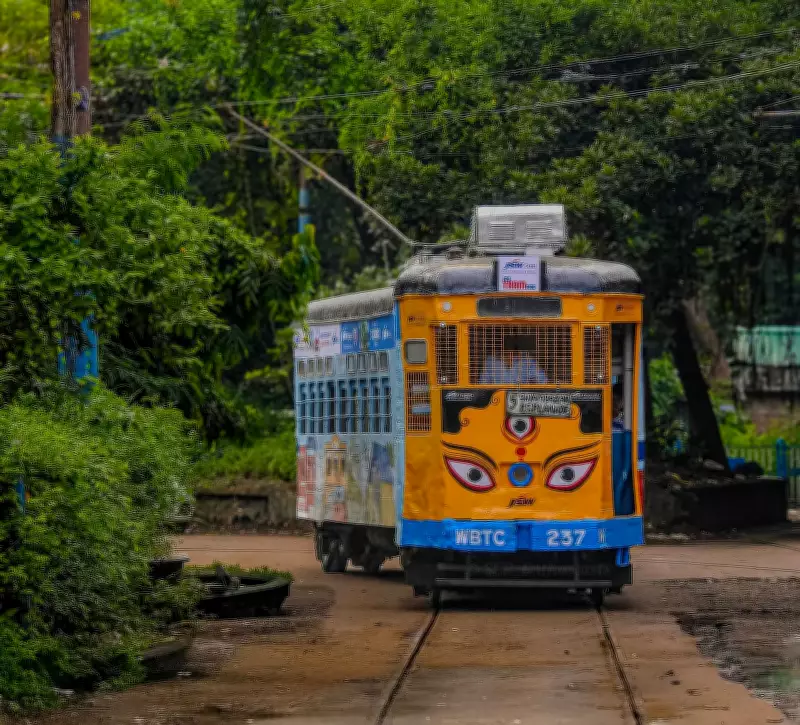
Kolkata's tram system has returned to the spotlight, driven by policy contradictions and growing public interest. Once dismissed as outdated, trams are now being reconsidered as a low-cost, sustainable option in a city grappling with congestion and fuel dependence. Following Prime Minister Narendra Modi's call to conserve fuel and rethink mobility, residents, planners, and transport advocates are revisiting trams not as nostalgia, but as a viable part of the city's transport mix.
Renewed interest in trams
Dr. Debasish Bhattacharyya of the Calcutta Tram Users Association notes a visible shift. People are discussing trams not merely as heritage, but as a sustainable and economical mode of transport. However, this renewed interest raises a key question: if trams still make sense, why have they nearly disappeared?
Years of shrinking routes and unclear policy
For those closely tracking the system, the answer lies in years of erosion. Sagnik Gupta, Joint Secretary of the Calcutta Tram Users Association, explains that the decline did not happen overnight. Since around 2011, routes were shut one after another, depots were repurposed, but no clear policy ever stated that trams would be completely shut down. Even after the Calcutta High Court intervened in 2021 and the state assured that trams would be retained in a limited, heritage form, activists say ground reality told a different story. By 2025, even that heritage stretch was being compromised. Infrastructure was altered, and bus stands came up where tram movement was supposed to continue, revealing the real intention. Gupta argues that the issue is not feasibility but intent. There is no real technical reason why trams cannot run in Kolkata today. The problem is not feasibility; it is intent.

Bhattacharyya echoes this, pushing back against the idea that trams are economically unviable. He emphasizes that they are not asking to preserve trams as nostalgia; they are saying trams make economic sense. When factoring in environmental savings, safety, and long-term sustainability, the return on investment is actually very high. That is the hidden truth. Administrative ambiguity continues to stall any revival. Different authorities keep denying responsibility, decisions are delayed, and projects are stopped midway, further damaging the system.
Can trams still work in a modern Kolkata?
On the ground, citizens and urban experts offer a mix of optimism and realism, not blind support, but conditional belief. Urban policy advocate Arghyadip Hatua states that trams are not just nostalgia pieces; they still make practical sense. However, revival cannot happen by only repainting tramcars. The city needs better walking spaces, as every tram journey begins and ends with walking. Hatua points to high-density corridors like Tollygunge–Ruby and transit hubs like Sealdah and BBD Bagh as logical routes. Instead of adding more cars and app cabs, trams can become proper urban connectors.
Residents agree that the problem is not the tram itself, but how it is integrated into the city. Bartik Saha recalls that earlier, trams were known to be very slow, pushing people away. But if there is a separate dedicated lane, not affected by traffic, speed and efficiency can improve significantly, like in many foreign cities. Entrepreneur Kunal Mandal frames the issue as one of urban priorities. The tram does not need more road; it already has tracks. What it needs is for the city to stop treating private cars as the default priority. That is a governance choice, not an engineering impossibility. He adds that the argument around congestion is often misplaced: the tram carries far more people per metre of road than a private car does. The real congestion comes from single-occupancy vehicles.

System under strain, but not beyond repair
Even as public interest grows, insiders warn that time is running out. During a recent visit to the Nonapukur tram workshop, members of the tram users' association pointed to visible gaps in maintenance and workforce capacity. Tamal Nanda notes that there are not enough spare parts anymore, and the skilled workforce is gradually disappearing. Over the next two to three years, most experienced staff will retire, creating a serious gap. Yet, he insists revival remains practical. A private car carries few people, while a tram can carry 80 to 100 passengers; the efficiency difference is huge. He also challenges the perception of slow speeds. A traditional tram runs at around 25 km/h, comparable to Kolkata's average traffic. The real problem is road management, including illegal parking, mixed traffic, and lack of enforcement.
Across voices, a common thread emerges: the system has not failed on its own; it has been allowed to weaken. Bhattacharyya warns that if action is not taken soon, the cost of revival will increase, not because trams are expensive, but because prolonged neglect will make restoration harder.
Sagnik Gupta remarks that for a long time, people saw trams as outdated because they were not aware of how cities across Europe and elsewhere have modernised and integrated them into efficient urban transport systems. Once you see how they function globally, you realise trams are not obsolete; they are simply underutilised here.
Why trams still make sense for Kolkata
- Fuel-independent mobility: Electric system reduces reliance on petrol and diesel.
- Affordable transport: Historically the cheapest way to travel across the city.
- High capacity, low space use: Moves more people per road space than private cars.
- Environmentally sustainable: Zero emissions at point of use.
- Safer commute: Lower accident rates and minimal crime.
- Existing ecosystem: Tracks, depots, and workshops still partly intact.
- Lower investment: Can be modernised at a fraction of large infrastructure costs.
Tamal Nanda, an electrical engineer, explains that many argue trams are too slow, a view he once shared. But after a lecture and discussions with experts, he realised that with average speeds of around 25 km/h, comparable to Kolkata's traffic, trams are not significantly slower. Modern systems are even faster, challenging the perception of inefficiency.
Kolkata tram network: Current status
Operational / partially functional
- Gariahat (South Kolkata): relatively more active, though services thin out during afternoons.
- Shyambazar (North Kolkata): sparse, irregular operations.
Nominal / non-operational stretch
- Esplanade – Maidan – Racecourse (heritage corridor): most visible central route, currently non-operational in parts, with missing overhead wires and covered tracks.
Non-functional / suspended routes
Infrastructure largely remains, but services discontinued:
- Belgachia – Rajabazar – Sealdah network (since 2018)
- Galiff Street depot – BBD Bagh corridor (via Aurobindo Sarani, Rabindra Sarani, Bowbazar, Amherst Street) (since July 2017)
- Kalighat – Kidderpore / Hazra – Mominpur (since 2018)
- Tollygunge – Ballygunge link (since Aug 2024)
- MG Road corridor (since July 2021)
- Bidhannagar (Ultadanga – Kankurgachi) (since May 2020)
- Kidderpore – Esplanade via Maidan (since May 2020)
- Behala – Joka stretch (since May 2011)
Overall
No formal blanket closure announced. Tracks and depot linkages largely intact. Network exists physically, but operations reduced to minimal, fragmented services.
Rajeeb Dutta, a painter and IT professional, states that trams do not fail cities; poor planning does. Trams are the lungs of Kolkata, eco-friendly, affordable, and non-polluting. In a world facing fuel uncertainty, they offer a reliable alternative. Sketching inside a moving tram reminded him why they deserve to stay.
There are approximately 250 tramcars in the system, but barely 10 are operational in shifts. Many more can be brought back if repaired. With the growing urgency around climate and congestion, Kolkata cannot afford to sideline trams. If modernised and integrated with metro and buses, they can move from being symbolic heritage to a genuinely useful transport system, says Preksha Lodha, a resident of Ballygunge.