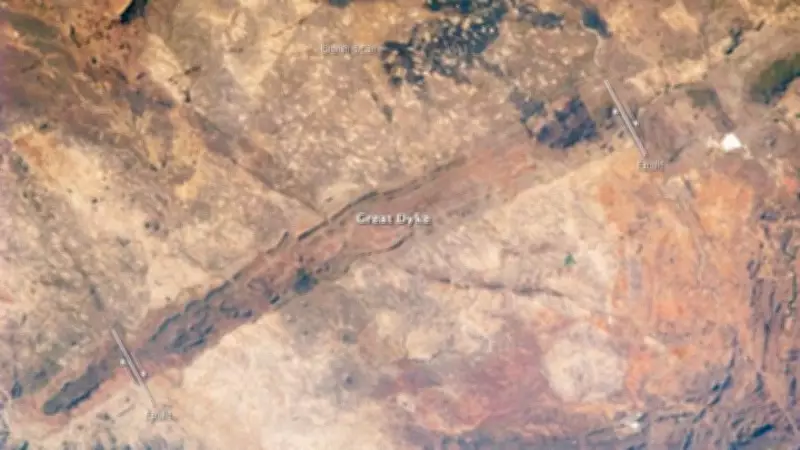
The 2.5-billion-year-old geological feature known as the Great Dyke of Zimbabwe has gained renewed attention following a comprehensive examination using satellite imaging and geophysics mapping supported by NASA. This massive igneous formation provides critical information about Earth's early geology, the formation of the Archaean crust, and ancient magma systems.
The Great Dyke of Zimbabwe: A Geological Archive of Deep Time
The Great Dyke is one of the world's most spectacular geological structures, forming an almost straight line over 500 kilometers long in Zimbabwe. It was formed during the Archaean Eon as a massive intrusion of magma that rose from deep within the Earth and cooled slowly beneath the surface over millions of years. This slow cooling allowed minerals to crystallize in distinct layers, creating a detailed record of geological history. Tectonic stability in the region has preserved the dyke for billions of years, and its layered structure reflects changes in the physical environment inside the Earth during that ancient era.
The Hidden 2.5-Billion-Year-Old Structure and Its Implications
Inside this formation, scientists have recently discovered an internal feature estimated to be around 2.5 billion years old. This hidden structure is not visible on the surface but exists as subtle variations in the dyke's inner composition. Researchers working with NASA-funded data believe it may be an ancient magmatic pipe or a magma chamber where molten rock cooled and chemically differentiated, forming distinct mineral layers. As noted in NASA's Earth Science programs, remote sensing and gravity data enable scientists to reveal subsurface heterogeneities related to early magmatic and tectonic events. The significance of this internal structure lies in its ability to reveal how magma behaved within the crust. Instead of being uniform, the dyke exhibits complex features indicating intense geological activity, such as repeated magma injections and subsequent chemical differentiation.

How Satellite Science Is Transforming Geological Discovery
Locating such a deeply hidden structure would have been nearly impossible using conventional field methods alone. Modern science relied on satellite-based technology, using data from multiple NASA-supported satellite missions. Satellites equipped with specialized instruments capture subtle changes in Earth's surface composition and temperature, revealing what lies beneath. By integrating satellite data with gravity and magnetic measurements, scientists generated a comprehensive view of the subsurface. Anomalies in these datasets led to the inference of a hidden structure inside the dyke. As stated in technical documents published by NASA, geophysical datasets integrated together offer an effective tool for unveiling hidden geological formations and their processes. This technique marks a new era in geology, where satellite technology complements traditional field studies.
Why This Discovery Reshapes Our Understanding of Early Earth
This finding has immense value for research on continental formation during early Earth. During the Archaean Eon, Earth's core generated higher heat flow, making the planet's surface more volatile. Features like the Great Dyke serve as geological chronicles of that time. The newly discovered structure points to greater complexity in magma systems than previously thought. Instead of uniform intrusions, evidence suggests multiple layers, changes in chemical composition, and interactions with both crust and mantle. This can refine theories about the formation of terrestrial planets. Additionally, the Great Dyke is renowned for its mineral deposits, including platinum group elements and chromium. Studying its inner features can aid mineral exploration. The exposure of a 2.5-billion-year-old structure hidden deep inside the Great Dyke demonstrates how advanced technology enables deeper insights into Earth's formation. By combining satellite imagery, geophysics, and geological knowledge, NASA-supported scientists are uncovering details that were previously unknowable. Such structures will continue to serve as key research areas for studying Earth's deep past.