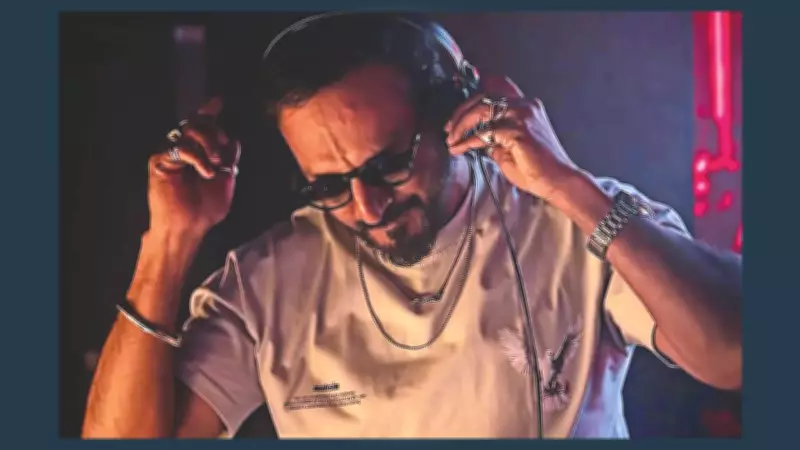
Nikhil Chinapa, a pioneering force in India's electronic music scene and a key figure behind major festivals like Sunburn and Supersonic, recently visited Lucknow for a festival appearance. In an exclusive interview, he shared his perspectives on artificial intelligence in music, explained why leadership intent determines the success of large events, and outlined his vision of repurposing public spaces such as airports into cultural centers.
AI and the Limits of Emotion in Music
“It’s going to get a lot worse before it gets better,” Chinapa remarked regarding AI's role in music and other creative fields. He believes AI struggles with emotion, which is central to music. “Music is precious and should not be reduced to monkeys on keyboards. Understanding music theory and having an innate sense of when to say ‘ooh’ or ‘ah’ is hard to quantify, and I’m unsure if AI can ever achieve that.” He illustrated this with everyday scenarios: “You’re a human who just won a gold medal at university—that’s a playlist. Your girlfriend of four years broke up with you—that’s a playlist. How can AI truly tap into that? AI cannot replicate emotion because emotion is transient, ductile, and constantly shifting. That will be difficult for AI to figure out.”
India’s Festival Scene: Untapped Potential
Despite the growth of music festivals across Indian cities, Chinapa, a co-founder of Sunburn and Supersonic, believes the scene is only scratching the surface. “Twenty years from now, we will still be just starting. That is the truth of India's potential.” He clarified that he refers specifically to the live music and festival market. “We have not even scratched the tip of the iceberg. The amount of headroom for growth is phenomenal.”

When discussing overbooking, crowd safety, and revenue-driven decisions in India's live music ecosystem, Chinapa reframed the issue as one of leadership rather than capability. “We have the infrastructure. We have the people who know how to run it. We have the technology.” The real gap, he argued, is intent. “Intent always starts at the top—in any organization, corporate, government, or non-profit. The problem is always at the top, never in the middle.”
He contrasted this with global touring setups: “When a show like Coldplay comes in, their core team oversees everything. The person in charge says, ‘No, I won’t let you do this; you must do it this way.’ Here, sometimes it becomes ‘Dekh lenge, ho jayega, kaam chala lenge.’” For him, the path forward is clear: “We need to take giant steps. We need more festivals, more curators, more brand involvement, more sponsorships, more experiences, more emphasis on culture and people, and less emphasis on spectacle.”
Reimagining Airports as Cultural Hubs
Alongside helping to scale a festival in Itanagar, Arunachal Pradesh, Chinapa is working on a project with Bengaluru Airport that reflects his broader vision for public spaces. “Airports in India have a lot of land, and with that land come parking, electricity, connectivity, and infrastructure. We’re exploring whether we can turn parts of those spaces into cultural hubs where artists can perform and curate experiences—spoken word, cinema, sculpture, poetry, immersive art, music, food, and retail.” The idea, he said, is to reimagine how public infrastructure can host culture. “We need to look at a space and ask what else can I do with this space.” For Chinapa, this is not just a passing idea but a lifelong mission. “I think before I die, it will happen in every airport in India. I will make it happen, or other people will, but it will happen.”
-Manas Mishra