On a winter evening in Delhi, chef Vidushi Sharma ordered truffle mac and cheese for her child at a premium cafe, with one request – to remove the truffle and get the plain version instead. “The menu said truffle mac and cheese for Rs 650. I didn’t even bother asking if it was a real truffle, because how could it be?” asks Vidushi, “Why would I put synthetic oil in my child’s system?”
Truffles, one of the world’s most expensive ingredients, have become commonplace on menus. When something that costs upwards of Rs 2 lakh a kilo appears casually on cafe menus with fries or pasta, it begs the question – what exactly are they serving? And unless you are dining at a luxury fine-dine restaurant, the answer is not truffle.
From Heston Blumenthal’s bougie truffle toastie to Gordon Ramsay’s truffle risotto with fresh truffle shavings – this expensive ingredient has become synonymous with luxury. Yet the scent that defines this ingredient for most diners has little to do with the fragile fungi dug out of European soil. It is, more often than not, a bottled simulacrum – a copy so convincing it risks replacing the original.

Truffle Oil Has Little in Common with Real Truffles
To most diners, truffle today means a powerful, gas-like aroma that hits the table before the plate lands. That smell typically comes from a single synthetic compound, 2,4-dithiapentane, blended into neutral oil and sold as truffle oil.
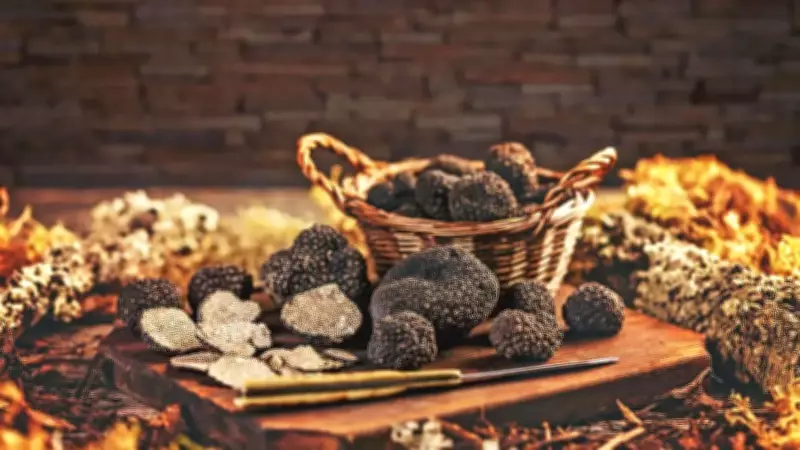
The real ingredient is far more elusive. Fresh truffles, whether the prized white ones from Italy or the French black truffles, derive their aroma from a complex interplay of compounds that shift with heat, fat and time. Their scent is earthy, fleeting, and often surprisingly subtle.
“Truffle oil has little in common with real truffles,” says chef Manish Mehrotra, arguing that diners raised on this harsh, linear aroma have been taught the wrong benchmark for what truffles smell like. He adds that once the copy becomes the benchmark, the original can feel too quiet to register as luxury.
“At one end, diners are paying ₹200 per gram for fresh truffles. At the other, ₹600 buys truffle fries scented with synthetic oil. Those two worlds rarely overlap,” says chef Vidushi Sharma.
How the Fake Became Familiar
Globally, the truffle oil backlash is at least two decades old. In a 2007 The New York Times article, chef Daniel Patterson admitted he had used truffle oil for years before realising it was largely synthetic, after which he discarded it.
Since then, chefs from Gordon Ramsay to Anthony Bourdain have dismissed truffle oil as “fake” or “a fraud”. Yet it quietly found its place in kitchens worldwide as an easy way to add a gloss of glamour.
It solved a problem. Real truffles are seasonal, expensive and perishable. Truffle oil, on the other hand, is stable, affordable, and instantly transformative. A drizzle can turn fries into a premium dish, a pizza into a menu upgrade.
“Once you realise that most of what people love about truffle is its aroma, you can recreate that in a lab and fool a lot of people,” says Sumit, founder of gourmet mushroom brand Shroomery. “For a long time, neither chefs nor consumers knew; even now, many don’t care. As long as the customer likes it, the chef will give them what they want.”
Easy Availability Has Distanced Diners from the Real Product
India arrived late to the global truffle boom, but quickly caught up. In the early 2000s, when chef Ritu Dalmia first introduced truffles on her menu, diners were wary. One sent back a dish for being “too stinky.” Today, cities host truffle festivals, and cafés routinely serve ‘truffle’ fries. In Delhi and Mumbai, young diners may be more familiar with the scent of truffle oil than with ghee.
“Diners have been trained to recognise the fake as the real thing. The louder the aroma, the less likely it is to be real,” says chef Manish Mehrotra.
“Earlier, truffles were only in fine-dining restaurants,” says Mehrotra. “Now you go to any café in a mall, and they are serving truffle fries or pizza.”

Delhi-based Rohit Singh, founder of The Truffle Man, says the easy availability of ‘truffle fries’ has distanced diners from the real product. “In 2017, restaurants sold truffle pizza at ₹3,000–4,000. After Covid, people started using Chinese truffles and cheaper oils. Guests don’t know what they’re eating; they’re just showing off that they’re eating truffle pizza,” he adds.
The Business of Bottling Luxury
On paper, truffles tick every luxury box: limited supply, high price, complex sourcing, insider knowledge. In practice, those very qualities have created a thriving grey market.
Fresh Italian white truffles can cost ₹3.5–4 lakh a kilo by the time they reach India. They are fragile, highly perishable, and require careful handling. For most restaurants, using them regularly is impractical.
By contrast, cultivated Chinese black truffles can be bought at $100–120 (₹10,000-11,000 approx) per kilo and resold into the Indian market at $800–900 (₹75,000-85,000 approx). “People buy from China, do the Italian labelling, and sell truffle sauce in India at prices that are impossible if it had real Italian truffle,” says Rohit.
Even on the oil side, he argues, “Back in 2017, a bottle of real truffle oil was ₹2,000. Today, with higher duties and freight, prices should be higher, not lower. If they are cheaper, something is wrong.”
In other words, when a luxury ingredient becomes cheaper over time despite rising costs, it is usually the quality – not the supply chain – that has been compromised.
Chinese Truffles and the Grey Zone of ‘Real’
If synthetic oil represents one level of imitation, Chinese truffles occupy a more ambiguous space. Botanically, they are real truffles. But culinarily, they are often considered inferior – milder in aroma, less complex in flavour. In global markets, they are frequently used as fillers or enhanced with synthetic compounds to mimic their European counterparts.
“Chinese truffles are cultivated, then enhanced with synthetic aroma to make them smell stronger, and sold in five-star hotels. Guests don’t know what they are eating,” says Rohit Singh.
It’s not just China. Spain has emerged as the world’s largest producer of black truffles, with cultivation techniques now spreading from the US to Australia and Sweden. Unlike lower-grade Chinese substitutes, these farmed truffles are widely accepted as high-quality and are used in fine-dining kitchens globally. Their quality, French truffle broker Eric Bienvenu told The New York Times, is “at least as good” as those grown in France.
Teaching the Palate Again
If the copy has become the default, can the original ever reclaim its place? Mehrotra believes the pendulum is swinging back, at least in serious kitchens. “That phase (of chefs using truffle oil) is passé. Good restaurants are not using it anymore.”
Sharma sees synthetic truffles as a phase, not a permanent fixture. “When something is only being consumed for its perceived premium value, there has to be a point where people get done with it,” she says.
In the meantime, she and other chefs are quietly rewriting the rules of engagement. She sources small pieces of real truffle in winter, shaves them over pizzas she bakes at home and avoids ordering suspiciously cheap “truffle” dishes when eating out.
Mehrotra is clear that if a restaurant is using fresh truffles, they will shave them in front of the guest, often weighing them before and after to show exactly how much went on the plate. “The key to cooking with truffles is that the truffle has to be king of the dish,” truffle hunter Višnja Prodan told the BBC in 2018. “No other flavours should overwhelm it.”
Rohit teaches clients simple storage rituals – wrapping each truffle in tissue, changing it daily, using glass jars in the fridge – to preserve aroma for up to two weeks, while warning them that beyond that, quality drops sharply.