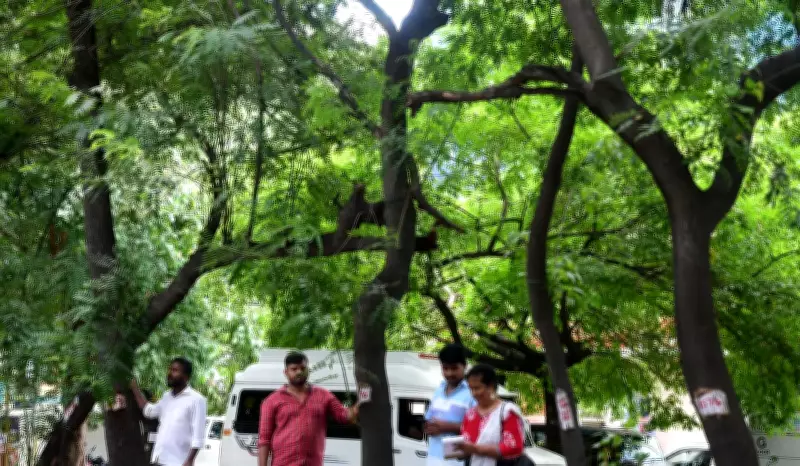
On the busy JP Nagar ring road in Bengaluru, motorists zip past a green median lined with mature trees. Their branches sway above the traffic, offering shade on scorching afternoons and softening an otherwise concrete landscape. Most commuters barely notice them. Fewer still know the story behind them.
Nearly 18 years ago, when this stretch was little more than a sun-baked median, two young men made a promise that would eventually transform it into one of south Bengaluru's greenest corridors. They were not environmentalists by profession, nor were they backed by a government programme or corporate funding. They were simply two friends from engineering college in their mid-20s — Ajit Vishwanath and Abhilash Narasimhamurthy — who decided that if Bengaluru needed more trees, someone had to ensure the saplings survived. That decision would cost them two years of Sunday mornings.
Around 2008, the duo approached Reforest India, a volunteer-driven organisation that plants and nurtures trees across the city, with a proposal to green the median along JP Nagar ring road. The stretch was then largely barren and exposed to the harsh sun. “We realised that people travelling on the road were suffering because there was hardly any shade,” recalled Ajit. “Planting trees seemed like the simplest way of making a lasting difference.” Reforest India agreed to plant the saplings only after receiving an assurance they would be looked after by Ajit and Abhilash.

Abhilash, recalling his experience, said, “I did not have a great interest in this initially, but all thanks to Ajit, who pushed me into joining the initiative. I simply joined hands with him. Today, when I show those trees to my children, it feels very nice.”
The first plantation drive was taken up on November 1, 2008, when 236 saplings were planted along a 2km stretch from what is now Vega City Mall to the JP Nagar underpass. As the results were encouraging, another 232 saplings were planted in 2009 across two 1km stretches connecting JP Nagar Social, Kanakapura Road, and the underpass. The plantation included species such as Hoovarasi, Mahogany, Peltoform, Indian Almond, Parkia, Shivni, Seeme Hunse (Kodukapuli), Akash Mallige, and Simarouba glauca, a medicinal species also known as Laxmi Tharu.
Every Sunday, the two friends would meet at dawn. A water tanker would arrive, and together they would spend hours moving slowly along the median, watering hundreds of saplings one by one. One controlled the tanker valve while the other dragged a heavy four-inch hose across the stretch. They alternated roles, repeating the process week after week. The work was physically demanding, but they did it.
Eventually, both started working. As water tankers were expensive, the duo dipped into their salaries and persuaded friends to contribute whenever funds ran short. “If someone had a birthday, we'd jokingly ask them to sponsor half a tanker,” Ajit said. “But one thing was certain. The watering would never stop.” Some saplings were lost along the way. Cattle uprooted a few. Others were damaged by passers-by. A handful simply failed to survive. The volunteers replaced them and carried on. The commitment lasted nearly two years — long enough for the young trees to develop roots deep enough to survive on their own.
Today, the results speak for themselves. After 18 years, Reforest India revisited the spot — one of its earliest large-scale plantation projects — on Thursday. Reforest India founder Janet SK Yagneswaran, along with volunteers Jefford Wilson and Nagraj, physically counted the trees and found that of the 500 saplings originally planted, 468 continue to survive, giving the initiative a remarkable survival rate of 93.6%. For Janet, the numbers tell a story of commitment rather than plantation. “What matters is whether the saplings survive. These trees are standing today because volunteers treated them as a long-term responsibility and not a one-day event,” she said.