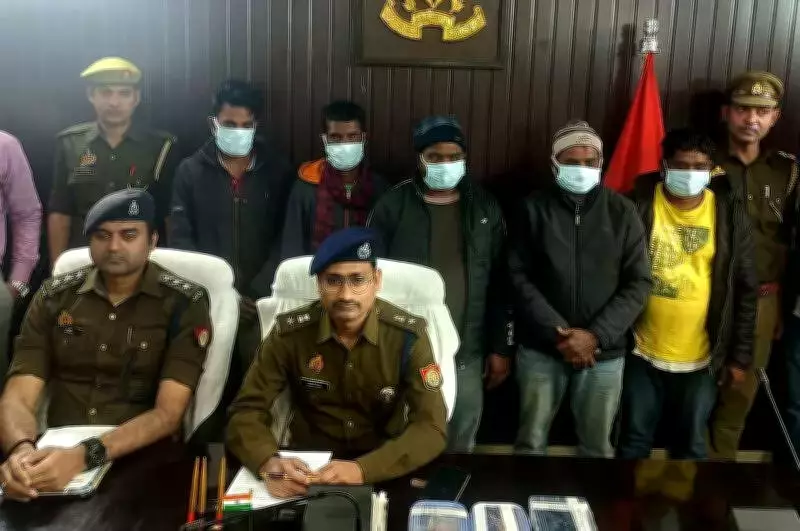
Varanasi Police Crack Down on Cyber Fraud Network, Arrest Five from Jharkhand
In a significant breakthrough, the Varanasi police on Wednesday apprehended five cyber criminals, including the gang leader, from Dhanbad in Jharkhand. The arrests are linked to a sophisticated cyber fraud case involving a staggering sum of Rs 42.50 lakh. The accused allegedly executed the scam by deploying Trojan and SMS forwarder-based APK files to compromise victims' devices.
Complaint and Legal Action Initiated
The case came to light when Madan Mohan Mishra, a resident of Tiwaripur village under the Chaubepur police station, filed a formal complaint at the cyber crime police station on December 8, 2025. Mishra reported that cyber criminals had illicitly accessed his bank account and siphoned off Rs 42.50 lakh. Acting swiftly on the complaint, the police registered a case under Section 318(4) of the Bharatiya Nyaya Sanhita (BNS) and Section 66D of the Information Technology Act at the cyber crime police station.
Subsequently, additional sections—61(2), 317(2), 338, 336(3), and 340(2) of the BNS—were incorporated at the local police station to strengthen the legal framework against the perpetrators. The investigation is being spearheaded by Station House Officer (SHO) Udaybeer Singh, who is overseeing the meticulous probe into the financial cybercrime.

Investigation and Arrests
A special police team was constituted to unravel the complexities of the case. Leveraging advanced electronic surveillance techniques and in-depth analysis of digital footprints, the authorities successfully tracked down and arrested the five accused from Dhanbad. The individuals have been identified as Shamim Ansari, Fakruddin alias Niranjan, Naseem Ansari, Shahbuddin Ansari, and Sahab Lal Marandi, all hailing from Dhanbad district.
During the operation, law enforcement officials recovered a substantial cache of evidence from the suspects' possession. This included four Android mobile phones, a SIM card, two notices issued under Section 41A of the Code of Criminal Procedure (CrPC) by the Delhi Police, a village head's official seal, five blank Aadhaar update forms, a four-wheeler vehicle lacking a registration number, and Rs 66,000 in cash.
Modus Operandi Unveiled
Upon interrogation, the accused disclosed their elaborate modus operandi to the police. They confessed to sending malicious Trojan and SMS forwarder-based APK files to unsuspecting victims, which granted them unauthorized access to the victims' mobile phones. Through this illicit access, the criminals allegedly harvested sensitive information such as internet banking user IDs, passwords, and one-time passwords (OTPs).
The stolen credentials were then used to transfer funds to mule bank accounts, from which cash was subsequently withdrawn, effectively laundering the illicit proceeds. This method highlights the gang's sophisticated approach to exploiting digital vulnerabilities for financial gain.
Forgery and Document Manipulation
Further investigations revealed that the gang employed a range of fraudulent tactics to facilitate their crimes. They utilized forged village head letterheads, seals, and Aadhaar update forms to illegally alter address details on Aadhaar cards. These manipulated Aadhaar documents were then used to open bank accounts across various financial institutions.
These fraudulently opened accounts served as conduits for committing cyber fraud, enabling the gang to layer their illicit transactions and obscure the money trail. The recovery of blank Aadhaar forms and official seals underscores the gang's preparedness for identity theft and document forgery on a significant scale.
The Varanasi police's successful operation not only led to the arrest of key suspects but also exposed a well-organized cybercrime network with ties to document forgery. The case continues to be under active investigation as authorities work to uncover any additional accomplices or linked fraudulent activities.