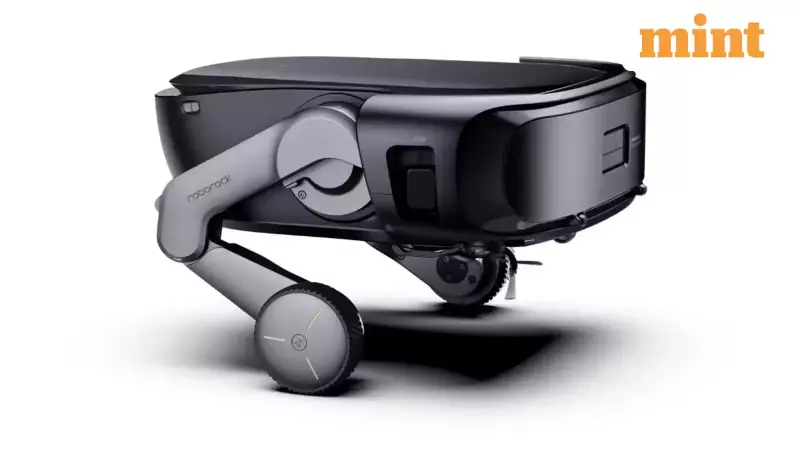
For years, the promise of a fully autonomous home clean has been tripped up by a surprisingly humble obstacle: the raised doorway or transition strip. While robot vacuum specs have soared, their real-world performance often falters at these small bumps, leaving users to perform mid-clean rescues. Roborock, a leading name in smart home cleaning, has unveiled a potential solution at CES 2026 with its Saros 20 and Saros 20 Sonic models, built around a clever mechanical fix designed for the realities of Indian homes.
The Doorway Dilemma: Why Robot Vacuums Get Stuck
The core problem is universal. Most homes feature at least one problematic transition—a slightly raised door lip, an old flooring strip, or a thick rug edge. These are obstacles humans step over without a thought, but for a robot vacuum, they can be insurmountable walls. The result is a fragmented cleaning cycle where the device gives up, sends an alert, and leaves entire rooms untouched. This transforms the advertised "whole home clean" into a frustrating experience of partial coverage.
Roborock's new Saros 20 series directly targets this fundamental flaw. The company has shifted focus from just increasing suction power or AI detection to improving basic mobility. The central innovation is the AdaptiLift Chassis 3.0, a system that allows the robot to physically raise its body to climb over obstacles rather than treating them as barriers to avoid.

AdaptiLift Chassis 3.0: The Technical Edge
This is not about stair climbing, but a practical elevation mechanism for daily use. Roborock claims the new chassis enables the Saros 20 to clear significant thresholds. The specifications are precise: total clearance of up to 3.3 inches, capable of handling double-layer thresholds up to 1.7 inches, with a per-step capability of 1.57 inches.
The benefits of this lift system extend beyond doorways. It is also engineered to adapt to different floor surfaces, particularly carpets. The chassis can adjust its ride height to handle carpet pile up to 1.2 inches thick. On mixed flooring common in Indian households, this should prevent the robot from slowing down, dragging, or avoiding carpeted areas altogether, especially when its mopping function is engaged.
If it performs as promised, the user experience simplifies dramatically: fewer interruptions, fewer manual rescues, and more rooms cleaned in a single, uninterrupted run.
Saros 20 vs. Saros 20 Sonic: The Mopping Divide
While both models share the adaptive chassis, they diverge on wet cleaning capabilities. The standard Saros 20 will handle vacuuming with this new mobility. However, for consumers prioritizing mopping, the Saros 20 Sonic is the standout model.
It is equipped with Roborock's VibraRise 5.0 sonic mop, which features an extendable mop design intended to clean right up to baseboards and edges—a traditional weak spot for robot mops. The accompanying app will offer controls to customize water flow and mop vibration intensity for different floor types, aiming for a more complete and tailored wet clean.
Announced at CES 2026 by tech writer Kanja Budhiraja on January 7, 2026, the Saros 20 line represents a pragmatic turn in robot vacuum development. However, key details remain pending. Roborock has confirmed the models will launch later in the year, but official pricing is not yet announced.
Furthermore, as a mechanical system, the long-term reliability of the lift mechanism will be crucial. Its performance after months of accumulating dust, hair, and repeated crossings over Indian home thresholds will be the ultimate test. For anyone whose current robot vacuum is perpetually stranded by a single annoying doorway, the Roborock Saros 20 series appears to be an upgrade finally designed for real-world obstacles, not just spec sheet victories.