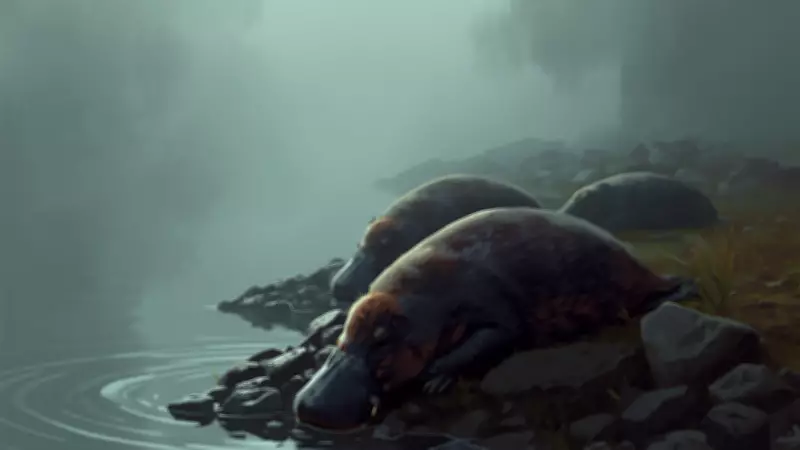
Fossil records dating back 25 million years that show evidence of platypuses, including those classified under Obdurodon insignis, have significantly changed scientists’ perception about the evolutionary process, ancient animals, and predatory behaviours.
Evolution of Platypus Fossils and Monotreme Diversity
The platypus is one of the few mammals that lay eggs, belonging to a very rare class called monotremes, dating back 100 million years. Studies have found that there were many types of platypus ancestors in the past, making the living platypus a relatively rare member of its family. According to a study published in the Journal of Mammalogy, the contemporary platypus (Ornithorhynchus anatinus) “is one of the most evolutionarily unique mammals in the world.” Nevertheless, extinct relatives like the Obdurodon species have some significant distinctions. Unlike the present platypus that lacks functional teeth after reaching adulthood, the extinct platypuses had fully functional teeth until old age. An analysis in Science Advances found that fossils from the platypus exhibit different cranial and dental features correlated with foraging behaviours, suggesting the evolution from toothed predators to suction feeders.
Crushing Bite Force and Predatory Behaviour
One of the most amazing discoveries from these fossilised creatures is how exceptionally strong the bite of ancient platypuses was. The molars of the fossils had intricate cusp designs used not just for grinding but also for crushing. As explained by the research published in the Journal of Zoology, extinct platypuses like the Obdurodon tharalkooschild had teeth adapted to “transversely masticate” their food. Other paleontological reconstructions also reveal that these extinct platypuses were able to hunt and kill crustaceans, shellfish, and even smaller vertebrates, which they probably crushed with their robust jaws. According to one study mentioned in National Geographic, there were giant toothed platypuses that preyed on lungfish and other small aquatic reptiles. Unlike today's platypuses, their contemporary counterparts use electroreception to find and eat soft invertebrates from the river bed.

Why Modern Platypuses Lost Their Teeth
Teeth loss in modern-day platypus presents a significant evolutionary problem. As per the theory of evolution, there were several things, such as dietary change and environmental change, that played an important role in making them lose teeth. In terms of adaptation in response to changes in the environment, they evolved into creatures capable of eating soft foods without a bulky jaw structure. As a result of natural selection, today’s platypus is characterised by a lightweight skull and specific modes of feeding, such as electroreception and suction feeding. With all these features, the platypus adjusted itself in muddy water habitats where detecting food became a priority over consuming it.
What These Fossils Reveal About Prehistoric Ecosystems
The mere existence of such strong predators among the monotremes suggests that prehistoric freshwater environments were much more complicated than previously imagined. Prehistoric platypuses must have faced competition from other organisms, as they had similar ecological niches to contemporary otters and small crocodiles. Also, these findings refute the notion that monotremes remained simplistic and static throughout history. Instead, it shows that platypuses evolved adaptively, diversely, and innovatively, developing some traits which were eventually rendered obsolete. Overall, while the emergence of platypus fossils dating back to 25 million years ago serves as a breakthrough in understanding the evolutionary development of platypuses, it also highlights the evolutionary complexity of mammals in general, whereby even the most peculiar species of mammals experienced drastic modifications through the course of history.