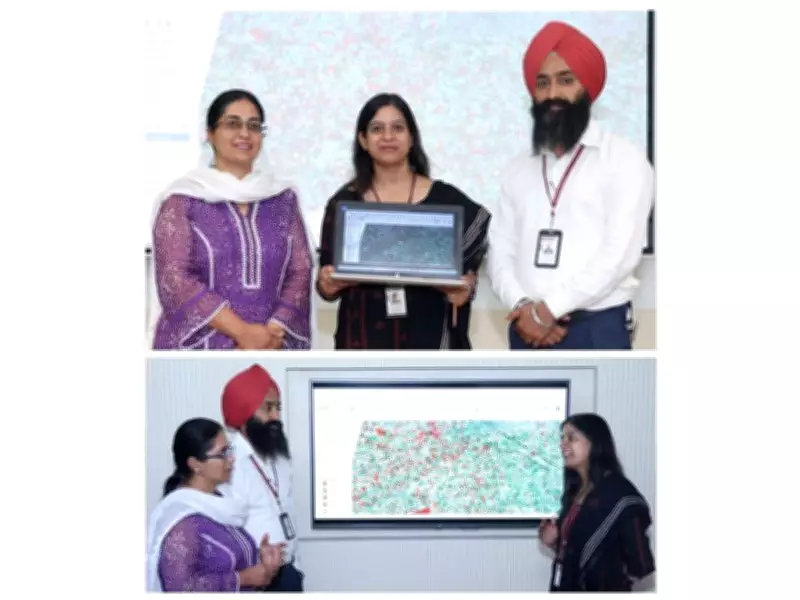
Researchers at Chandigarh University have developed an Artificial Intelligence (AI)-powered Transformer Model capable of accurately predicting crop yields using satellite imagery, climate data, and historical agricultural records. This innovation aims to empower farmers, policymakers, and agricultural agencies to make informed decisions, strengthen food security, and advance resilient farm management.
Research Details and Methodology
The research was led by Kusum Lata, Assistant Professor in the Department of Computer Science Engineering, along with Dr. Navneet Kaur, Professor in the same department, and Dr. Simrandeep Singh, Professor from the University Centre of Research and Development. The study focused on improving crop yield forecasting in Punjab's agricultural heartland. It was presented at the 2026 International Conference on Signal Processing and Electronics Design (ICSPED) at Chandigarh College of Engineering and Technology.
The model utilizes data from Sentinel-1 and Sentinel-2 satellites, operated by the European Space Agency (ESA), to monitor agricultural fields continuously. These observations are combined with climatic variables such as rainfall, temperature, and soil moisture, along with historical crop production records, creating a comprehensive picture of crop performance throughout the growing season.

Model Performance and Efficiency
The transformer model was evaluated on four major crops cultivated in Ludhiana district—paddy, maize, moong, and sugarcane—using data collected between 2019 and 2023. Experimental results showed that the transformer model outperformed widely used approaches such as Random Forest and Long Short-Term Memory (LSTM) models, indicating stronger agreement between predicted and actual yields. The framework also recorded lower prediction errors and improved computational efficiency.
According to Kusum Lata, “Unlike conventional machine learning models, the newly developed lightweight transformer can identify critical crop growth stages and learn complex temporal patterns that influence final yields. We have designed the model to deliver high predictive performance that require fewer computational resources, making it suitable for practical deployment in large-scale agricultural monitoring systems.”
The lightweight architecture requires nearly 40 percent fewer parameters than conventional transformer models while delivering faster and accurate predictions. This efficiency makes it suitable for near real-time agricultural applications, including regional crop monitoring, production forecasting, and early warning systems.
Implications for Agriculture
Accurate crop yield prediction has become increasingly important as farmers face growing challenges from climate variability, changing weather patterns, and rising food demand. Traditional field surveys are often time-consuming, labor-intensive, and limited in scale. The Chandigarh University researchers overcame these limitations by integrating advanced AI techniques with real-time Earth observation data.
Reliable forecasts can support agricultural planning, optimize resource allocation, strengthen crop insurance mechanisms, and improve market management strategies. In a state like Punjab, where agriculture plays a central role in the economy, such technologies can contribute to more resilient and sustainable farming systems.
Future Developments
The researchers shared that one of the key strengths of the model lies in its ability to combine multiple sources of information into a single predictive model. By integrating satellite-derived observations with climatic and historical datasets, the system captures the complex interactions that influence crop productivity and provides a more robust understanding of agricultural outcomes.
Future developments will focus on enabling near real-time forecasting through cloud-based platforms, paving the way for broader adoption of AI-driven decision support systems in agriculture, added the Chandigarh University researchers.

About Chandigarh University
Chandigarh University is a NAAC A+ Grade University and QS World Ranked University. This autonomous educational institution is approved by UGC and is located near Chandigarh in Punjab. It is the youngest university in India and the only private university in Punjab to be honored with A+ Grade by NAAC. CU offers more than 109 UG and PG programs in fields including engineering, management, pharmacy, law, architecture, journalism, animation, hotel management, and commerce. It has been awarded as The University with Best Placements by WCRC.