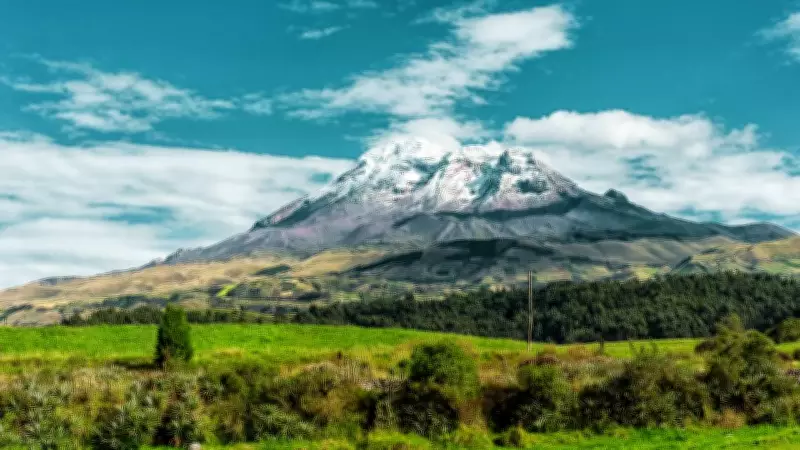
When thinking about the most elevated point on Earth, Mount Everest immediately comes to mind. Standing at 8,848.86 metres above sea level, it has long held the title of the world's tallest mountain. However, another mountain is even closer to outer space than Everest: the magnificent stratovolcano Chimborazo in Ecuador.
An Unusual Geographical Phenomenon
At first glance, this might sound like an internet myth designed to attract attention. How could a mountain nearly 2,500 metres shorter than Everest be farther from the centre of the Earth? The answer lies in the fact that Earth is not a perfect sphere.
Chimborazo stands at approximately 6,263 metres above sea level. While it cannot rival Everest in altitude, its summit is the farthest point from the planet's centre. This oddity has puzzled scientists and travel enthusiasts for decades, serving as a reminder that our planet holds many surprises.

Earth's Oblate Spheroid Shape
As children, we learn that Earth is a spherical ball. In reality, it is an "oblate spheroid," flattened at the poles and bulging at the equator due to its rotation. The equatorial diameter is 43 kilometres longer than the pole-to-pole diameter. This difference significantly affects measurements from Earth's centre.
Places on the equator start from a point farther from Earth's centre compared to other locations. This is where Chimborazo comes into play.
Why Chimborazo Beats Everest
Chimborazo sits almost directly on the equator, at about one degree south latitude, while Everest lies much farther north at around 28 degrees latitude. Because Chimborazo stands on the equatorial bulge, its summit has a hidden advantage.
Measured above sea level, the comparison is straightforward:
- Mount Everest: 8,848.86 metres
- Chimborazo: approximately 6,263 metres
Everest clearly wins. However, when measuring from Earth's centre, the rankings change dramatically. Chimborazo's summit sits about 6,384.4 kilometres from Earth's centre, while Everest sits at around 6,382.3 kilometres. That means Chimborazo extends roughly 2.1 kilometres farther from Earth's centre than Everest. In other words, Chimborazo reaches farther outward into space even though Everest rises higher above sea level.
This distinction often leads to the popular statement that Chimborazo is "closer to outer space." While catchy, scientists phrase it more precisely: Chimborazo is the farthest point on Earth's surface from the planet's centre.
Does This Mean Chimborazo Is Higher?
No. Everest remains the undisputed tallest mountain above sea level. Sea level is the universal reference for measuring mountain height. Chimborazo only wins using a different calculation method. Imagine two buildings on uneven ground: one may be taller from the road, but the other's roof is farther from Earth's centre. The mountain itself hasn't changed; only the reference point has.
A Destination Where Geography Becomes Extraordinary
Beyond the scientific aspect, Chimborazo is one of South America's most spectacular geographical features. Located in the Andean region of Ecuador, this dormant volcano is a prominent landmark surrounded by snowy peaks and picturesque scenery. It is part of the Chimborazo Fauna Reserve and attracts hikers, mountaineers, and geology enthusiasts.
Tourists have a rare opportunity to visit a place with one of the most unusual geographical facts. People often travel to destinations with superlative records—the highest mountain, largest desert, deepest gorge, or tallest waterfall. Chimborazo is one of those places, though few know about this fascinating fact.