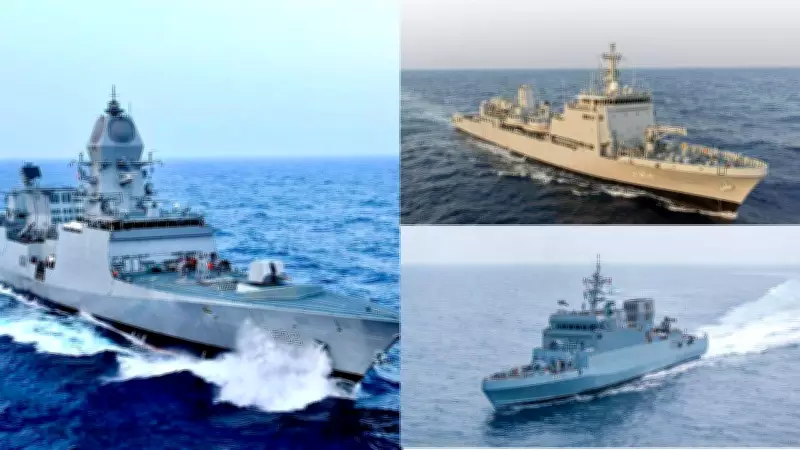
Three Vessels, One Network
When Prime Minister Narendra Modi commissioned INS Dunagiri, INS Sanshodhak and INS Agray in Kolkata on June 21, the event appeared to be another addition to the Indian Navy's growing fleet. But taken together, the three vessels reveal something larger: the Navy is building an integrated maritime warfare network rather than merely adding more ships.
Each vessel performs a distinct role. One gathers information, another hunts submarines and the third protects the battlespace. Combined, they create a layered maritime picture that gives commanders greater awareness and combat capability across the Indian Ocean.
The Ship That Maps the Battlefield
Every military operation begins with information. At sea, that information starts beneath the waves. INS Sanshodhak, the Navy's newest Survey Vessel (Large), is designed to map the seabed, study ocean conditions and collect hydrographic data. While it lacks the missiles and guns associated with frontline warships, it performs a task that is increasingly important in modern naval warfare.

Detailed seabed maps help navies understand underwater terrain, identify submarine operating areas and chart safe routes for warships. They also assist in monitoring critical undersea infrastructure such as communication cables and energy assets. In effect, Sanshodhak creates the underwater picture on which future naval operations depend.
The Submarine Hunter
Once an area has been mapped and understood, it must be monitored. That is where INS Agray enters the picture. The Anti-Submarine Warfare Shallow Water Craft is designed to detect, track and engage enemy submarines operating close to India's coastline and strategic maritime approaches. Modern submarines are among the most difficult military platforms to locate. Their ability to remain hidden makes them a major threat to warships, ports and sea lanes.
Using specialised sonars, underwater sensors and anti-submarine weapons, Agray serves as the Navy's underwater watchdog. It patrols areas of interest, searches for hostile submarines and helps deny adversaries the ability to operate undetected.
The Shield and Sword
Information and surveillance alone are not enough. Any maritime network ultimately requires a platform capable of defending it and striking threats at long range. That role falls to INS Dunagiri, a Project 17A stealth guided missile frigate. Equipped with advanced sensors, air-defence systems, anti-ship missiles, torpedoes and helicopter facilities, Dunagiri is designed to fight across all domains of naval warfare. It can engage aircraft, missiles, surface combatants and submarines while operating far from India's shores.
If Sanshodhak provides the data and Agray identifies underwater threats, Dunagiri acts as the fleet's shield and sword, protecting the maritime battlespace and delivering combat power when required.
As PNS Hangor Expands Reach, INS Agray's Role Grows
The commissioning of INS Agray comes at a time when the underwater security environment in the Indian Ocean is becoming increasingly complex. Just days before the vessel's induction, Pakistan signalled its intent to re-establish a naval presence in the Bay of Bengal for the first time since the 1971 war, centred around the newly inducted PNS Hangor, a China-built submarine equipped with Air-Independent Propulsion (AIP) technology.
Unlike conventional diesel-electric submarines that must surface periodically to recharge batteries, AIP-equipped boats can remain submerged for weeks, making them significantly harder to detect and track. Pakistan plans to induct eight Hangor-class submarines, a move that could substantially enhance its underwater reach and allow it to sustain patrols far beyond the Arabian Sea into the eastern Indian Ocean.

The development coincides with a rapid thaw in Pakistan-Bangladesh relations. Since the political changes in Dhaka in 2024, the two countries have expanded defence contacts, resumed direct connectivity, increased military exchanges and conducted joint activities such as Aman-25. Pakistani warships have already made historic port calls to Chattogram, while reports suggest discussions on deeper defence cooperation are underway. Although Bangladesh has not publicly offered basing facilities, improved access to ports such as Chattogram and Mongla could potentially support Pakistani naval deployments in the Bay of Bengal.
This is where INS Agray becomes strategically relevant. As an Anti-Submarine Warfare Shallow Water Craft, the vessel has been designed specifically to detect, track and neutralise hostile submarines operating in coastal and littoral waters. Equipped with advanced sonar systems, underwater sensors and anti-submarine weapons, Agray strengthens India's ability to monitor submarine activity close to its coastline, island territories and critical sea lanes.
A Glimpse of the Navy's Future
The commissioning of the three ships highlights a broader shift in naval strategy. Modern maritime warfare is increasingly network-centric, where success depends not on individual platforms but on how effectively they work together. A survey ship maps the operating environment. An anti-submarine vessel monitors it for threats. A stealth frigate secures the area and provides offensive capability.
Together, the three ships form a layered system of awareness, surveillance and combat power. At a time when submarine activity in the Indian Ocean is increasing and maritime competition is intensifying, the simultaneous induction of INS Sanshodhak, INS Agray and INS Dunagiri offers a glimpse into how India plans to secure its waters in the decades ahead. Individually, they are capable ships. Collectively, they represent a blueprint for the Indian Navy's future force structure.