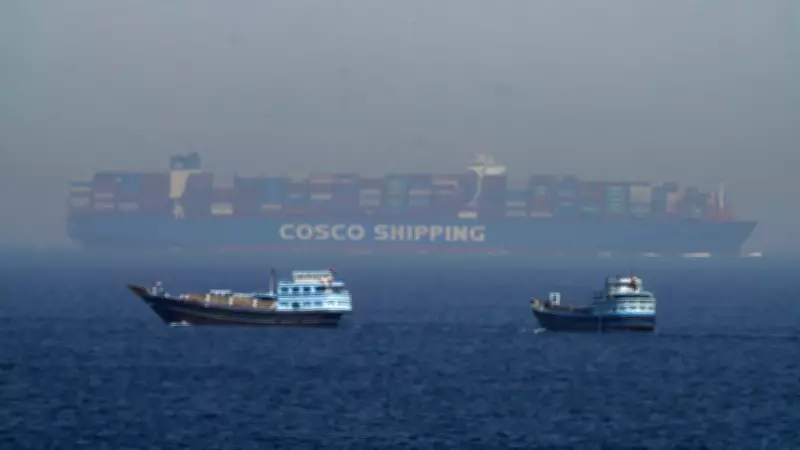
Strait of Hormuz Emerges as Critical Vulnerability for Global Internet Infrastructure
The Strait of Hormuz, long recognized as a crucial global shipping route, is now emerging as a highly vulnerable corridor for undersea internet cables as tensions in West Asia continue to escalate. This narrow passage controls approximately one-third of India's westward internet traffic, a capacity that experts warn cannot be easily rerouted due to limited alternative supply routes.
Security Crisis Halts Critical Cable Repair Operations
The deteriorating security situation has forced the suspension of ongoing cable repair operations in the region. Ships that have been working there since September 2025 have been compelled to halt repairs because of mounting security risks, creating significant challenges for maintaining global internet connectivity.
Several major subsea cable systems were compromised last September, including Airtel's SEA-ME-WE 4 (SMW4) and I-ME-WE (IMEWE) systems along with Flag Telecom's FALCON cables near Jeddah in Saudi Arabia. Repair work on these critical infrastructure components has now been paused indefinitely, according to industry sources familiar with the developments.

"Repair operations are cumbersome, expensive, and can take several months," explained an executive directly involved in the situation. "The last cuts had disrupted roughly 17% of Asia-Gulf internet traffic and rerouting that capacity has been a significant challenge. Previously, the Strait of Hormuz was being perceived as a safe alternative to the Red Sea for building redundancies. But now with the US-Iran conflict, we expect further delays and heightened costs."
Billions in Infrastructure Investments Now at Risk
The region has witnessed substantial investments in new cable infrastructure in recent years, with several sovereign and private players committing billions of dollars to construct new cables in the Gulf seas. Industry experts had anticipated a near doubling of capacity in the coming years before the current security crisis emerged.
"Several sovereign and private players have committed billions of capital in constructing new cables in the Gulf seas and the region is expected to see near doubling of capacity in the coming years," said Amajit Gupta, group CEO and MD at Lightstorm, a network infrastructure company that owns and operates 21,000 kilometers of subsea cables.
Multiple new subsea cable projects are currently under development along this corridor, including Reliance Jio's ambitious India-Europe-Express and India-Asia-Express systems, along with Google's Dhivaru project. These represent significant investments in global connectivity infrastructure that now face unprecedented security challenges.
Shifting Security Paradigms and Industry Responses
The strategic narrative around the Strait of Hormuz has undergone a dramatic transformation. Previously viewed as a safer and faster alternative to the Red Sea, the corridor is now emerging as another geopolitical flashpoint with far-reaching implications for global communications infrastructure.
"In fact, with the turbulence in the Red Sea last year, several companies were considering sovereign land routes through West Asia for laying cables as opposed to the sea," Gupta explained. "It was a faster and safer route transiting through peaceful territories. Clearly, that narrative has now been challenged with the current conflict."
Industry responses have been measured but concerned. An Airtel spokesperson clarified that "We do not have any submarine cable passing through the Strait of Hormuz" in response to media queries, while Jio and Flag Telecom did not provide immediate comments on the situation.
Broader Implications for India's Digital Ambitions
Industry executives warn that prolonged disruption could significantly impact India's ambitious plans to build a $270 billion data center ecosystem and establish itself as a global hub for cloud services exports. The country's digital transformation goals are increasingly intertwined with the security and reliability of international connectivity routes.

Major technology companies have already made substantial commitments to Indian infrastructure. Meta Platforms has selected Mumbai and Visakhapatnam as landing sites for the India leg of its multibillion-dollar undersea cable project, Waterworth. Meanwhile, Google is expected to land its Blue-Raman subsea cable on Indian shores, creating vital connections between West Asia, Europe, and Asia.
During a recent visit to New Delhi, Alphabet chief Sundar Pichai unveiled the India-America Connect initiative aimed at creating new subsea cable routes, highlighting the strategic importance of secure connectivity infrastructure.
Expanding Security Concerns Beyond Undersea Cables
The security crisis is extending beyond undersea cables to affect data center infrastructure throughout the region. On Wednesday, Amazon Web Services reported that three of its facilities—two in the United Arab Emirates and one in Bahrain—were attacked by drones, disrupting services across West Asia.
"Assets perceived as foreign can become high-visibility targets amid evolving geopolitical tensions," observed Sudhir Kunder, chief business officer at DE-CIX India, a networking infrastructure company. This statement underscores the complex security landscape facing international technology infrastructure in the region.
The convergence of geopolitical tensions, critical infrastructure vulnerabilities, and ambitious digital development plans creates a complex challenge for governments, corporations, and international organizations. As the situation continues to evolve, the security of global internet connectivity through vital corridors like the Strait of Hormuz remains a pressing concern with implications for economies, communications, and international relations worldwide.