

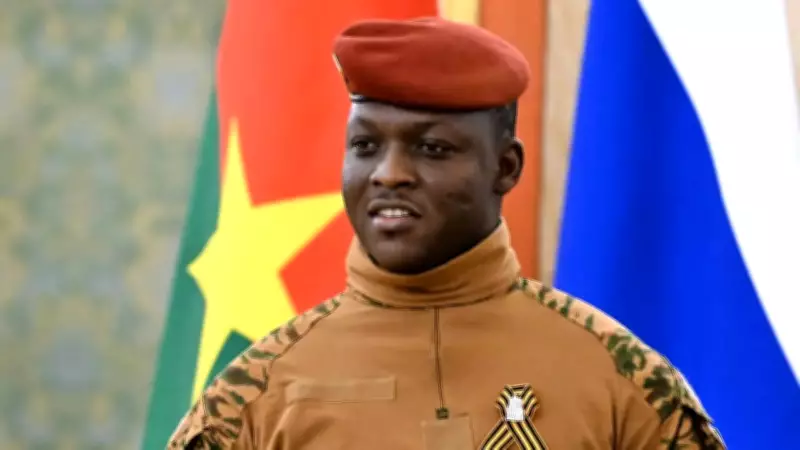
Burkina Faso's Military Ruler Declares Democracy 'Not For Us' in Stark Television Address
In a striking televised interview broadcast on national television this Thursday, Captain Ibrahim Traore, the military junta leader of Burkina Faso, delivered a blunt message to the nation's citizens: they must "forget" about democracy. The interview, aired on state broadcaster RTB, marks a significant hardening of the regime's stance since Traore seized power in a coup in September 2022, which itself overthrew a previous junta.
A Systematic Crackdown on Political Dissent and Democratic Institutions
Since assuming control, Captain Traore's government has implemented a series of measures that have severely restricted political freedoms and silenced opposing voices. The military administration dissolved the country's electoral commission last year, effectively halting any formal electoral processes. Then, in a decisive move this February, the junta-led parliament officially dissolved all political parties, whose activities had been suspended since the initial coup in 2022.
"We're not even talking about elections, first of all," Traore stated unequivocally during the interview. "People need to forget about the issue of democracy. Democracy isn't for us." This declaration directly contradicts the previously stated transition to democratic rule, which was initiated after the first coup in January 2022 and was originally scheduled to conclude in July 2024.

Extended Transition Period Amidst Ongoing Jihadist Violence
However, the junta decided to extend this transition period by an additional five years, thereby allowing Captain Traore to remain in power. This extension comes as Burkina Faso continues to grapple with severe jihadist violence that has plagued the nation for nearly a decade, resulting in the loss of thousands of lives. The ongoing conflict has created a complex security situation that the junta cites as a justification for its authoritarian measures.
The United Nations has expressed strong concern over these developments, urging Burkina Faso to reverse the ban on political parties and cease the repression of civic space. The international body has highlighted the importance of protecting democratic principles and human rights, even in challenging security contexts.
Hostility Towards Western Nations and Media Suppression
Since taking power, the junta has adopted a notably hostile stance towards Western countries, particularly France, which has historical ties to the region. This animosity has extended to the media landscape, with the government banning or suspending numerous international media outlets and expelling several of their journalists. These actions have further tightened control over information and limited external scrutiny of the regime's policies.
The cumulative effect of these measures—dissolving political parties, extending the transition period, suppressing media, and now openly rejecting democracy—paints a picture of a regime consolidating power amidst ongoing instability. As Burkina Faso navigates this turbulent period, the international community watches closely, balancing concerns over security with calls for the restoration of democratic governance and civil liberties.

