Underneath the beautiful, rolling hills of the Dordogne area in southwestern France, a large-scale secret of history lay hidden in total darkness for thousands of years. On September 12, 2000, devoted cave explorer Marc Delluc was hunting for new passageways in the caves of this region. He eventually discovered a very small and hard-to-notice fissure in the limestone rock, through which he decided to squeeze his body.
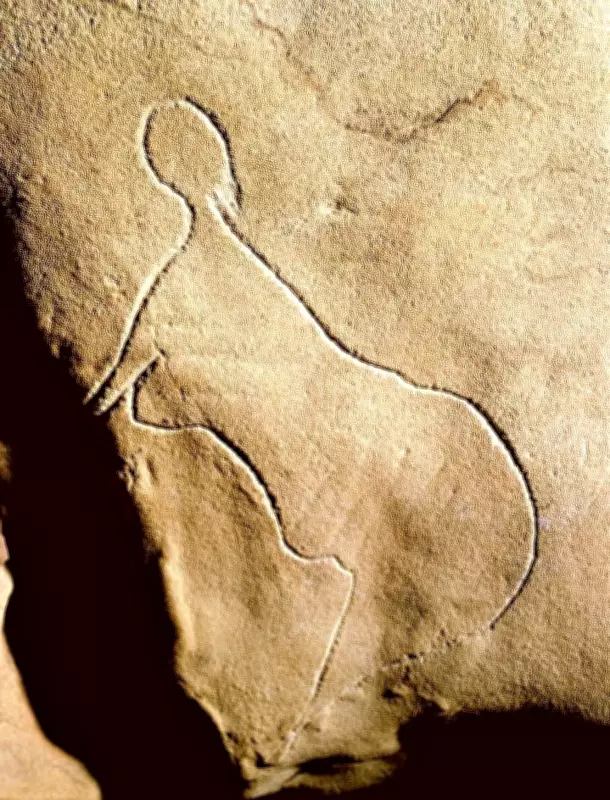
While moving through the dark and wet underground passage, he lifted his lamp to examine the walls. As per his expectations, he should have come across normal geological features; however, he saw many beautiful, detailed lines carved into the stones. The marks could have been thoughtlessly overlooked by archaeologists as random scratches made by cave bears or erosion. Yet, as Delluc explored further, the marks began to form magnificent images of mammoths, bison, and wild horses that had long since died out. This was a rare find indeed—an untouched Upper Palaeolithic gallery that would soon be dubbed Cussac Cave by the rest of the world.
Unraveling the Two Mysteries of a Prehistoric Shrine
This exciting discovery shook up the scientific community, as the cave held a mixture of prehistoric wonders never before witnessed by humans. According to an in situ study of the Gravettian individual from Cussac Cave, a complete anthropological study featured in the American Journal of Biological Anthropology, the cave was unique since it housed monumental rock paintings as well as untouched human skeletal remains. By analyzing the unique artistic style of the animal carvings and utilizing advanced radiocarbon dating on the surrounding sediment, researchers determined that the cave was actively used during the Gravettian period, roughly 25,000 to 30,000 years ago. Further exploration uncovered an intact human skeleton, suggesting the cave served as a prehistoric burial site and a place of worship. Remarkably, ancient footprints preserved in the mud indicate the use of sophisticated footwear.

The scientists, concentrating on one particular part of the underground structure known as Locus 2, discovered an almost complete human skeleton lying in a natural depression. It became obvious that a layer of clay covering the bones had been applied intentionally, by placing a body inside the natural hollow for an archaic burial ceremony. This showed that the cave was no longer only a location for creating prehistoric art, but a highly important place that combined both religious aspects of worshipping dead ancestors along with artistic activities.
The Ghostly Footsteps Left in Ancient Mud
In addition to spectacular wall carvings and perfectly preserved skeletons, the unique cave environment managed to retain something else. As mentioned in a special archaeological study called Evidence of the use of soft footwear in the Gravettian cave of Cussac, published in the journal Scientific Reports, the muddy floors of the corridor retain the footprints of the inhabitants from thousands of years ago. In the study of the footprints, researchers observed circular impressions in the form of depressions, which lacked individual toe impressions. Due to this particular feature, the scientists assumed that the ancient population used highly sophisticated leather shoes to protect themselves from the cold stone floors of the caves.
Cussac Cave is protected with great precision today by the French government, as its opening is not easily accessible to many people each year, so that the delicate drawings are not harmed by excess moisture and breathing in the air.
As we walk the streets of modern French towns busy with daily bustle, an old world, rich in its depths, waits patiently for us in the darkness just below our feet.