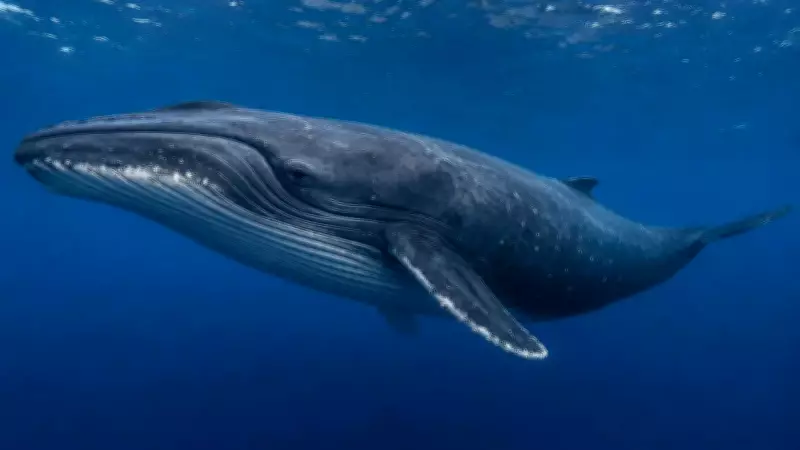
Not every scientific discovery begins with a dramatic excavation. Sometimes the most important part comes later, after the fieldwork is over and the fossil has spent years waiting for someone to look at it more closely.
A Decades-Old Fossil Rewrites Baleen Whale Origins
That was the case for a whale unearthed in New Zealand's South Island during the summer of 1988. The remains were collected from marine sediments in the Hakataramea Valley, a landscape that today bears little resemblance to the shallow seas that covered the region roughly 27.5 million years ago. At the time, the fossil was recognized as an ancient whale, but its wider significance remained unclear. Decades passed before a detailed study showed that the specimen represented something unexpected: a previously unknown species that lived during a pivotal period in whale evolution.
According to a study published in Royal Society Open Science titled “A new archaic baleen whale Toipahautea waitaki (early Late Oligocene, New Zealand) and the origins of crown Mysticeti,” the fossil belongs to an extinct baleen whale named Toipahautea waitaki. The researchers described it as one of the earliest known whales to possess baleen while lacking functional adult teeth, offering a glimpse into a major evolutionary transition.

How the New Zealand Fossil Helped Researchers Study Early Whale Evolution
The specimen was recovered from the Kokoamu Greensand, a fossil-rich geological formation in southern New Zealand. During the Late Oligocene, when the animal was alive, much of the country consisted of scattered islands surrounded by productive marine environments. The fossil itself was incomplete. Parts of the skull survived alongside sections of the jaw, ear bones, vertebrae, and limb elements. Yet enough of the skeleton remained to allow a detailed anatomical investigation.
The skull is thought to have measured around one meter in length, suggesting an animal roughly five meters long. That would have made it considerably smaller than many living baleen whales. Even so, several features preserved in the skull and jaws attracted the attention of researchers attempting to understand how early whales fed and how modern baleen-bearing species emerged.
How Scientists Identified a Previously Unknown Baleen Whale Species
One of the most informative parts of the fossil turned out to be its ear bones. In whales, these structures often preserve distinctive anatomical traits that help paleontologists identify relationships between species. As the research progressed, the combination of features preserved in the specimen did not fit any previously described whale. The jaws appeared toothless, while parts of the upper jaw showed evidence associated with the blood supply used to support baleen. Taken together, the anatomy suggested that the animal belonged to an early group of whales that had already abandoned adult teeth and relied on baleen for feeding.
The researchers eventually established a new genus and species, naming it Toipahautea waitaki. The name combines Maori words referring to origins and baleen, while also recognizing the Waitaki region where the fossil was found. According to the study, the whale occupied a position close to the evolutionary branch that would later give rise to modern baleen whales.
What the Fossil Reveals About the Evolution of Baleen Whales
The shift from toothed ancestors to baleen-bearing giants remains one of the most significant transformations in mammalian history. Modern species such as blue whales, humpbacks, and minke whales feed by filtering enormous quantities of prey from seawater, yet their distant ancestors possessed teeth. The New Zealand fossil provides evidence from a period when that transition was still unfolding. As described in the study published in Royal Society Open Science, Toipahautea lived about 27.5 million years ago and appears to represent an early stage in the emergence of fully baleen-bearing whales. The authors argued that the specimen helps establish a minimum age for this evolutionary development and indicates that the transition may have occurred earlier than previously recognized.

Its anatomy also hints that ancient baleen whales experimented with a variety of feeding strategies. The Oligocene oceans were inhabited by species that combined different jaw structures, tooth arrangements, and filtering mechanisms, creating a far more diverse picture than the one seen among living baleen whales today.
The Long Road from Excavation to a New Whale Species
The long gap between excavation and formal identification is not unusual in paleontology. Fossils can remain in collections for years while researchers focus on other projects or wait for new analytical methods and comparative material. In this case, the specimen collected in 1988 gradually became the subject of a detailed study that culminated in its scientific description many years later. What initially appeared to be one fossil among many eventually proved to be an important piece of a much larger puzzle.
The story serves as a reminder that discoveries are not always made at the moment something is dug from the ground. Sometimes they emerge slowly, through careful examination and comparison, as researchers revisit old specimens with new questions. For Toipahautea waitaki, the journey from quarry to scientific recognition took decades, but it ultimately revealed one of the earliest known members of the lineage that would lead to today's baleen whales.