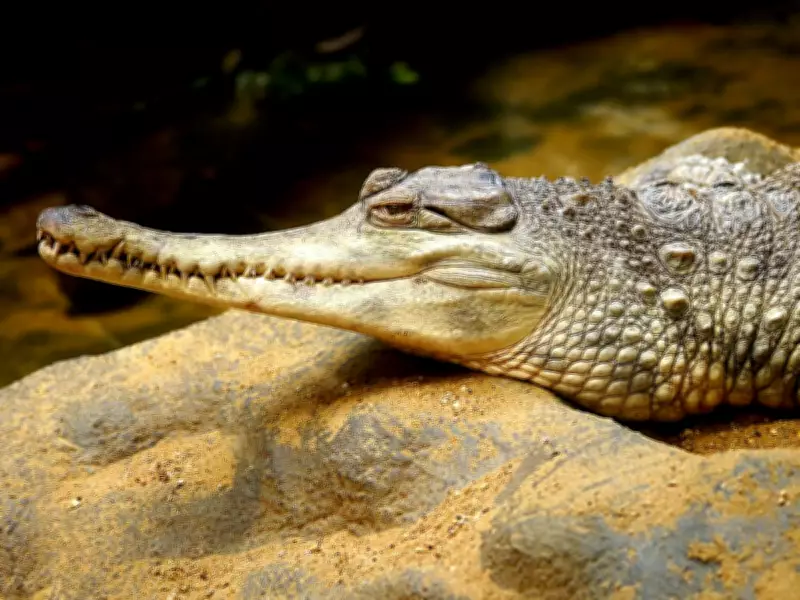
Most Americans picture a crocodile as a massive, snapping predator. But deep in the rainforests of West Africa, there lives a crocodile that quietly hunts fish in narrow jungle rivers, has never been recorded attacking a human, and is so rarely studied that the world barely knows it exists.
Meet the West African slender-snouted crocodile (Mecistops cataphractus), and it may not be with us much longer.
A species more endangered than anyone realized
The West African slender-snouted crocodile is Critically Endangered, the last step before extinction in the wild, according to the IUCN Red List. The situation is even more alarming than that list suggests. According to the study, “Systematic revision of the living African Slender-snouted Crocodiles,” the living African Slender-snouted Crocodiles, formerly considered a single species, are now two distinct species, one in West Africa and one in Central Africa. The study shows that splitting them into two groups means each covers a much smaller range than previously thought, and both are at much greater risk of extinction than earlier assessments suggested. We thought we knew how endangered this animal is. We were mistaken.
The scientist spending her nights on the river
This species has been studied in Côte d’Ivoire by Christine Kouman, co-founder of the conservation NGO EBURCO, for more than 10 years with support from Project Mecistops at Florida International University. The gentle giant disappearing from West Africa's rivers. Her fieldwork is grueling: carrying all supplies into remote areas, setting up a field camp, then going out by boat after dark to catch crocodiles with a snare pole, tag and measure them, and release them safely. The biggest she has caught in her interview was 2.85 meters long, a little over nine feet. Kouman notes that despite years of handling the animals by hand, she has never been injured.

What the science is revealing
For her PhD, Kouman tagged 26 individual slender-snouted crocodiles with VHF radio-tracking devices to study their spatial ecology: home ranges, habitat selection, and social interactions between sexes and size groups. The species has a smaller home range than large crocodiles such as the Nile or saltwater crocodile, but a larger home range than the false gharial of South-east Asia, a species with a similarly slender snout and comparable rainforest habitat. The animals were not aggressive: they shared the same stretches of the river, using the same spots at different times to avoid competing for resources. Dwarf crocodiles, also resident in Taï, keep to small streams and swampy forest interiors, leaving the main river to the slender-snouted species. Their habitat adaptations are equally remarkable. In the dense jungle where there are no open riverbanks, these crocodiles bask on protruding rocks and fallen tree branches. They also hide under overhanging vegetation, waiting for fruit to fall and to attract fish: their main prey, along with frogs and other aquatic animals.
The river is changing, and not for the better
When Kouman started her research, the Hana River was clear enough to drink directly from. Since 2019, it has been murky and discolored, thick with sediment from artisanal mining on the eastern boundary of the park. For a crocodile that eats fish, a degraded river is a degraded food source. Found only where the forest still stands: lose the trees, and this species disappears with them. According to the UNESCO/UNEP-WCMC World Heritage assessment of Taï National Park, Taï is the largest remaining fragment of the Upper Guinean rainforest, which once covered five West African countries. This assessment suggests that ongoing deforestation in the broader landscape is fragmenting habitat connectivity and isolating wildlife populations with potential long-term impacts on the ecological viability of the park. Dr Ahizi Michel, Kouman’s colleague and co-founder of EBURCO, found that wherever forest had been cleared across Côte d’Ivoire, the slender-snouted crocodile had disappeared entirely, surviving only in well-protected forest areas. Kouman is clear: lose the forest and the species disappears with it.

Why it matters even from thousands of miles away
According to the local fishermen around Taï, the park functions like a bank. When fish are hard to come by in their own waters, they rely on the park to replenish their stocks, meaning the park's well-being is directly linked to their food security. According to the UNESCO/UNEP-WCMC assessment, Taï is a refuge for tool-using chimpanzees, pygmy hippos, and dozens of species found nowhere else on Earth, and is one of the last intact ecosystems of its kind. Kouman describes Taï as a paradise for the slender-snouted crocodile and is working with EBURCO and local authorities to keep it that way. Her message is simple: save the forest, save the river, and this ancient, gentle animal still has hope. Lose either, and it doesn't.