Nature's Optical Marvels: Animals With The Most Mesmerizing Eyes
Nature serves as an extraordinary treasure trove filled with countless beautiful and mesmerizing organisms that consistently captivate human imagination. However, it is only through deeper exploration that we truly begin to appreciate the authentic beauty and remarkable adaptations of these living creatures. Among the most fascinating features in the animal kingdom are eyes that appear almost surreal in their design and function.
Stalk-Eyed Flies: The Binocular Visionaries
Have you ever encountered a fly that appears to be wearing binoculars? Stalk-eyed flies derive their name from the males, whose eyes are positioned on elongated, slender peduncles that extend sideways from their heads. These distinctive structures are not merely decorative. The bright red orbs, combined with stubby antennae, enable males to engage in intense stare-down competitions with rivals.
Longer eye stalks generally indicate superior genetic quality, transforming these head-to-head confrontations into critical mating contests. Females actively select their partners based on these visually striking extensions, making eye stalk length a direct determinant of reproductive success in this species.

Four-Eyed Fish: The Aquatic Multitasker
The four-eyed fish possesses a remarkable gaze-split superpower that enables exceptional environmental awareness. Although it has only two eyes, each organ is divided horizontally like a sophisticated bifocal lens, complete with dual pupils and retinas. This unique anatomical configuration allows the fish to simultaneously scan above the water surface for potential predators while searching below for food sources.
By maintaining position at the air-water interface, this species transforms basic survival into an exercise in seamless multitasking, demonstrating evolutionary ingenuity at its finest.
Mantis Shrimp: The Ultimate Visual Predator
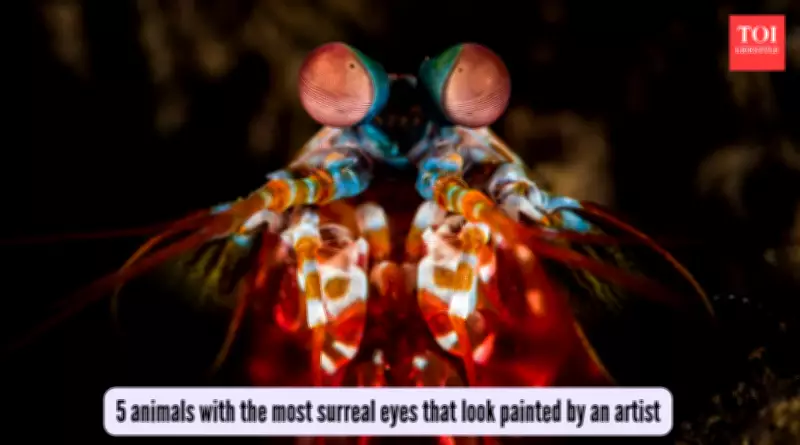
Mantis shrimp represent the pinnacle of visual evolution, possessing capabilities that far surpass human vision. Each of their two stalked eyes operates independently, capable of scanning three distinct images simultaneously per eye. This extraordinary ability is supported by an impressive array of 16 different photoreceptor types.
These marine creatures can detect ultraviolet and polarized light, along with color hues beyond human comprehension. Their advanced visual system enables them to identify prey or potential mates from considerable distances, giving them a significant predatory advantage in their underwater habitats.
Chameleon Eyes: The Masters of Camouflage
Chameleons possess visual organs that perfectly complement their reputation as camouflage experts. Instead of the typical white sclera found in many animals, their eyes feature only a tiny pupil visible through color-changing eyelids that seamlessly match their skin patterns.
These turret-like ocular structures can rotate 180 degrees independently, providing nearly 360-degree environmental awareness without requiring any body movement. Their specialized eyelids function like retractable tubes, ensuring rapid and precise visual tracking capabilities essential for both hunting and predator avoidance.
Dragonflies and Flounders: Specialized Visual Hunters
Dragonflies boast massive compound eyes composed of thousands of individual ommatidia units, resembling living honeycombs that expertly track airborne prey. They capture insects over water with ultraviolet vision capabilities and razor-sharp precision, even while engaging in aerial competitions with rivals.
Flounders undergo a fascinating transformation as they mature, becoming progressively flatter with one eye gradually migrating to join the other on their upper side. In their adult form, both eyes face upward from their streamlined, sand-buried bodies, enabling them to effectively ambush prey while remaining nearly invisible to both predators and potential meals.
These remarkable ocular adaptations demonstrate how evolution has equipped various species with specialized visual tools that serve as critical survival mechanisms. From independent eye movement to split-vision capabilities and ultraviolet detection, nature's optical innovations continue to inspire both scientific curiosity and aesthetic appreciation.