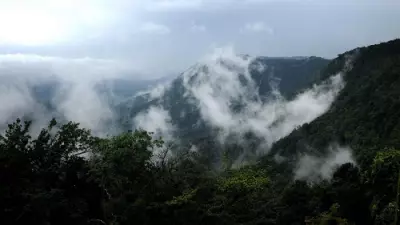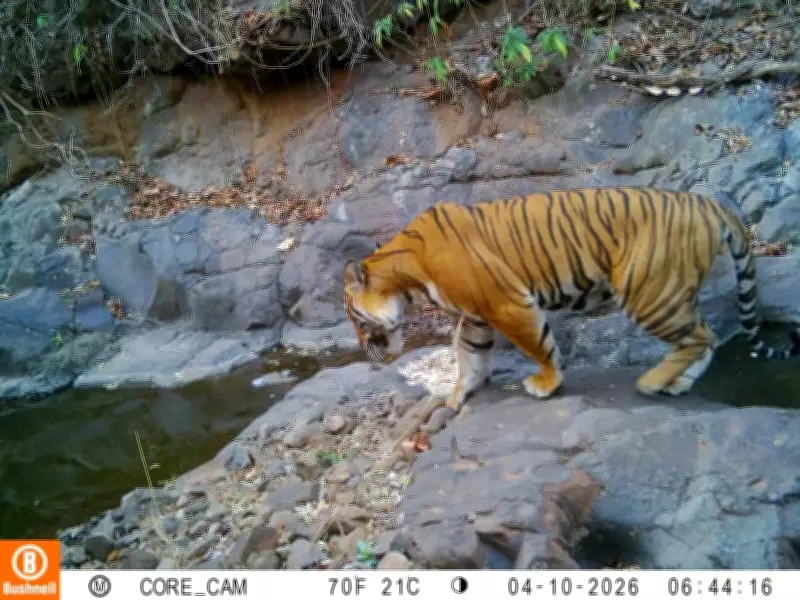
In a significant conservation milestone, a camera trap hidden deep inside a privately owned forest in Ratnagiri district has captured a Royal Bengal Tiger moving through a landscape that faced widespread deforestation threats less than two decades ago. Researchers from the Pune-based Applied Environmental Research Foundation (AERF) photographed the tiger nearly 18 years after launching MyForest, India's first incentive-based private forest conservation initiative.
Conservation Efforts Validated
Conservationists Archana Godbole and Jayant Sarnaik described the sighting as the culmination of years of persistence, scientific monitoring, and community engagement. The tiger was sighted in a private forest under a conservation agreement in the Kulye-Phansawle corridor in Sangameshwar, with support from the World Land Trust in the UK.
"We are very happy to share this golden moment in our journey of saving private forests in the northern Western Ghats," Godbole said. "When we began this work, many people were sceptical. But we knew that preventing deforestation in this ecologically important region was critical for protecting biodiversity. This sighting validates what we have believed all along."

Importance of the Sighting
The forests where the tiger was recorded lie within the broader Sahyadri-Konkan landscape, an important wildlife corridor connecting protected areas in the northern Western Ghats. The presence of a top predator such as a tiger is often considered an indicator of a healthy ecosystem, one that supports adequate prey, forest cover, and ecological connectivity.
Sarnaik emphasized the significance: "The significance of the sighting is heightened by the fact that these are largely private forests. Unlike protected areas managed by the government, private forests remain vulnerable to logging, land-use change, and fragmentation."
MyForest Initiative
When AERF launched its conservation initiative in 2007, many of these forests had little protection. The organization introduced a simple but innovative model: compensate landowners for conserving their forests rather than cutting them down. Through legally binding conservation agreements, farmers and local communities receive incentives to protect forest patches on their land. What started with just 100 acres under protection in 2009 has expanded to nearly 14,000 acres across the northern Western Ghats. Thousands of those acres lie in critical buffer zones and wildlife corridors associated with the Sahyadri landscape.
"But conservation agreements alone were not enough. Beginning in 2012, AERF started intensive biodiversity monitoring using trail cameras and field surveys to document wildlife using these forests," added Godbole. Over the next 14 years, AERF built a substantial body of evidence showing that private forests support a wide range of species. Researchers collaborated with scientists and academic institutions to understand the ecological value of these landscapes and their role in maintaining connectivity between protected areas.
Community Partnership Key to Success
"The tiger sighting is not a coincidence. It is the result of years of protecting and restoring these forests with local communities. The data from our monitoring consistently showed that these forests are important for biodiversity. The tiger is perhaps the strongest confirmation of that," Sarnaik said. According to him, one of the most important lessons from nearly two decades of work has been that conservation succeeds when local communities become partners rather than bystanders.
"The message from all these years of monitoring has been very clear. Building the capacity of local communities and creating suitable incentives are critical for sustaining conservation on a large scale. Healthy forests support healthy wildlife populations and strengthen the ecological integrity of the entire landscape," Sarnaik added.

Rewarding Moment for Field Team
For the field team that captured the image, the moment was rewarding. Many of them have spent years walking these forests, maintaining camera traps, documenting wildlife, and working closely with villagers who chose conservation over short-term economic gains. Conservationists said that the tiger's appearance sends an important message beyond Ratnagiri. As wildlife habitats across India face increasing pressure, landscapes outside protected areas are becoming crucial for the long-term survival of species.
The photograph is also a reminder that conservation is often measured not in months or years, but in decades. For Godbole and Sarnaik, whose work began with a belief that private forests deserved protection long before the idea gained wider acceptance, the tiger's silent passage through the forest is perhaps the most powerful endorsement yet.